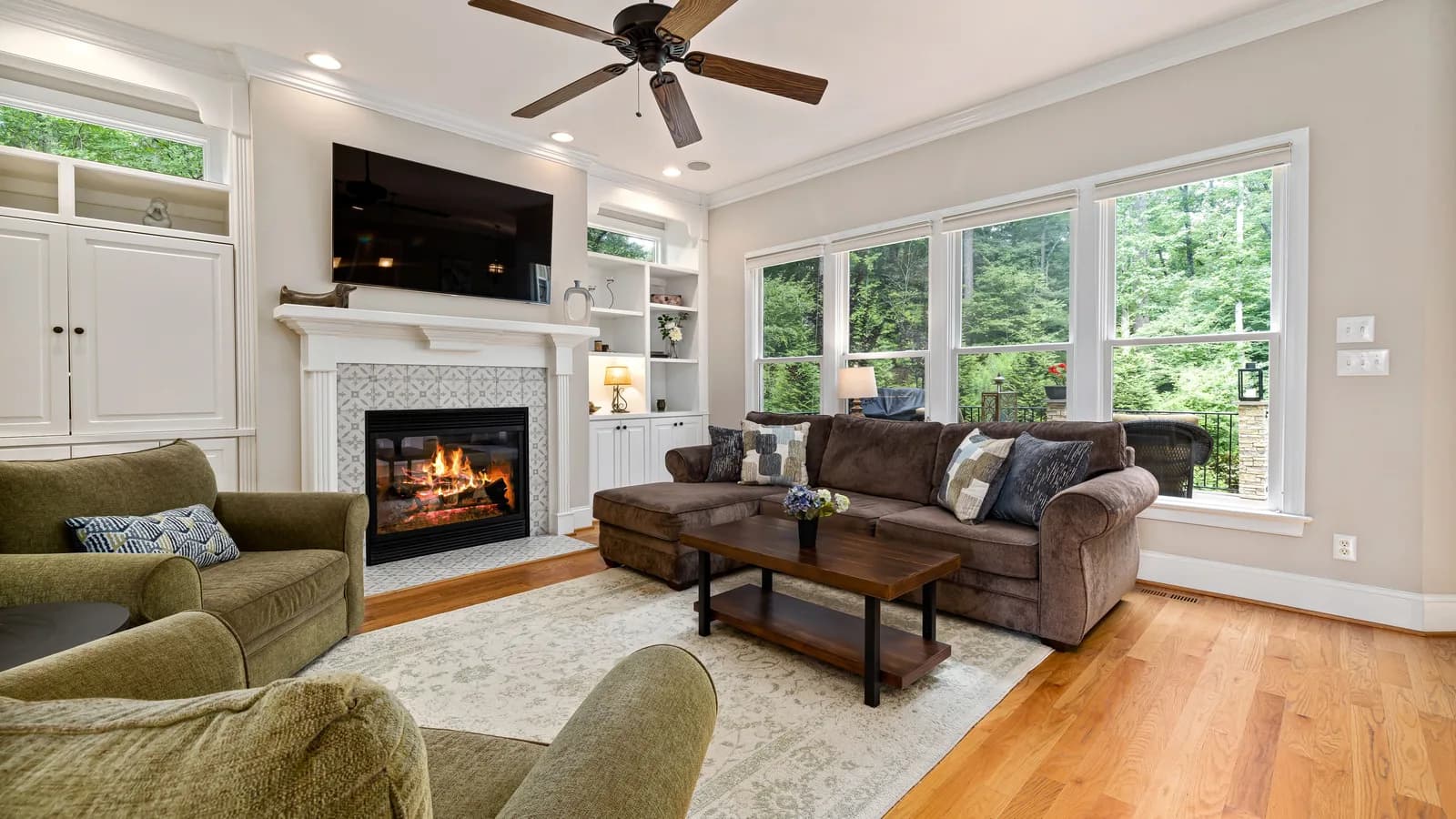
Measure the room, blade path, and ceiling height first; then compare airflow, mounting, moisture rating, support, controls, and complete installed scope.
Choose ceiling fan size from the room's square footage, ceiling height, and open space around the blades. Blade span narrows the shelf; it does not make the final choice. The exact fan still has to deliver useful airflow, hang at a safe height, suit the room's moisture, and connect to fan-rated support.
Measure the room before choosing a blade span
Measure wall to wall in feet, then multiply length by width. For an L-shaped or open room, divide the occupied area into rectangles and add them. Do not size from a listing photo or the words bedroom, kitchen, or great room. Two rooms with the same floor area can have different ceiling heights, furniture zones, obstructions, and useful fan locations.
ENERGY STAR publishes the starting ranges below for conventional residential fans. Use them to make a shortlist. The model manual gets the last word.
| Measured room area | ENERGY STAR suggested blade span | What to verify next |
|---|---|---|
| Up to 75 square feet | 29 to 36 inches | Door swings, cabinets, wall clearance, and usable mounting height |
| 76 to 144 square feet | 36 to 42 inches | Whether airflow reaches the occupied zone without crowding the room |
| 144 to 225 square feet | 44 inches | The exact model's airflow at each speed and required clearances |
| 225 to 400 square feet | 50 to 54 inches | Room shape, seating location, and whether one fan can cover the long dimension |
A 12-by-12 room lands exactly on a boundary, so there is no magic answer hiding in the table. A 42-inch fan is not automatic, and a 44-inch one is not automatically wrong. Favor the model that clears the room and moves air where people actually sit or sleep.
Draw the blade circle and clearance zone
Mark the proposed fan center on a simple ceiling plan. Divide the blade span by two to get the radius, then draw that circle. Measure from the blade tips to the nearest wall, sloped ceiling, open cabinet door, tall furniture, light, sprinkler, beam, or other obstruction.
ENERGY STAR guidance uses at least 18 inches from walls; Hunter's residential measurement guidance calls for 30 inches from the nearest wall or obstruction. Do not split the difference. Follow the fan's stated clearance and any stricter requirement that applies. If the blade circle will not fit at the intended center, a smaller model or a professionally reviewed second location is a better answer than shaving the margin.
Long open-plan rooms may need two smaller fans rather than one oversized fan. Divide the occupied space into roughly square zones and check each blade circle separately. Coordinate the fan locations with the room's lighting layers, ceiling registers, doors, and conversation areas instead of treating the ceiling as empty.
Measure ceiling height and total drop
Measure floor to ceiling at the mounting point. Then find the model's assembled drop from ceiling to the bottom of the blade and, if it has a light, to the bottom of the light. Do not estimate from downrod length alone because the canopy and motor housing add height.
ENERGY STAR says blades should be at least 7 feet above the floor and preferably 8 to 9 feet above it for airflow when the ceiling allows. It also notes that low-profile or hugger fans can move less air because the blades sit closer to the ceiling. Hunter says blades need at least 8 inches of ceiling clearance in its measurement guidance. Check the selected manual because angled ceilings, extension rods, and low-profile mounts have model-specific limits.
- Low ceiling: Look for a purpose-built low-profile fan whose total drop keeps the blade height compliant. Do not shorten or improvise mounting parts.
- Standard ceiling: Compare flush and short-downrod options by assembled blade height and airflow, not by appearance alone.
- High or sloped ceiling: Confirm the approved downrod range, ceiling-angle limit, adapter requirements, sway clearance, and service access.
Compare airflow, not just diameter or blade count
Blade span describes the footprint. Airflow, commonly reported in cubic feet per minute, describes what a particular fan moves. Compare it at the speeds you expect to use, then weigh sound, controls, efficiency, and energy use.
Our view: airflow at a tolerable everyday speed matters more than blade count or a dramatic finish. More blades do not prove that a fan moves more air; motor design, blade shape, pitch, speed, and clearance all affect performance.
A ceiling fan cools people through air movement rather than lowering the room's air temperature. Turn it off when the room is empty. If the larger goal is comfort with less waste, pair the fan decision with a room-by-room energy reset instead of expecting the fan to correct insulation, solar gain, duct, or humidity problems.
For a bedroom, check low-speed airflow and sound rather than only the maximum number. For a living room, map where people actually sit. For a long room with one small seating group, placing a properly sized fan above that occupied zone can be more useful than chasing whole-room coverage.
Match the location rating
Read the listing for the entire fan and light kit. Indoor-only, damp-rated, and wet-rated are different uses. Hunter describes damp-rated fans as suitable for humid or covered outdoor locations that are not directly exposed to water, while wet-rated fans are built for possible rain or direct moisture exposure. Follow the exact listing rather than relying on a seller's outdoor label.
Bathrooms, laundry rooms, covered porches, exposed patios, and coastal locations add different moisture and corrosion conditions. Check the fan, blades, fasteners, controls, and light kit together. Also verify temperature and salt-exposure limits when the manufacturer publishes them.
The 4Homes weekly email
Every Tuesday: what changed for homeowners this week, plus our newest guides.
No spam. Unsubscribe anytime.
Confirm the box and electrical boundary
A ceiling fan requires support designed for its dynamic load. Hunter instructs buyers to verify a ceiling-fan-approved box rated for the fan's weight and attached to suitable building structure. A box that currently holds a light is not proof that it is fan-rated.
Keep this a selection and planning step. Do not remove a cover, probe conductors, modify wiring, or work on an energized circuit to identify the box. A qualified electrician should evaluate an unknown box, install fan-rated support, address damaged or ungrounded wiring, add controls, and handle any work beyond the product instructions and local requirements.
Also confirm that the chosen wall control, remote receiver, light kit, motor, and smart control are listed as compatible. A standard lamp dimmer is not automatically a fan-speed control.
Plan the complete 2026 cost
The price spread is wide. In a Home Depot retail snapshot reviewed in October 2026, representative 52-inch fans ran from about $80 for a basic wet-rated model to more than $800 for a premium lighted model; other examples sat near $200 to $360. These are product examples, not a national installed-cost promise. Stock, finish, controls, and promotions all move the number.
| Cost line | Include before comparing |
|---|---|
| Fan | Exact blade span, airflow, location rating, motor, finish, warranty, and included mount |
| Light and controls | Light kit, bulbs or integrated LED, wall control, remote, receiver, and compatible switches |
| Mounting | Approved downrod or angle adapter, fan-rated box or brace, and ceiling repair |
| Professional work | Electrician diagnosis, support and wiring scope, access, permits, and final testing where required |
| Ownership | Replacement remote, light components, cleaning access, and manufacturer support |
For professional bids, use the contractor quote comparison so each quote covers the same support, wiring, controls, patching, and testing.
How to save money without buying the wrong fan
Once the measurements rule out the bad fits, compare what remains. A lower sticker price disappears quickly if the fan needs an unplanned control, downrod, light kit, or early replacement because it was never rated for the location.
An existing wall control is worth keeping only when the fan instructions approve it. Finish comes later. If the room needs better light as well as air movement, plan both before an electrician opens finished work. File the model number, manual, receipt, control-pairing steps, and replacement-parts information where someone can find them again.
Ceiling fan buying checklist
- Room length, width, square footage, ceiling height, and occupied zone are measured.
- The blade circle clears walls, doors, cabinets, lights, sprinklers, beams, and other obstructions.
- Assembled blade height meets the fan instructions and applicable requirements.
- Airflow, low-speed comfort, noise, controls, and efficiency are compared for the exact model.
- Indoor, damp, or wet rating matches the real moisture exposure.
- A fan-rated box and structural support are confirmed without live-wire investigation.
- The complete price includes mounting parts, controls, light, professional work, and repairs.
Frequently Asked Questions
What size ceiling fan do I need for a 12-by-12 room?
A 12-by-12 room is 144 square feet. ENERGY STAR's room-size table places 76 to 144 square feet in the 36- to 42-inch blade-span range. Treat that as a starting point, then confirm the exact fan's wall clearance, airflow, mounting height, and installation instructions before buying.
Is a 52-inch ceiling fan too big for a bedroom?
It can be too large for a small bedroom, but the room label does not decide the fit. Measure the room and the distance from the proposed fan center to walls, doors, cabinets, and other obstructions. Compare those dimensions with the exact model's required clearances and airflow data.
How low can a ceiling fan hang?
ENERGY STAR and Hunter guidance both say the blades should be at least 7 feet above the floor. ENERGY STAR says 8 to 9 feet above the floor is preferable for airflow when the ceiling allows it. The fan manual and local requirements still govern the actual installation.
Can I install a ceiling fan where a light fixture is now?
Only if the electrical box and its attachment are listed and installed to support a ceiling fan, and the circuit and controls suit the fan. A standard light-fixture box may not provide that support. Have a qualified electrician evaluate the box, wiring, controls, and mounting structure rather than opening or modifying live wiring yourself.
Do I need a damp-rated or wet-rated ceiling fan?
Use a damp-rated fan for a humid or covered location only when its listing permits that use. Choose a wet-rated fan where rain or direct water exposure is possible. An indoor-only fan does not become suitable outdoors because the porch has a roof; follow the exact product listing and instructions.