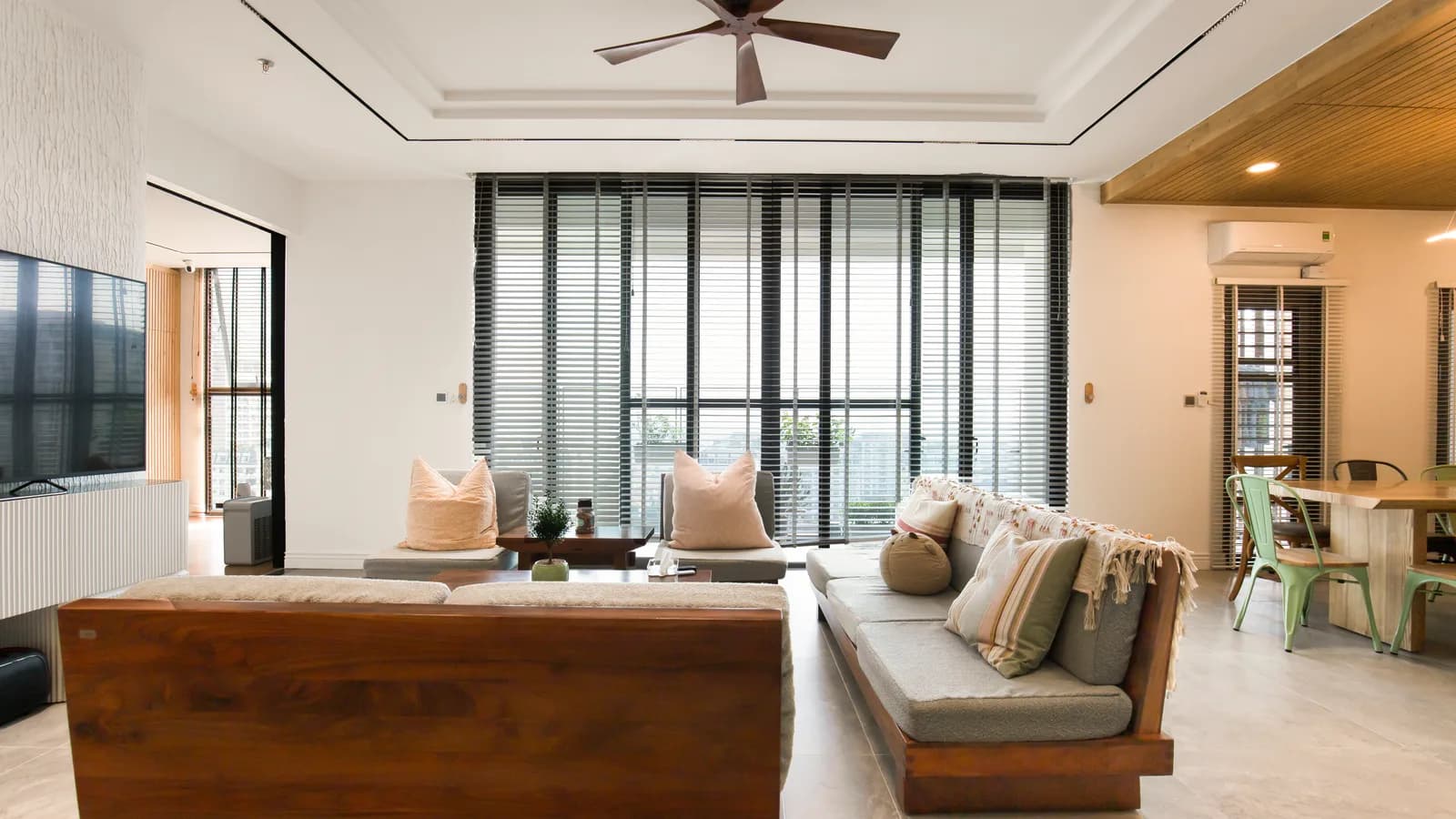
Most reversible ceiling fans turn clockwise on low in winter. Confirm the direction from below, use the model's documented control, and stop if the fan creates a cold downdraft.
Looking up from below, most reversible ceiling fans should turn clockwise at low speed in winter. This pulls air up and gently pushes the warm air that collects near the ceiling back out toward the walls and down to where you live. Before changing anything, stop the fan completely, confirm the exact control method in your model's manual, and only run it in an occupied room. A ceiling fan does not heat a room on its own, so the real test is whether you feel a comfortable breeze or an uncomfortable downdraft.
The 30-second direction and breeze check
Stand directly under the running fan with the room normally occupied.
- Summer (cooling): blades turn counterclockwise when viewed from below, creating a direct downward breeze you can feel. This is the setting most people recognize.
- Winter (circulation): blades turn clockwise when viewed from below, lifting air upward and redirecting warm air along the ceiling toward the walls. You should not feel a cool breeze straight down.
If your fan spins the wrong way for the season, it will usually feel drafty in winter or move far less air than expected in summer. Most reversible fans run quietly in both directions; the difference is purely where the air goes.
How to reverse a ceiling fan without guessing
Fans are wired differently, so do not assume the switch location your neighbor used. Stop the fan fully before touching any control, then follow the model manual rather than a generic “flip the switch” instruction. Common controls include:
- Pull-chain: with the fan stopped, locate the direction chain or switch identified by the manual. Use it once, then check the direction after restarting.
- Remote control: press a small “reverse” button, often marked with curved arrows. Some remotes only reverse when the fan is off or on low speed.
- Wall control: look for a toggle switch labeled with directional arrows or an up/down pair.
- App-controlled fan: open the manufacturer app and select direction; some apps show summer/winter labels.
If you cannot find a reverse control, check the manual or the motor-housing label for the model number before assuming the fan is not reversible. Do not force or invent a control that is not documented for the fan.
Which setting fits your room
| Situation | Winter direction | Notes |
|---|---|---|
| Standard ceiling (8–10 ft), reversible fan, room occupied | Clockwise, low speed | Confirm no uncomfortable downdraft from below |
| High or vaulted ceiling (over 10 ft) | Clockwise, low; often needs a downrod-adjusted blade length | Air may not reach living level; verify comfort before relying on it |
| Fan has no reverse switch | Leave off in winter | A non-reversible fan cooling downward will make the room feel colder |
| Room is empty or you are leaving | Turn the fan off | Running a fan in an empty room wastes electricity |
| You feel a noticeable cold downdraft | Turn it off and re-check direction | The wrong winter direction defeats the purpose |
What a ceiling fan can and cannot do in winter
A ceiling fan redistributes air that is already warm; it does not add heat. In winter, warm air rises and pools near the ceiling. Running clockwise at low speed gently moves that trapped warmth back down into the living space, which may let you set the thermostat lower while staying comfortable.
Two honest boundaries matter here:
- No universal savings number. How much this helps depends on room height, insulation, your heating system, and how the air actually moves in your specific house. Any page that promises an exact percentage is making a claim it cannot prove for your home.
- The fan must be on low and the room occupied. High speed in winter creates a cooling downdraft that works against your heater. An empty room gains nothing.
The 4Homes weekly email
Every Tuesday: what changed for homeowners this week, plus our newest guides.
No spam. Unsubscribe anytime.
Cost, savings, and when to call a pro
Typical cost: $0 if you already own a reversible fan and can reach its control safely. Reversing direction is free; the only ongoing cost is the electricity the motor uses, which is small compared with your heating bill.
Where money can enter:
- A fan that will not reverse or has no reverse switch: either replace it or leave it off in winter rather than paying for a conversion.
- Ceiling-box or wiring work: never attempt to add a reverse control, move a switch, or upgrade the mounting box yourself. That is qualified-electrician work.
- A new reversible fan: budget for the unit plus professional installation if you are not already wired for it.
Compare actual behavior, not claimed percentages: note whether the room feels more even and whether you can lower the thermostat without feeling colder. If neither happens, the fan may be the wrong size or blade pitch for the room — a separate question covered by the ceiling-fan sizing guide.
Safety stop / call-a-pro boundary
Stop and call a professional, not a YouTube fix, if any of these apply:
- You must use a tall ladder you are not comfortable working from, or the fan is out of easy reach on a high ceiling.
- The fan wobbles, makes an abnormal sound, or the canopy (the cap over the motor) feels loose.
- A blade is cracked, damaged, or visibly unbalanced.
- You cannot identify the reverse control in the manual and are unsure which wire or switch does what.
- Anything smells hot, sparks, or the circuit breaker trips when you touch the control.
Ladder safety matters here: use a stable, properly rated ladder, keep three points of contact, and do not overreach. The ladder buying guide explains how to pick one that reaches your ceiling safely.
Related guides
- How to choose the right ceiling fan size for your room — blade span, clearance, and airflow before you buy or replace a fan.
- Fixing a drafty exterior door — drafts around doors matter more than fan direction when your heating bill spikes.
- How to pick a home ladder — the safe way to reach high fans and ceilings.
- Checklist before turning your heat on — get your heating system ready for cold weather.
- Bathroom exhaust fan checks — a working exhaust fan helps control moisture, which relates to the same winter comfort questions.
Frequently Asked Questions
Should a ceiling fan turn clockwise or counterclockwise in winter?
Clockwise when viewed from below, at low speed. This lifts air upward and pushes warm air down the walls. Counterclockwise is the summer cooling setting.
What speed should a ceiling fan run on in winter?
Low. Low speed moves the trapped ceiling warmth without creating a cool downdraft you can feel. High speed works against winter heating.
Should I leave the ceiling fan on all day in winter?
No. Turn it off when the room is empty. A ceiling fan redistributes air rather than heating an unoccupied space, so running it through the day only adds to your electricity use.
Why does my ceiling fan have no reverse switch?
Not all fans are reversible. If there is no reverse control on the chain, remote, wall switch, or app, your model likely cannot reverse. Leave it off in winter rather than forcing a control that does not exist.
Does fan direction still matter with a vaulted or high ceiling?
Yes, but the effect is weaker. Warm air pools higher before it can be redirected down, so a high-ceiling fan often needs the right blade length and downrod to move air effectively. Confirm you feel real comfort rather than assuming it works.