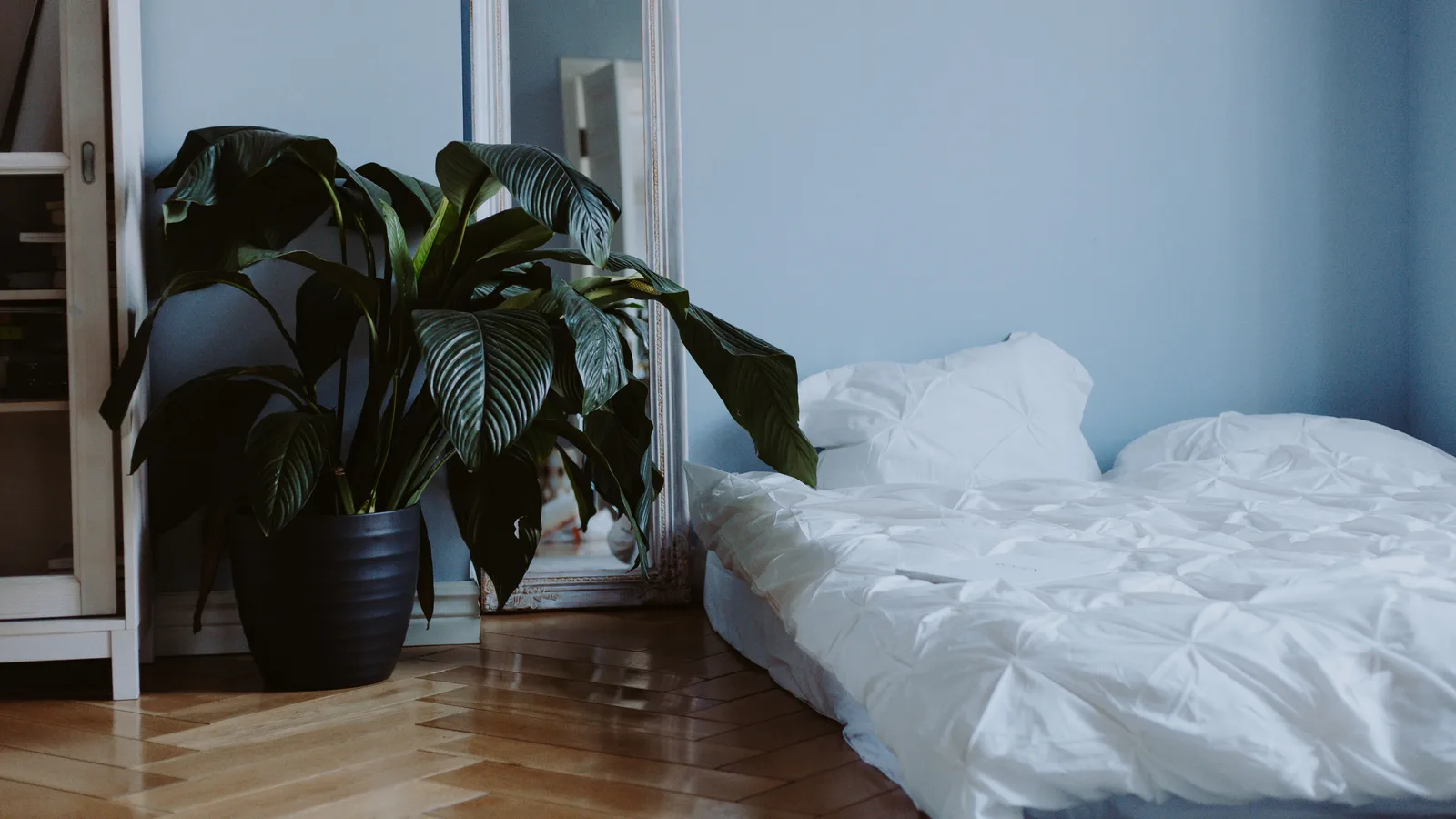
Small bedrooms feel bigger when the eye can travel across the room without stopping at clutter, oversized furniture, or harsh visual breaks. Start with the view from the doorway, then correct bed scale, floor coverage, storage, lighting, and contrast. You do not need a renovation to make a meaningful difference.
Make a small bedroom look bigger by clearing the view from the door, fitting the bed to real walking space, and keeping the floor and main wall surfaces visually continuous. Rearrange and remove before buying. Then use measured storage, one useful mirror, a correctly scaled rug, and light at several heights to make the room feel open without moving a wall.
What makes a bedroom feel small
A room feels small when the eye and the body keep stopping. A blocked doorway, bed wider than the usable wall, narrow route to the closet, several small rugs, and furniture at every edge divide one room into fragments. The fix is not to make everything tiny. It is to create a clear hierarchy: one bed wall, one walking route, one storage plan, and fewer visual interruptions.
Stand at the doorway because that is where the room makes its first impression. Photograph what you see at eye level. Mark the uninterrupted floor, the largest wall, the natural-light direction, and the first object that blocks the view. A crowded chair or broad dresser may be doing more harm than the wall color.
A small-bedroom plan is a layout and storage decision before it is a decorating decision. “Small” does not mean one universal square footage; it means the furniture, circulation, and required functions compete for the same limited area.
Measure the room before moving furniture
- Draw the shell. Record wall lengths, ceiling height, doors, windows, closet openings, radiators, vents, outlets, switches, and fixed lights.
- Measure full furniture footprints. Include the bed frame, headboard, handles, open drawers, chair pullback, and any leaning mirror.
- Trace daily routes. Walk from the door to the bed, closet, window, and any required exit. Carry a laundry basket through the route.
- Tape two layouts. Mark proposed footprints with painter's tape before lifting furniture or ordering replacements.
- Test at night. Check whether the person using the room can reach a lamp, move safely, and open storage without squeezing past sharp corners.
Do not publish one magic walkway number as if it suits every room or person. The route must work for the actual household and preserve safe access to doors, windows, heating equipment, and required exits. Someone using mobility equipment or needing caregiver access may need a different arrangement than a staged guest room.
If a piece cannot move safely, empty it and follow the maker's handling instructions. Secure tall or top-heavy furniture as directed. CPSC's Anchor It campaign says top-heavy furniture and televisions should be anchored and tempting objects should not be placed where children may climb for them.
Choose the bed wall and protect the path
| Layout choice | What it can improve | What to test | Warning |
|---|---|---|---|
| Bed centered on a clear wall | Creates one strong focal point | Access on the sides actually used | Do not block a vent, outlet, or closet route |
| Bed along one wall | Opens a wider route in a narrow room | Making the bed and comfortable entry | Often inconvenient when two people use it |
| Bed below a window | Uses an otherwise difficult wall | Window operation, drafts, light, and egress | Keep cords, heaters, and required access clear |
| One nightstand | Releases floor and wall space | Whether both users can reach light and essentials | Do not create a cord across the path |
| Wall-mounted bedside shelf | Reduces visual and floor bulk | Wall support and load rating | Do not guess at anchors or concealed wiring |
The bed sets the scale because it is usually the largest object. Include the frame, not just the mattress, when testing size. A bulky footboard or platform lip can consume the exact inches needed for movement. If the current frame is the problem, compare a simpler frame before assuming the mattress size must change.
Keep the most open route visible from the door. Avoid lining the perimeter with a trail of small furniture. One appropriately sized dresser can make a room feel calmer than a nightstand, bench, narrow cabinet, rolling cart, and extra chair competing for the same floor.
Make storage reduce visual noise
Move storage upward before spreading it outward, but do not fill every wall. Closed storage usually reads more quietly than open shelves packed with mixed objects. Start inside the closet: remove what belongs elsewhere, group everyday clothes at easy reach, and use the existing height only where it can be reached safely.
Under-bed containers work when they fit completely, slide without scraping, and hold a stable category such as off-season clothing or extra linens. Loose bags and half-visible boxes make the room feel more crowded. The off-season clothing guide explains how to keep stored textiles clean, dry, and bounded.
A tall dresser can save floor area compared with a broad low unit, but height adds a tip-over concern. Follow the manufacturer's anchoring instructions and use hardware suitable for the wall. Do not put toys, remote controls, or frequently wanted objects on top where a child may climb. For a closet overhaul, test inexpensive changes before deciding whether a closet system is worth the cost.
Use light, mirrors, color, and rugs as one system
Daylight works best when curtains, furniture, and clutter do not block it. Keep the window operational and the sill clear enough to notice condensation or leaks. Where young children are present, CPSC says cordless window coverings are the safest option; beds and furniture should be moved away from existing cords.
Place one mirror where it reflects daylight, an open sightline, or the tidy bed wall. A mirror that faces an overflowing rack simply doubles the clutter. Mount it with hardware rated for the mirror and wall. A leaning mirror that can tip, slide, or narrow the walkway is not a space-saving solution.
Layer light instead of relying on one harsh ceiling fixture. General light, a bedside task light, and a small source in a dark corner add depth. Keep lamp cords out of the route and never run them under rugs. If a new hardwired fixture, receptacle, or switch is needed, use a licensed electrician rather than treating wiring as part of a decorating afternoon.
Related wall, trim, and ceiling tones can reduce abrupt boundaries, but white is not mandatory. Test large paint samples in the room's morning, afternoon, and evening light. If walls peel, stain, feel damp, or show mold, find the cause before painting. In a pre-1978 home, EPA says renovation or painting can create dangerous lead dust and recommends a lead-safe certified contractor.
A rug should connect the bed area rather than float like a small island. Tape the proposed rug footprint and confirm doors clear it and walking edges lie flat. Exposed flooring around a correctly sized rug can make the room feel continuous; several small mats can make it look chopped up and add trip edges.
The 4Homes weekly email
Every Tuesday: what changed for homeowners this week, plus our newest guides.
No spam. Unsubscribe anytime.
Plan the budget in layers
The first layer costs $0: remove unrelated items, test layouts, clear the doorway, edit surfaces, and move a lamp you already own. The next layer is measured storage and textiles. Angi's September 2026 organization guide lists basic bins at $5 to $20 each, premium bins at $20 to $60, and shelving at $30 to $200. It lists professional organizers at $50 to $150 per hour and single-room projects around $200 to $500.
Painting is a separate budget. Angi's July 2026 room-painting guide reports a common professional range of $400 to $1,600, with a broader $200 to $2,000 span based on room size, prep, coats, ceiling height, and location. These are planning ranges, not quotes. Paint, repair, lead-safe work, trim, and furniture moving can change the total.
| Priority | Low-cost test | Spend only when |
|---|---|---|
| Layout | Tape two arrangements and live with each | A piece truly blocks daily use |
| Storage | Edit contents and use temporary boxes | The measured category and return path are stable |
| Lighting | Move existing lamps and change approved bulbs | A real task or dark zone remains |
| Paint | Clean, patch, and test large samples | The wall is sound and the color solves a defined problem |
| Professional help | Write the layout, repair, or organizing scope | Safety, accessibility, mounting, wiring, lead, or heavy lifting crosses the DIY boundary |
Save money without buying miniature furniture
Keep full-size pieces that fit and work. A small room does not need dollhouse furniture; it needs fewer pieces with clear jobs. Sell, donate, or relocate the least useful floor-standing item before buying a replacement. Measure the delivery path as well as the destination, using the furniture delivery-path method for any large dresser, bed, or chair.
Buy paint and organizers only after the layout is settled. Reuse sound bins inside closed storage where appearance does not matter. Ask a professional organizer to solve a defined trouble spot rather than paying to style the entire room. If the refresh expands into wiring, built-ins, wall changes, or broad repairs, stop and rebuild the scope with the room-refresh budget guide.
Small-bedroom checklist
- Photograph the view from the door and remove the first unnecessary obstruction.
- Measure the shell, furniture, open drawers, doors, and daily routes.
- Tape two layouts before lifting furniture or ordering replacements.
- Protect doors, windows, vents, heaters, outlets, and required exits.
- Use closed, vertical, or under-bed storage only for stable categories.
- Anchor top-heavy furniture and mount mirrors for the wall and load.
- Reflect useful light, layer lamps, and keep cords out of the route.
- Test paint and rug footprints before buying.
- Call the right professional for accessibility, lead, wiring, unsafe mounting, or heavy moving.
Frequently Asked Questions
What color makes a small bedroom look larger?
Related light or mid-tone colors can make the walls, trim, and ceiling read as a more continuous surface, but daylight and contrast matter more than one magic color. Test a large sample through morning and evening before painting, and repair moisture or peeling paint before treating color as the solution.
Should a small bedroom have a large mirror?
A securely mounted full-length mirror can extend a useful view and reflect daylight when it faces a window or an uncluttered part of the room. Avoid placing it where it doubles visual clutter, creates glare, narrows the walking path, or can tip; use mounting hardware suited to the mirror and wall.
Can I use a king-size bed in a small bedroom?
Only if the measured footprint leaves practical access to the door, closet, windows, and both sides used by the household. Tape the complete frame footprint on the floor before deciding. If normal movement requires turning sideways or blocking storage, a smaller bed will improve the room more than decorative tricks.
Does a low bed make a small bedroom look bigger?
A lower bed can expose more wall and reduce visual bulk, but it is not automatically better. Consider comfortable transfers, under-bed storage, mattress ventilation, baseboard heat, outlets, and cleaning access. Choose the height that works safely for the people using the room rather than copying a staged photo.