The cheapest useful backyard lighting depends on what you need to see. Solar stakes are the simplest option for a path, plug-in string lights can make a deck or patio usable at night, and low-voltage lighting is a more permanent approach for larger areas. Start with one purpose, then light only that area.
The cheapest way to make a backyard more usable after dark is usually to light one specific area rather than trying to illuminate the whole yard. A path needs guidance. A deck needs enough light to sit and move safely. A large yard may need a more durable system. These are different jobs, and the cheapest solution for one can be disappointing for another.
My take: most backyards are over-lit because homeowners mistake brightness for usefulness.
Outdoor lighting should help people move, gather, and see basic hazards without turning the yard into a parking lot. Start by standing outside after dark and noticing what is actually missing. Is it the walk from the back door to the gate? The steps off the deck? The table where people eat? Or simply a dark corner that makes the patio feel uninviting?
The answer determines the system.
Solar stake lights are the low-effort path option
Solar stake lights are usually the easiest and least involved starting point. They do not require wiring, an outlet, or a contractor. Place them along a garden path, beside a short walkway, near a small planting border, or around the edge of a patio where gentle definition is more important than strong illumination.
They work best where their solar panels receive dependable daylight. A stake light installed under dense tree cover, a roof overhang, or a shaded porch may not charge well enough to be useful later. Before buying several, observe the area during the day. The most attractive location at night may not be the location that gets enough sun.
Solar stakes are not ideal for every need. They generally provide modest light, which is often enough for navigation but not for cooking, detailed outdoor work, or lighting a large open yard. Their performance can also vary with weather, season, panel cleanliness, and battery condition. Treat them as path markers, not security lighting.
Placement matters. Use enough spacing that people can understand where the path goes, but do not line every edge with bright points. A few well-placed lights at turns, steps, and entrances often work better than a dense runway effect. Avoid placing them where lawn equipment, pets, or foot traffic will knock them over.
A useful test is to place a few temporary markers along the route first and walk it after dark. You may find that the path only needs lights at a change in direction, at a low step, and near the gate. Lighting every straight section can add clutter without making the route meaningfully easier to follow.
Plug-in string lights make a deck or patio usable
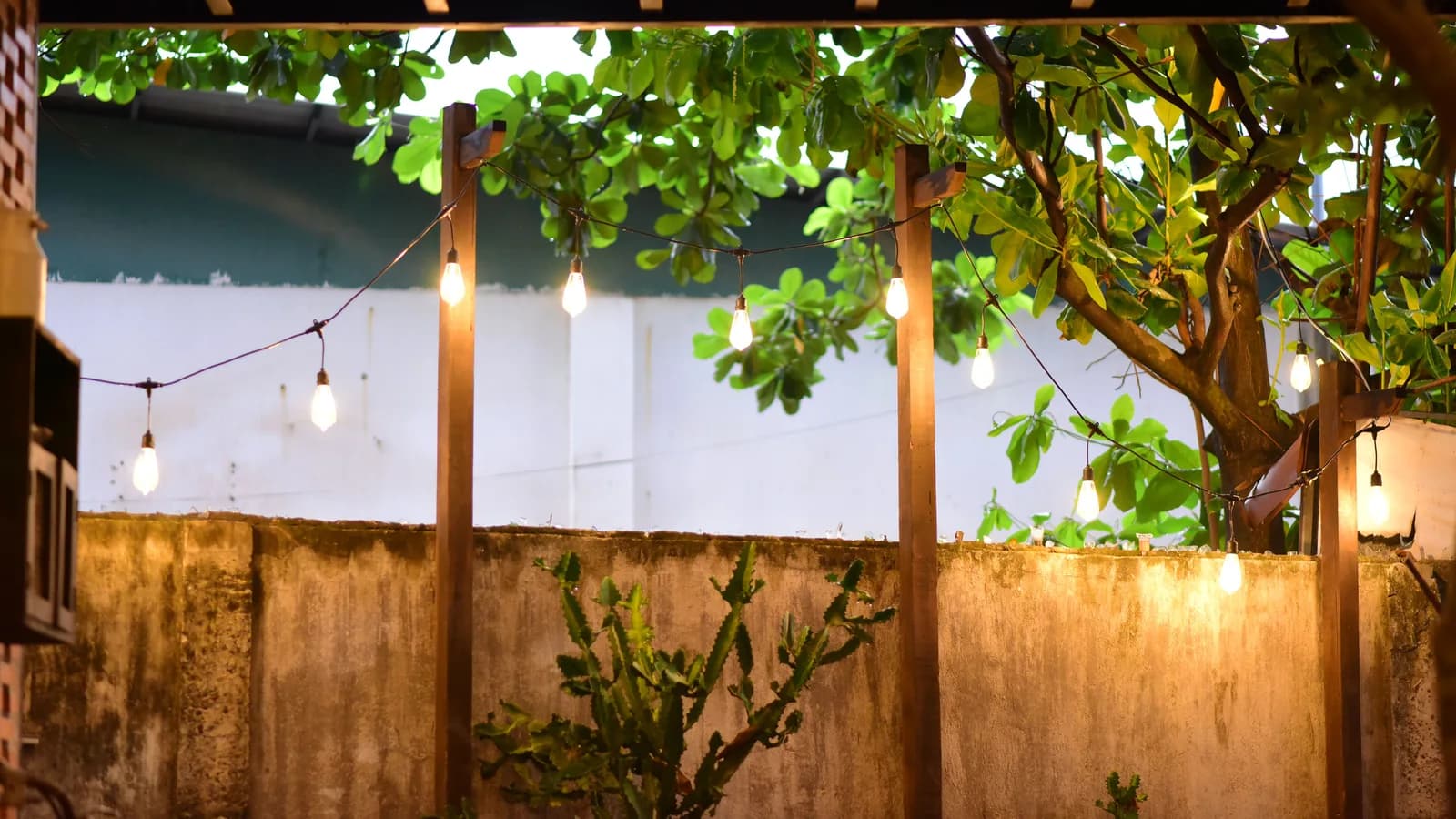
Plug-in string lights are often the best low-cost option for a deck, patio, porch, pergola, or defined seating area. They can make an outdoor table or sitting space feel usable without requiring a permanent landscape project. Their light is broad and social rather than directional.
Use outdoor-rated lights and outdoor-rated mounting hardware. Do not string indoor lights outside and hope for the best. Check the cord, plugs, sockets, and the connection point for weather suitability. Keep connections protected as appropriate for outdoor use, and avoid running cords where people walk or where water tends to collect.
Attach lights to stable supports. A house wall, pergola, sturdy posts, or a purpose-built support can work. Thin tree branches, loose gutters, and flimsy fencing are poor anchors. A string of lights has weight, catches wind, and can gradually pull on whatever holds it up.
Think about height and sag before installing. Low strings can interfere with tall guests, doors, umbrellas, and routine patio use. Very high strings may disappear into darkness and provide less practical light than expected. Test the route with a temporary line or a few clips before committing to hardware.
Warm-looking light is usually easier on the eyes in a seating area than a harsh, cool-looking light. It makes faces, food, wood, plants, and masonry look more natural at night. The goal is to see comfortably, not to make the patio look like a work site.
If your patio has no overhead structure, support posts can create a defined outdoor room, but they should be stable enough for wind and tension. Do not rely on a light cord itself to hold the layout in place. A setup that looks fine on a calm evening can become loose, low, or damaged after repeated weather exposure.
Low-voltage landscape lighting is the durable middle ground
Hardwired low-voltage landscape lighting requires more planning and costs more effort than solar or plug-in options, but it is often the better long-term choice for paths, planting beds, steps, trees, and larger outdoor layouts. It uses a transformer connected to an appropriate power source, with low-voltage cable feeding fixtures around the yard.
This type of system is useful when you want consistent placement and more control. You can use path lights for walking routes, focused fixtures for landscape features, and subtle lighting at steps or changes in level. The result can feel deliberate without being glaring.
Some homeowners can install parts of a low-voltage system themselves, particularly fixture placement and cable routing, if they understand the product instructions and site conditions. Electrical work at the power connection, new outdoor circuits, buried service concerns, or anything beyond your comfort level is a reason to consult a qualified electrician. Do not improvise around outdoor electricity.
Plan the lighting pattern before burying cable or setting fixtures. Place fixtures temporarily after dark, using safe temporary testing methods allowed by the system, and look at the effect from the house, patio, sidewalk, and neighboring property. Light that looks subtle while you are standing beside it may appear bright from across a property line.
The 4Homes weekly email
Every Tuesday: what changed for homeowners this week, plus our newest guides.
No spam. Unsubscribe anytime.
Light for the task, not for every square foot
A deck needs light near the door, stairs, table, grill area, and seating zone. A path needs low guidance at changes in direction and footing. A whole yard rarely needs uniform lighting unless there is a specific use that requires it.
Layering can help, but keep it modest. A porch light may cover the door. String lights can define the seating area. A few path lights can guide people to the gate. That is enough for many small yards. The dark portions of the yard can remain dark.
Be especially careful around steps, pools, retaining walls, uneven paving, and changes in grade. These locations need clear visibility, but fixture placement should avoid creating sharp glare or confusing shadows. A light aimed directly into someone’s eyes can make it harder, not easier, to see the step below.
Consider timers or controls so lights are not left on unnecessarily. Automation is optional; a simple routine can work. The main point is to avoid lighting an empty yard all night out of habit.
Respect darkness, neighbors, and the view from inside
Outdoor lighting affects more than your property. A fixture aimed at a neighbor’s bedroom, a bright bulb visible from the street, or a strong upward beam can create needless friction. Before finalizing the setup, stand at your property edge and look back toward the house. Then look out from your own windows.
Shield or redirect fixtures that shine outward or upward. Keep light focused downward where people need it. This protects night visibility, reduces wasted light, and makes the yard feel calmer. It also lets you enjoy the night sky and the quieter parts of your landscape.
Do not add more fixtures just because an area still looks dark from a photograph. Human eyes adjust. A softly lit patio with a defined path is often more comfortable than a uniformly bright backyard. Start small, live with the lighting, and add only where an actual gap remains.
Frequently Asked Questions
Are solar stake lights bright enough for a backyard path?
They are commonly bright enough to mark a short, simple path and show where to walk. They are less suitable when you need strong illumination for stairs, work areas, or a broad yard.
Can I install outdoor string lights myself?
Many homeowners can install them if the lights, mounting hardware, and power connections are rated for outdoor use. Use stable supports, avoid unsafe cord routes, and consult an electrician when a new electrical connection is needed.
Do I need an electrician for low-voltage landscape lighting?
Fixture placement and cable layout may be manageable for some homeowners, depending on the system and site. Work involving electrical connections, new circuits, buried utilities, or uncertainty about safe installation should be handled by a qualified electrician.