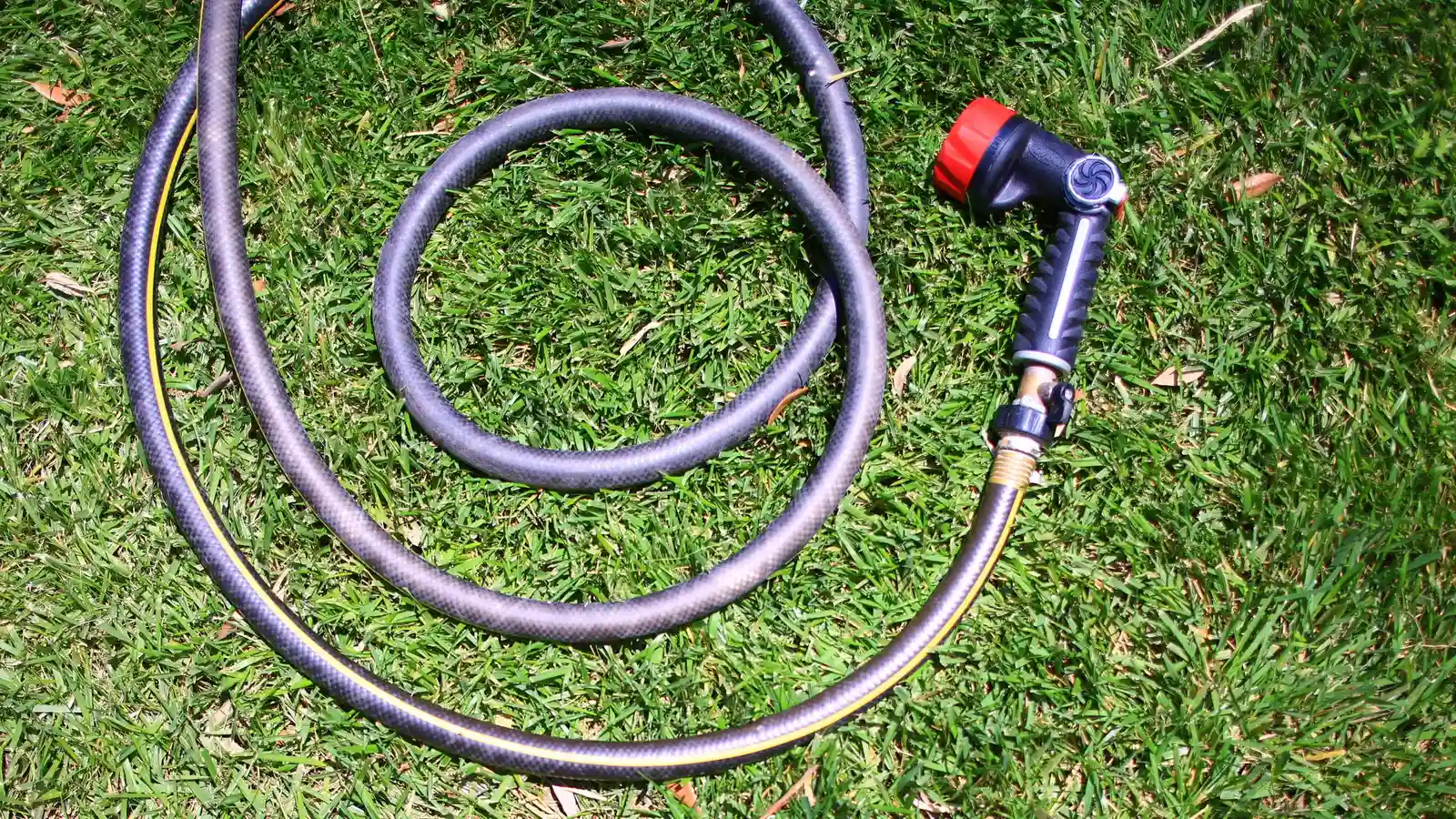
Disconnect, drain, inspect, and loosely coil the hose before protected winter storage, while treating the outdoor faucet and home plumbing as a separate job.
To store a garden hose for winter, shut off the faucet, release pressure, disconnect every attachment, drain the hose end to end, inspect its fittings and washer, then make a loose coil and put it in the dry storage location required by its manual. Do this before freezing weather. Treat the outdoor faucet and the home's supply piping as a separate winterization job rather than assuming that putting away the hose protects the plumbing.
The seven-step winter storage workflow
- Choose a mild, dry time. A flexible hose is easier to straighten and drain than one already stiff from cold. Plan a safe discharge point where the remaining water will not ice a walkway, run toward the foundation, or enter a storm-sensitive area.
- Shut off water and release pressure. Close the outdoor faucet. Open the nozzle or watering wand until flow stops, then remove it. If the faucet will not close, leaks at the wall, or behaves abnormally, stop there and arrange a plumbing check.
- Disconnect at the faucet. Turn the hose coupling by hand while supporting it so you do not twist the faucet. Do not wrench on a stuck, corroded, or frozen connection. Separate multiple hoses, quick connects, splitters, timers, sprinklers, and nozzles because each can trap water.
- Drain by gravity. Extend one hose at a time without kinks. Put the outlet end at a safe low point. Raise the other end, then walk toward the outlet while moving a high loop along the hose. Repeat from any section that still feels heavy or sloshes.
- Inspect after the water is out. Look at both couplings, the rubber washer, strain-relief sleeves, and the full jacket. Set aside damaged parts before they disappear into the winter coil.
- Let it dry and coil loosely. Wipe off soil. Give surface moisture and the ends time to dry, then form broad loops without twisting the hose. Tie the coil lightly only if it will otherwise unravel.
- Store it supported and protected. Use a broad hanger, reel, bin, or shelf that does not pinch the hose. Keep the ends out of dirt and pests. If the manual requires above-freezing storage, use a location that actually stays above freezing; an unheated shed may not qualify.
Drain the hose without damaging it
Teknor Apex, a hose manufacturer, tells owners to disconnect, raise one end, and progressively lower or move along the hose until the water drains. ELEY's reel instructions use the same basic idea with a product-specific sequence: release pressure, disconnect the inlet, fully unwind the hose on a flat or downhill route, then rewind slowly while water leaves the open end. The detail that matters is a continuous downhill path with no kink acting as a dam.
Do not use compressed air unless the exact hose, reel, and attachments provide an approved method and pressure limit. A residential garden hose setup is not the same as a professionally blown-out irrigation system. Compressed air can turn a loose fitting into a projectile, damage a component, or leave water trapped in an assembly that was never arranged to drain that way.
A reel needs its own manual. Water can remain in an inlet hose, swivel, valve, or short leader even after the long hose looks empty. Portable reels may be movable to protected storage; wall-mounted reels may have a defined draining position. Follow those instructions rather than copying a seven-step procedure written for a different reel.
Inspect fittings, washers, and the hose jacket
Remove the flat washer from the female coupling only if the product instructions allow it. Replace a washer that is split, hardened, distorted, or missing with the correct size and material. A good washer sits flat. Stacking washers to stop a leak or overtightening the coupling can hide damaged threads and make the spring leak harder to diagnose.
| What you find | Reasonable next step | Do not do |
|---|---|---|
| Worn or missing hose washer | Match a replacement to the coupling and keep a spare with the nozzle | Force the coupling tighter against the faucet |
| Loose accessory or repairable end fitting | Use a compatible maker-approved repair and pressure-test it outdoors in spring | Assume every hose type accepts a generic clamp-on end |
| Bulge, exposed reinforcement, deep crack, split, or crushed coupling | Retire or replace the hose according to local disposal options | Store it as if the damage will improve over winter |
| Leak at the faucet body or wall | Keep the hose disconnected and have the plumbing diagnosed | Buy another hose to solve a faucet problem |
Mark a questionable area with painter's tape before coiling so it is easy to find later. If the hose carried anything other than ordinary potable-source water, follow the hose and material instructions for cleaning and disposal. Do not bring a contaminated hose into household storage merely to keep it warm.
Loose coils beat tight circles
The goal is not a perfect-looking spiral. It is a coil that follows the hose's natural curve. Start at one end on clean ground and make broad loops, turning the hose as needed so it does not twist between your hands. If a loop wants to spring smaller or cross over itself, straighten that section and try again rather than pulling it tight.
Keep the weight off the couplings. A wide wall hanger spreads the load across the hose jacket; a nail or narrow hook creates one hard bend. A reel can work when it is drained and used according to its instructions. On a shelf or in a bin, place the coil flat and do not stack sharp tools, fertilizer, solvents, or heavy equipment on top of it.
Where to put the hose
Read the product label or manual before choosing between a basement, attached garage, detached garage, shed, or outdoor box. Teknor Apex recommends a cool, dry place protected from the elements and says the location should not be subject to freezing. ELEY says a heated indoor location adds protection after draining and warns that an unheated garage or shed can still fall below freezing. Those are manufacturer instructions, not proof that every hose has the same limit.
Keep the hose away from direct sunlight, vehicle traffic, rodents, hot equipment, and chemicals that could contact the jacket. In living space, use a clean, fully drained hose and a tray or bin for any last drips. Label the coil by length if you own more than one. That makes spring setup quicker and keeps this maintenance guide separate from our garden hose length and diameter buying guide.
Hose storage is not whole-house plumbing winterization
Disconnecting the hose is a useful first boundary: it lets the hose drain and may allow a frost-free outdoor faucet to drain as designed. It does not tell you whether the faucet is frost-free, whether it slopes correctly, whether there is an interior shutoff, or what position that valve and faucet should occupy for winter.
The Onondaga County Water Authority describes one common setup with an interior shutoff, exterior draining, and a faucet cover. Your home may be different. Follow the installed faucet maker's instructions and local plumbing guidance. Do not force a hidden valve, improvise heat on a frozen faucet, or apply one online sequence to every home. If you cannot identify the system, a licensed plumber can map it before the first freeze.
Keep irrigation separate too. Zones, backflow assemblies, pumps, and compressed-air blowouts need system-specific decisions. Use the sprinkler winterization guide for that scope, and add both jobs to the seasonal home care calendar.
Cost planning and the savings case
The basic storage job can cost $0 if you already have a dry shelf or broad support. Price evidence reviewed on October 29, 2026 showed a Home Depot 10-pack of 5/8-inch hose washers at $3.78. Lowe's listed 25-, 50-, and 100-foot Teknor Apex hoses at $19.98, $29.98, and $49.98, with a 100-foot Zero-G example at $79.98. These are dated examples, not promised local prices.
| Planning item | Observed or sourced range | Money check |
|---|---|---|
| Drain, inspect, and coil | $0 with supplies and storage already available | Use the product instructions before buying accessories |
| Replacement washers | $3.78 for a 10-pack example at Home Depot | Match size; a washer will not repair bad faucet threads |
| Replacement hose examples | $19.98 to $79.98 in the Lowe's listings reviewed | Buy by measured length and task, not as part of this storage job |
| Outdoor spigot replacement | $120 to $500 nationally in Angi's 2026 guide | Ask whether access, wall repair, shutoff work, permit, and warranty are included |
The clearest savings come from avoiding an unnecessary hose replacement and finding a small fitting problem before spring. Reuse a wide shelf or hanger if it supports the coil without a sharp bend. Replace a worn washer instead of replacing an otherwise sound hose. But do not turn thrift into false economy: a bulged pressure hose or leaking faucet deserves diagnosis, not another season of tighter connections.
The 4Homes weekly email
Every Tuesday: what changed for homeowners this week, plus our newest guides.
No spam. Unsubscribe anytime.
When to call a professional
Call a licensed plumber when the outdoor faucet drips with the hose removed, the faucet body moves at the wall, the connection is cracked or badly corroded, an indoor shutoff will not operate normally, or there is water staining inside the wall or basement. Stop if the coupling is frozen in place. A plumber should also handle a suspected freeze break, concealed piping, or a faucet replacement beyond your legal and practical scope.
Use a qualified irrigation contractor for system winterization, regulated backflow equipment, pumps, or a blowout requiring controlled compressed air. Before requesting quotes, photograph the faucet and visible piping, note where the interior shutoff appears to be, and describe the leak or winterizing question without prescribing the repair. Compare the written diagnosis and scope with the contractor quote comparison guide.
Spring restart
Before reconnecting, uncoil the hose in mild weather and check the jacket, fittings, and washer again. Connect by hand without cross-threading. Open the faucet slowly and inspect both ends and any repaired area under normal pressure. If the faucet leaks with the hose removed, the plumbing problem is still there.
Record the hose length, storage location, replaced parts, and any spring leak in the house file. One line is enough. Next fall, you will know which coil belongs to which faucet and whether last year's “small drip” ever received a real fix.
Garden hose winter storage FAQs
Should I disconnect my garden hose for winter?
Yes, when freezing weather is possible, disconnect the hose from the outdoor faucet, release pressure, and drain it. A connected hose can hold water at the faucet and may keep a frost-free faucet from draining as designed. The hose step does not replace the separate winterizing instructions for your home's outdoor plumbing.
How do I get all the water out of a garden hose?
Remove the nozzle and other attachments, separate joined hoses, lay one end where water can drain safely, and extend the hose without kinks. Raise the other end and walk toward the outlet while keeping a high loop behind you. Repeat until water stops flowing, then let the hose finish drying before coiling it.
Can I leave a drained garden hose outside all winter?
Follow the hose maker's storage instructions. Draining lowers the risk from trapped water, but some manufacturers still call for dry, protected, above-freezing storage because cold, sunlight, or weather can damage the jacket and fittings. An unheated garage or shed is not automatically above freezing.
How tightly should I coil a garden hose for storage?
Use broad, relaxed loops rather than tight bends. The correct loop size depends on the hose material and its manual, but the coil should lie naturally without flattening, twisting, or forcing the fittings inward. Support the coil across a wide hanger or shelf instead of hanging its full weight from one coupling.
Sources used
Teknor Apex winter hose storage guidance; ELEY Hose Reels winterizing instructions for hoses, reels, swivels, and watering tools; Onondaga County Water Authority outdoor faucet winterizing guidance; Family Handyman's hose-storage article used as ranking evidence and a comparison source; Home Depot hose-washer listings; Lowe's garden-hose listings; Angi's 2026 outdoor spigot replacement cost guide; and the product manual for the hose, reel, faucet, and watering attachments in the homeowner's own setup.
Frequently Asked Questions
Should I disconnect my garden hose for winter?
Yes, when freezing weather is possible, disconnect the hose from the outdoor faucet, release pressure, and drain it. A connected hose can hold water at the faucet and may keep a frost-free faucet from draining as designed. The hose step does not replace the separate winterizing instructions for your home's outdoor plumbing.
How do I get all the water out of a garden hose?
Remove the nozzle and other attachments, separate joined hoses, lay one end where water can drain safely, and extend the hose without kinks. Raise the other end and walk toward the outlet while keeping a high loop behind you. Repeat until water stops flowing, then let the hose finish drying before coiling it.
Can I leave a drained garden hose outside all winter?
Follow the hose maker's storage instructions. Draining lowers the risk from trapped water, but some manufacturers still call for dry, protected, above-freezing storage because cold, sunlight, or weather can damage the jacket and fittings. An unheated garage or shed is not automatically above freezing.
How tightly should I coil a garden hose for storage?
Use broad, relaxed loops rather than tight bends. The correct loop size depends on the hose material and its manual, but the coil should lie naturally without flattening, twisting, or forcing the fittings inward. Support the coil across a wide hanger or shelf instead of hanging its full weight from one coupling.