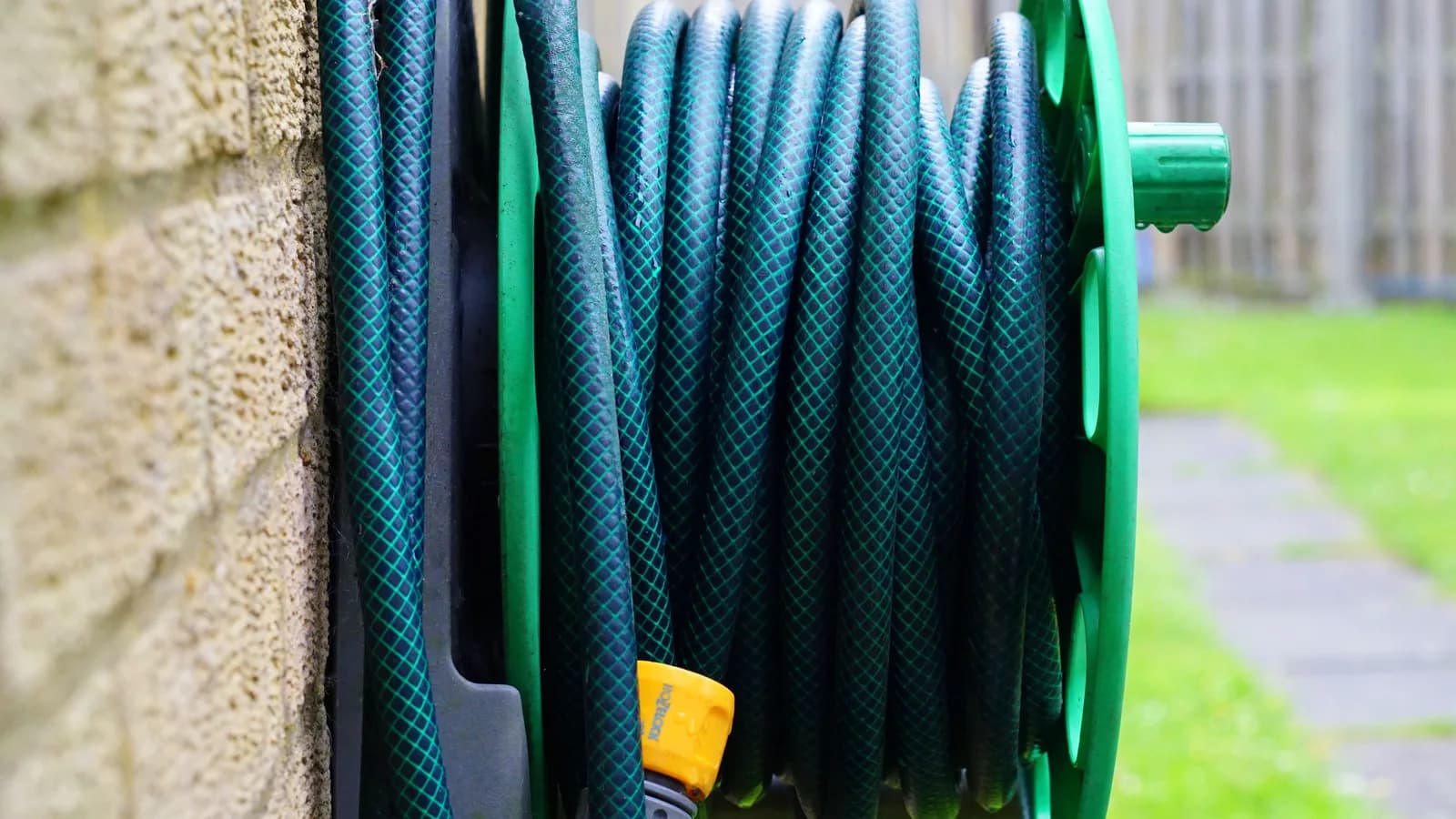
Measure the route, match diameter to the watering job, and compare weight, fittings, storage, and total cost before buying more hose than you need.
Measure from your outdoor spigot to the farthest point you need to reach, add a few extra feet for slack, and buy in 25-foot increments up to 100 feet. For many residential watering jobs, a 5/8-inch hose is a useful starting point; compare 1/2-, 5/8-, and 3/4-inch products by the task, run length, weight, and the equipment they must supply. Getting these two numbers right before you shop saves you from buying a hose that is too short, too narrow, or both.
Why Length and Diameter Matter Together
A hose that is long enough but too narrow will deliver weak, slow water at the end. A hose that is wide enough but too short forces you to drag it around the yard or leave sections kinked. The two dimensions work as a pair, so decide on both before you head to the store.
Measuring for Length
Walk from your spigot to the farthest spot you will regularly water. A garden hose is not a straight line in practice; it will sag, loop around planters, and bend around corners. Allow enough slack for ordinary bends and handling. Home Depot's buying guidance recommends measuring to the farthest point and purchasing slightly longer than your exact measurement. Common retail lengths come in 25-foot increments: 25 ft, 50 ft, 75 ft, and 100 ft. If your measurement lands between sizes, buy the next available length up—do not buy 100 ft when 60 ft will do.
Choosing Diameter
Retail buying guides list diameters from 3/8 inch through 3/4 inch, while many current residential products are 5/8 inch. The inner diameter determines how much water can pass through at a given pressure. A wider hose carries more volume but is heavier, stiffer, and more expensive. A narrower hose is lighter and cheaper but restricts flow, especially over longer distances.
| Diameter | Useful starting point | Tradeoff to check |
|---|---|---|
| 3/8 or 1/2 inch | Light watering, short reach, or a product made for a specific low-flow task | Easier to carry, but flow loss can be more noticeable on long runs |
| 5/8 inch | General yard watering and ordinary nozzles | Middle ground for weight and delivered volume |
| 3/4 inch | Long runs or equipment that calls for more delivered volume | Heavier, bulkier, and often more expensive |
Retail prices vary widely by construction, fittings, warranty, and brand. Compare the exact product rather than assuming diameter sets price, and include the nozzle, shutoff, reel, or hanger in the same shopping list.
Purchase Checklist
Before you buy, confirm each item below:
- Measured straight-line distance from spigot to farthest watering point
- Added only enough slack for the real route and ordinary bends
- Rounded up to the next 25-foot increment (25 / 50 / 75 / 100 ft)
- Chose diameter by task, run length, handling weight, and any connected equipment requirement
- Checked hose material for your climate (compare weight, flexibility, temperature limits, kink resistance, and warranty from the actual product data)
- Confirmed the hose couplings match your spigot thread (match the existing outdoor faucet and every intended accessory)
- Looked for a leak-free, crimped or threaded coupling at both ends
- Verified the hose is stored flat or coiled without sharp bends to avoid kink points
Costs: Product vs. Plumbing Repair
It is important to keep two budgets separate.
Hose product cost is the one-time retail price of the hose itself. Home Depot product listings showed several 50-foot hoses from about $16 to $54, from a basic 5/8-inch medium-duty hose to a 1/2-inch recoil model. Those are dated examples, not a universal range. Construction, fittings, warranty, brand, and local availability change the total, so price the nozzle, shutoff, reel, or hanger separately.
Plumbing repair cost is a separate line item and should not be folded into your hose budget. If your outdoor spigot is cracked, the shut-off valve is stuck, or the hose bib leaks at the thread, that is a repair or replacement job. Do not assume a new hose will fix a leak at the spigot; the hose is a product, the spigot is plumbing.
When to Call a Pro
Call a licensed plumber or irrigation contractor rather than troubleshooting alone if:
- Water pools around the spigot base even when the hose is disconnected, suggesting a buried line or shutoff valve issue.
- The hose bib thread is stripped or the bib is corroded through and will not accept a new coupling.
- You need to relocate the outdoor spigot to a different wall or add a second bib for a longer hose run.
- You are planning a permanent irrigation system and want the hose bib integrated with a backflow preventer and pressure regulator.
A new hose does not solve any of these. EPA WaterSense guidance on outdoor water conservation emphasizes preventing leaks and managing runoff; a leaking spigot or a hose that over-sprays onto a driveway defeats that goal, and the fix is at the plumbing level, not the hose level.
The 4Homes weekly email
Every Tuesday: what changed for homeowners this week, plus our newest guides.
No spam. Unsubscribe anytime.
Saving Money on Your Hose Purchase
- Buy the length you actually need. A 100-foot hose you will only use at 40 feet costs more upfront and is heavier to store.
- Do not jump to 3/4 inch without a task that benefits from the added delivered volume; extra hose weight is paid for every time you move it.
- Compare the product’s stated temperature range, weight, flexibility, warranty, and storage needs rather than buying from a material label alone.
- Store the hose flat or loosely coiled in shade. UV exposure and kinking shorten hose life and lead to early replacement.
- Check the coupling threads before leaving the store. A mismatched or cracked coupling will cause a leak you will blame on the hose.
- Plan your watering layout so the hose does not need to stretch across a patio or walkway. If you find yourself dragging it, the real fix may be a second spigot or a hose reel on a post, not a longer (and pricier) hose.
- For beds, consider a drip line or soaker hose that delivers water near the soil instead of spraying across pavement or foliage. Watch the first cycle and adjust the run time so water does not pond or run off.
For a broader look at how to plan watering across the year, see our four-season garden plan. If you are reducing lawn area in favor of drought-tolerant plantings, a shorter hose may be all you need; our guide to lower-water yard native plants walks through layout options. If your hose endpoint lands on a patio or deck, check our patio comfort and drainage plan so excess water does not pool at the hose's reach. And if you are considering a pressure washer for the same spigot, read how to choose the right pressure washer size before committing to a 3/4-inch hose you may not need for watering.
Garden hose FAQs
What is the most common garden hose size for a typical home?
There is no single size for every home. Choose the shortest stocked length that reaches with ordinary slack, then match the inside diameter to the task and connected equipment.
Should I buy a longer hose than I think I need?
Buy slightly beyond the measured route so the hose can turn ordinary corners without tension, then choose the nearest available length. Excess length adds weight, pressure loss, storage bulk, and cost.
Will a 3/4-inch hose give me more water than a 5/8-inch hose?
It can deliver more volume when the faucet, run, fittings, and connected equipment support it. The benefit is more relevant on long runs or high-volume tasks; it also brings more weight and bulk.
Why does a new hose still leak at the outdoor faucet?
A missing or damaged hose washer, crossed coupling, damaged threads, or a faulty faucet can leak. Reconnect only by the product instructions and call a plumber for a loose, corroded, frozen, or abnormal faucet.
Frequently Asked Questions
What is the most common garden hose size for a typical home?
There is no single size for every home. Choose the shortest stocked length that reaches with ordinary slack, then match the inside diameter to the task and connected equipment.
Should I buy a longer hose than I think I need?
Buy slightly beyond the measured route so the hose can turn ordinary corners without tension, then choose the nearest available length. Excess length adds weight, pressure loss, storage bulk, and cost.
Will a 3/4-inch hose give me more water than a 5/8-inch hose?
It can deliver more volume when the faucet, run, fittings, and connected equipment support it. The benefit is more relevant on long runs or high-volume tasks; it also brings more weight and bulk.
Why does a new hose still leak at the outdoor faucet?
A missing or damaged hose washer, crossed coupling, damaged threads, or a faulty faucet can leak. Reconnect only by the product instructions and call a plumber for a loose, corroded, frozen, or abnormal faucet.