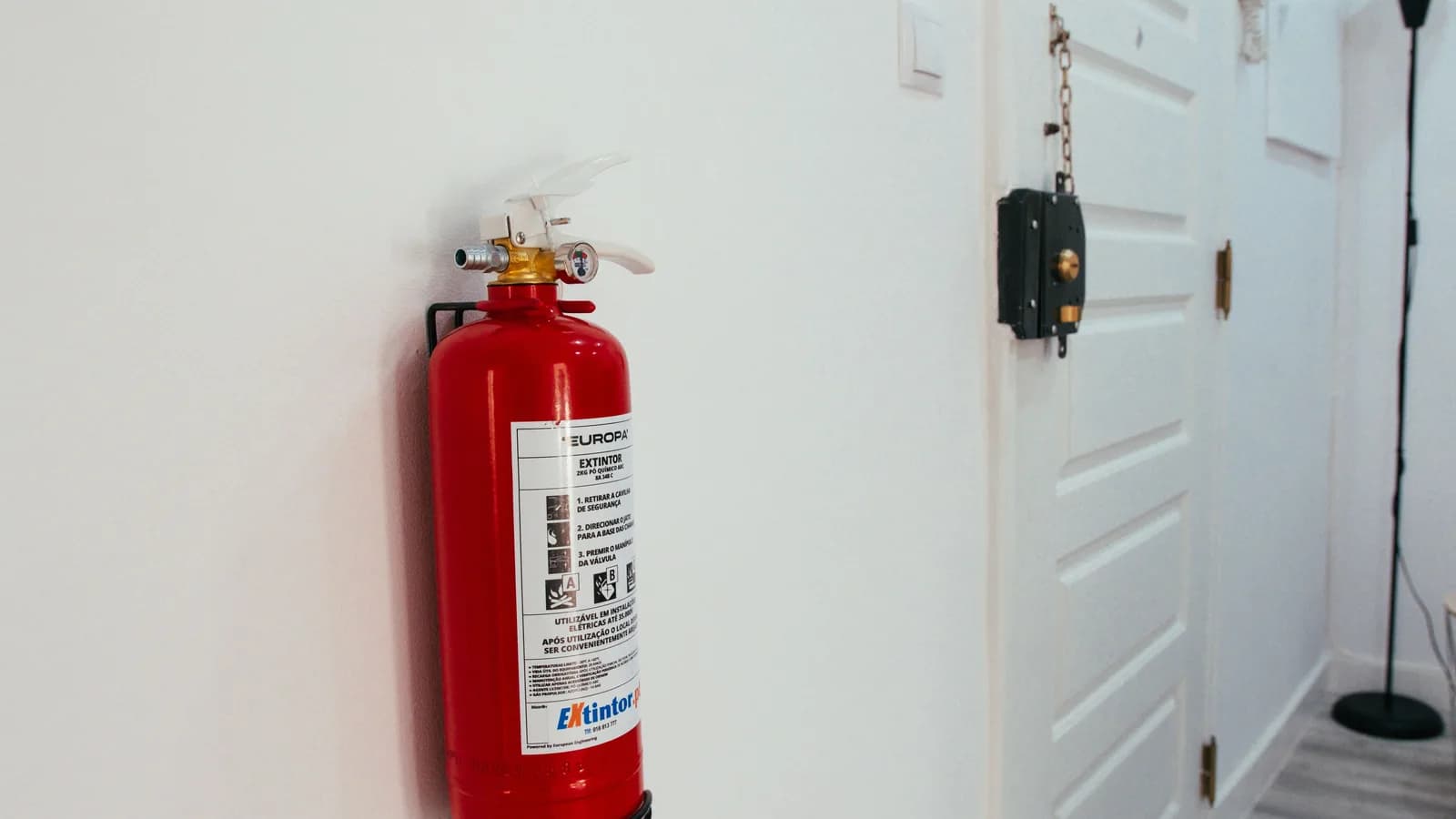
Choose by listed fire class, tested capacity, ready weight, service plan, and placement that keeps the exit behind the user.
Choose a home fire extinguisher by its listed fire classes, capacity rating, total weight, service type, and the household's ability to use it while keeping a clear exit. A UL Listed ABC unit is a practical starting point for many living areas, but it is not permission to fight a growing fire. Everyone leaves, the fire department is called, smoke is limited, the fire is small and contained, and the user keeps the exit behind them.
An extinguisher buys a brief chance to stop a small fire or clear an escape path. It does not make a room safe to re-enter. If there is doubt, get out, close the door if you can do so safely, stay out, and call 911 from outside.
Read the rating instead of shopping by canister color
U.S. extinguishers use letters for the hazard and numbers for tested capacity. The U.S. Fire Administration explains that the number before A represents multiples of 1.25 gallons of water equivalence. The number before B represents the approximate square feet of a Class B fire the tested operator can address. C means the agent is suitable where energized electrical equipment is involved; it has no number.
| Class | Typical fuel | What the label means |
|---|---|---|
| A | Wood, paper, cloth, and ordinary trash | The number indicates relative Class A capacity |
| B | Flammable liquids such as gasoline, oil, and some paints | The number indicates tested Class B fire area |
| C | Energized electrical equipment | The agent will not conduct electricity under the listing test |
| D | Combustible metals | A specialized agent must match the metal hazard |
| K | Commercial cooking oils and fats | A wet-chemical unit is designed for this cooking hazard |
A label such as 2-A:10-B:C describes capability, not room size or guaranteed success. Look for “UL Listed” or another nationally recognized testing-laboratory mark accepted for the application. Decorative fire sprays, blankets, aerosol products, and unlisted devices are not automatic substitutes for a listed extinguisher.
Start with the person who must lift it
USFA recommends buying the largest extinguisher the user can safely and comfortably operate. Take that literally. Compare the full ready-to-use weight, not only pounds of extinguishing agent. The intended user should be able to release the bracket, carry the unit, pull the pin, hold the nozzle or horn as directed, and squeeze the handle without setting the extinguisher down.
Our view: two manageable extinguishers in sensible locations beat one large unit that nobody in the house can lift. Children should evacuate and alert an adult, not be assigned firefighting duty. A person with limited grip, reach, balance, vision, or breathing capacity needs an escape-first plan and equipment selected with local fire-safety help.
Map the hazards and exits before choosing locations
Walk each floor and mark exits, sleeping areas, kitchen, attached garage, workshop, fireplace or stove, utility room, and places where fuels or solvents are lawfully stored. Then ask where a small fire might block the route. The extinguisher belongs where a user can reach it while moving toward an exit, not in the hazard's hottest corner.
- Kitchen: mount away from the range so flames do not stand between the user and the unit. A fitted metal lid can smother a small pan fire if it is safe to slide it on. Never carry a burning pan or use water on burning grease.
- Garage or workshop: account for fuel, paint, batteries, tools, vehicles, and welding. Metal, lithium-ion, and other specialized hazards may require expert selection and a different response.
- Living and sleeping floors: keep the route visible, unobstructed, and near an exit. Smoke alarms and the household escape plan do the life-safety work first.
- Outdoor cooking: follow the appliance and fuel instructions. Keep equipment outside and away from structures as required; an indoor extinguisher should not be buried behind the grill.
Use the electrical panel safety check for electrical warning signs and the chimney-fire response guide for a suspected flue fire. Neither situation should be converted into a household extinguisher experiment.
Choose disposable or rechargeable on purpose
| Feature | Disposable unit | Rechargeable unit |
|---|---|---|
| After use | Replace according to the label, even after a short discharge | Qualified fire-equipment service inspects and recharges it |
| Inspection | Owner checks gauge or indicator, pin, seal, hose, body, label, and access | Owner checks plus required professional maintenance |
| Purchase cost | Usually lower | Usually higher, with service costs later |
| Good fit | Household willing to replace the full unit when required | Household with accessible certified service and a long-term maintenance plan |
Do not buy a used extinguisher with an unknown service history. Check the manufacture date, recall status, pressure indicator, tamper seal, hose or nozzle, mounting bracket, and readable instructions before leaving the store. Register the product when the manufacturer offers registration.
Mount it so the exit stays behind you
Follow the unit's bracket and wall instructions, including fastener type and permitted mounting height. The wall must support the loaded bracket. Keep the extinguisher visible and free of coats, shelving, doors, and stored boxes. Do not drill where wiring, plumbing, or gas lines may be concealed.
Stand at the planned spot and look toward the hazard. You should be able to back toward an exit without turning around or passing the fire. If the unit is behind a locked door, inside a cluttered cabinet, or beyond the stove, move it. Ask the local fire department whether your floor plan, attached garage, fuel storage, or local code calls for another location or rating.
Use it only when all five conditions are true
- Everyone else is leaving and the fire department has been called.
- The fire is small, contained, and not spreading beyond the original object or surface.
- The room is not filling with smoke, and you can breathe and see clearly.
- The extinguisher label matches the burning material.
- A clear exit is directly behind you, and you can retreat immediately.
If any condition fails, leave. Heat at the doorway, smoke above or around you, a pressurized container, spreading flame, a lithium-ion battery in thermal runaway, or uncertainty about the fuel ends the attempt. Close doors on the way out when safe. Never go back for the extinguisher.
For a suitable small fire, USFA teaches PASS: pull the pin, aim low at the base, squeeze slowly and evenly, and sweep from side to side. Follow the unit label for distance and technique. If the first discharge does not control the fire, retreat. Even when the flame appears out, stay outside and let the fire department check for hidden fire and safe re-entry.
The 4Homes weekly email
Every Tuesday: what changed for homeowners this week, plus our newest guides.
No spam. Unsubscribe anytime.
Inspect it without pretending the gauge proves everything
Use the label's schedule and make a short visual check at least as often as it requires. Confirm the unit is present and accessible; the pin and tamper seal are intact; the gauge or indicator is in the operable range; the hose and nozzle are clear; the cylinder has no rust, dent, leak, residue, or damage; and the instructions face outward. Do not test it with a quick squeeze.
A green gauge shows pressure, not agent condition, correct weight, or absence of internal damage. Rechargeable units need the professional maintenance and hydrostatic testing required by their label, standard, and local rules. Disposable dry-chemical units have a finite service life; Consumer Reports cites NFPA guidance to remove nonrechargeable units 12 years after manufacture.
After any discharge, replace or service the unit immediately. Dry chemical can impair visibility and damage equipment; avoid breathing the dust and follow fire-department and product cleanup guidance. An extinguisher involved in fire, heat, impact, corrosion, or a recall should not go back on the wall.
Budget for the whole safety setup
Current November 2026 listings show basic home ABC extinguishers around $20 to $30 at Lowe's and Home Depot, while a U.S.-made 5-pound rechargeable 2-A:10-B:C model is listed around $75 by Fire Extinguisher Depot. Prices move by rating, agent, valve construction, bracket, rechargeability, and shipping. These are retail planning examples, not product endorsements or local quotes.
| Budget item | What to include | Where false savings show up |
|---|---|---|
| Extinguisher | Listing mark, complete rating, ready weight, bracket, warranty | Buying by color or agent pounds without reading the rating |
| Mounting | Correct location, wall backing, listed bracket, compatible fasteners | Leaving the unit boxed on a shelf behind clutter |
| Rechargeable service | Inspection, recharge, parts, tag, transport, future testing | Buying a serviceable unit where no local service is practical |
| Household plan | Working alarms, escape practice, visible address, meeting place | Treating the extinguisher as a substitute for evacuation |
Save money by choosing a listed rating and size that the household can actually maintain, checking recalls, and comparing the full replacement or service cycle. Do not buy a larger unit only because its cost per pound looks lower. Ask a local fire-equipment company for an itemized price when the home has a workshop, fuel storage, commercial-style cooking, or unusual electrical equipment.
Build the extinguisher into the fire plan
Photograph each manufacture date and location, keep receipts and manuals, and put inspection reminders in the seasonal home-care calendar. Practice two exits from sleeping rooms and choose an outdoor meeting place. Test smoke and carbon-monoxide alarms according to their manufacturers and applicable local requirements.
The extinguisher is the last optional step before retreat, not the first response. The first response is the alarm, evacuation, closed doors when safe, and the fire department.
Sources used
U.S. Fire Administration, Choosing and Using Fire Extinguishers; Occupational Safety and Health Administration, portable extinguisher class and rating guidance; Consumer Reports, Fire Extinguisher Buying Guide; current November 2026 retail listings from Home Depot, Lowe's, and Fire Extinguisher Depot; NFPA extinguisher service-life guidance as cited by Consumer Reports; and the exact extinguisher label and manual.
Frequently Asked Questions
What type of fire extinguisher is best for home use?
A UL Listed multipurpose ABC extinguisher is a common fit for ordinary combustibles, flammable liquids, and energized electrical equipment, but no single extinguisher fits every hazard or every user. Choose the largest listed unit each intended user can carry and operate, then check local requirements and special hazards such as cooking oil, fuel, or a workshop.
What size fire extinguisher should I buy for my house?
The U.S. Fire Administration recommends the largest extinguisher the user can safely and comfortably operate. Compare the complete rating, weight, handle reach, hose or nozzle, mounting instructions, and each household member's ability. A larger rating is not useful if the person cannot lift, aim, or control the unit while keeping an exit behind them.
Where should a fire extinguisher be kept at home?
Mount it in plain sight and within the manufacturer's height and location instructions, near an exit and away from the most likely fire source so you do not have to move toward flames to reach it. Do not hide it behind stored items or place it directly over a stove. Local fire officials can advise on a home's layout.
Do I need a separate fire extinguisher for the kitchen?
A home plan should account for kitchen hazards, but an extinguisher never replaces a lid, alarms, an escape plan, or calling the fire department. Multipurpose ABC units cover many household hazards; Class K units address commercial-style cooking oils and appliances. Ask the local fire department or fire-equipment professional what fits the actual cooking equipment and local code.
How often should a home fire extinguisher be replaced?
Inspect it on the schedule in its label and manual and replace or service it after any use, damage, recall, pressure loss, or failed inspection. NFPA guidance cited by Consumer Reports says disposable dry-chemical units should be removed from service 12 years after manufacture. Rechargeable units need qualified maintenance on their required schedule.