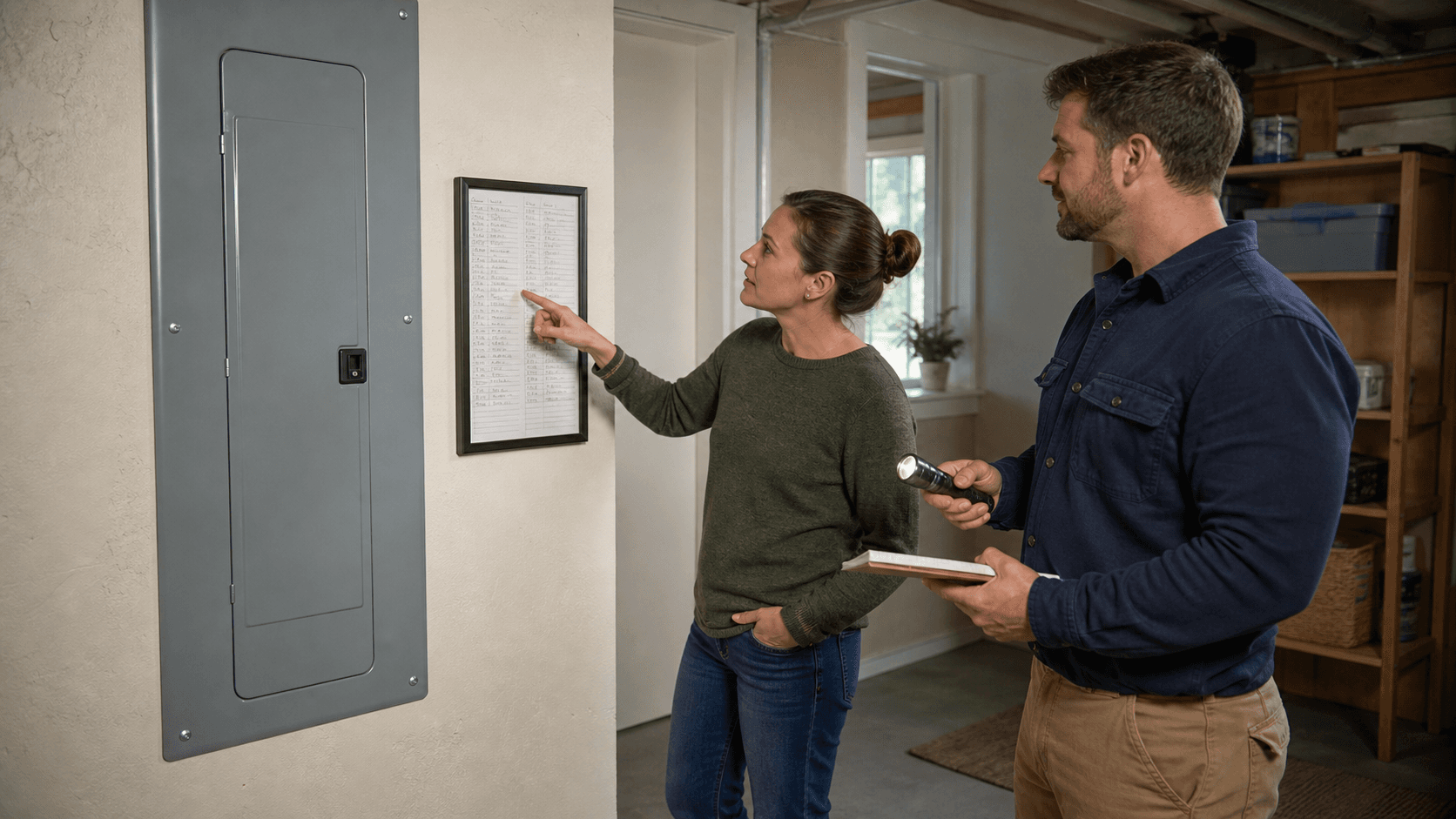
Homeowners can learn a lot from the outside of the panel. The cover stays closed and the warning signs stay visible.
The homeowner's panel check should happen from the outside. Look, listen, smell, photograph, and write down what the house was doing. Do not remove the panel cover, reach inside, tighten anything, or touch the enclosure to judge its temperature. The useful result is a clear record for an electrician, not a do-it-yourself diagnosis.
A boring panel check is a good panel check. If opening the metal cover seems necessary, the homeowner portion is over.
Stop before the checklist when danger is present
Smoke, visible arcing, a burning or rubbery odor, crackling, active water near the panel, or a damaged enclosure changes the job. Keep people away. Do not operate the panel, do not use water on an electrical fire, and call emergency services or the electric utility as the situation requires. A wet panel after a leak or flood should be treated as energized until the proper authority says otherwise.
Frequent breaker trips, flickering lights, buzzing, discoloration, shocks or tingles, and hot-smelling insulation also call for an electrician. The NFPA electrical safety checklist and ESFI home-wiring guidance identify these as warning signs. Do not touch a cover, switch, or receptacle to confirm that it is hot.
Make three passes without touching the equipment
Pass one: access and surroundings
Can an electrician reach the panel without moving shelving, paint cans, bicycles, or stored boxes? Can the outer door open fully? Is there steady footing and enough light to see the face of the enclosure? Keep the work area clear. Exact clearance rules depend on the installation and locally adopted code, so do not turn a general article into a tape-measure verdict.
Look above and around the panel for plumbing, stains, condensation, pest activity, impact damage, or a route by which water could reach it. Stay back if moisture is active. Moving a leak source or altering the panel area may involve more than one trade.
Pass two: the closed enclosure
From a comfortable distance, note rust, staining, soot, deformation, loose outer-door hardware, or openings where a filler plate appears to be missing. Listen for buzzing or crackling. Smell the air without leaning close. The outer door and the inner metal cover should remain in place.
The U.S. Consumer Product Safety Commission's guide to home wiring hazards explains that breakers and fuses protect wiring by opening a circuit when current exceeds a safe level. That protective role is why a breaker should never be taped on, held in position, or replaced with a higher rating to stop nuisance trips.
Pass three: the circuit story
Read the directory inside the outer door if the panel is dry, intact, and safe to approach. Photograph it. Mark entries that say only “lights,” “plugs,” or “spare” when the actual circuit is unclear. Do not experiment by removing the cover or moving conductors. A qualified electrician can trace circuits and produce an accurate directory.
Add a short list of large electrical loads already in the house and any being considered: electric cooking, clothes drying, water heating, space conditioning, vehicle charging, a workshop, solar, storage batteries, or backup power. Empty breaker spaces do not prove the service can carry another large load.
Match the observation to the response
| What is observed | What to do | What not to do |
|---|---|---|
| Smoke, sparking, fire, or active water near the panel | Keep away and contact emergency services or the utility as appropriate. | Do not operate breakers, open the enclosure, or use water. |
| Burning odor, buzzing, crackling, soot, or discoloration | Stop using affected equipment if that can be done away from the panel and call an electrician promptly. | Do not touch the panel to test heat or keep resetting a circuit. |
| One breaker trip with an obvious plug-in overload and no other warning sign | Unplug the likely loads. Follow the panel and breaker instructions only after the cause is removed. | Do not assume every trip is an overload. |
| A second trip or a trip with no clear cause | Leave the circuit off and arrange diagnosis. | Do not reset it repeatedly or install a larger breaker. |
| Rust, staining, missing fillers, damage, or a poor directory | Photograph the condition and put it on the electrician's scope. | Do not remove the cover or improvise a patch. |
| No warning sign, but a major new electrical load is planned | Request a load calculation and written upgrade plan before buying equipment. | Do not use empty spaces as proof of capacity. |
A tripped breaker is a message, not a chore
Write down the circuit, what was running, what started immediately before the trip, and whether lights dimmed or an odor appeared. If a likely overload came from portable devices and no warning sign is present, unplug those devices before following the manufacturer's reset instructions. Some breaker handles move to a middle position and must be moved fully off before they can be reset; the CPSC home electrical safety checklist is a useful general reference, but the panel labeling and manufacturer instructions control the actual operation.
Stop after a repeated trip. A breaker can be responding to overload, a short circuit, a ground fault, damaged equipment, or another problem that cannot be separated safely from the hallway. Repeated resetting erases useful evidence and can put damaged wiring back under load.
The 4Homes weekly email
Every Tuesday: what changed for homeowners this week, plus our newest guides.
No spam. Unsubscribe anytime.
Plan new loads before shopping for hardware
Vehicle chargers, heat pumps, electric water heaters, induction ranges, hot tubs, workshops, solar equipment, batteries, and generators can change the electrical plan. Ask an electrician to document the service rating, panel and bus ratings, calculated load, grounding and bonding observations, available circuit options, permit needs, and whether utility work is involved.
Our position is simple: do not buy the charger, appliance, or backup system first and make the house solve the problem later. Capacity, connection method, equipment location, and emergency shutoff needs belong in the purchasing decision.
Ask for an inspection record you can keep
Give the electrician the panel photographs, trip log, planned-load list, and any prior permits or service records. Ask for findings in writing. The useful report identifies observed conditions, tests performed, urgent corrections, recommended work, permit responsibility, and items that were outside the inspection scope.
An older panel is not automatically unsafe, and a neat-looking panel is not automatically sound. Brand, condition, alterations, protective devices, loads, installation, and local requirements all matter. That judgment belongs with someone qualified to inspect the system.
Keep one hard boundary
A homeowner can clear access, read labels, record symptoms, and photograph the closed equipment. Removing the dead front or panel cover exposes a different level of risk, even when the main breaker is off. Internal inspection, testing, tightening, breaker replacement, conductor work, and capacity changes belong with a qualified electrician working under the applicable rules.
The outside check still matters. It turns “something seems wrong” into a useful record, and it can surface the warning that gets the right person involved before the next reset.