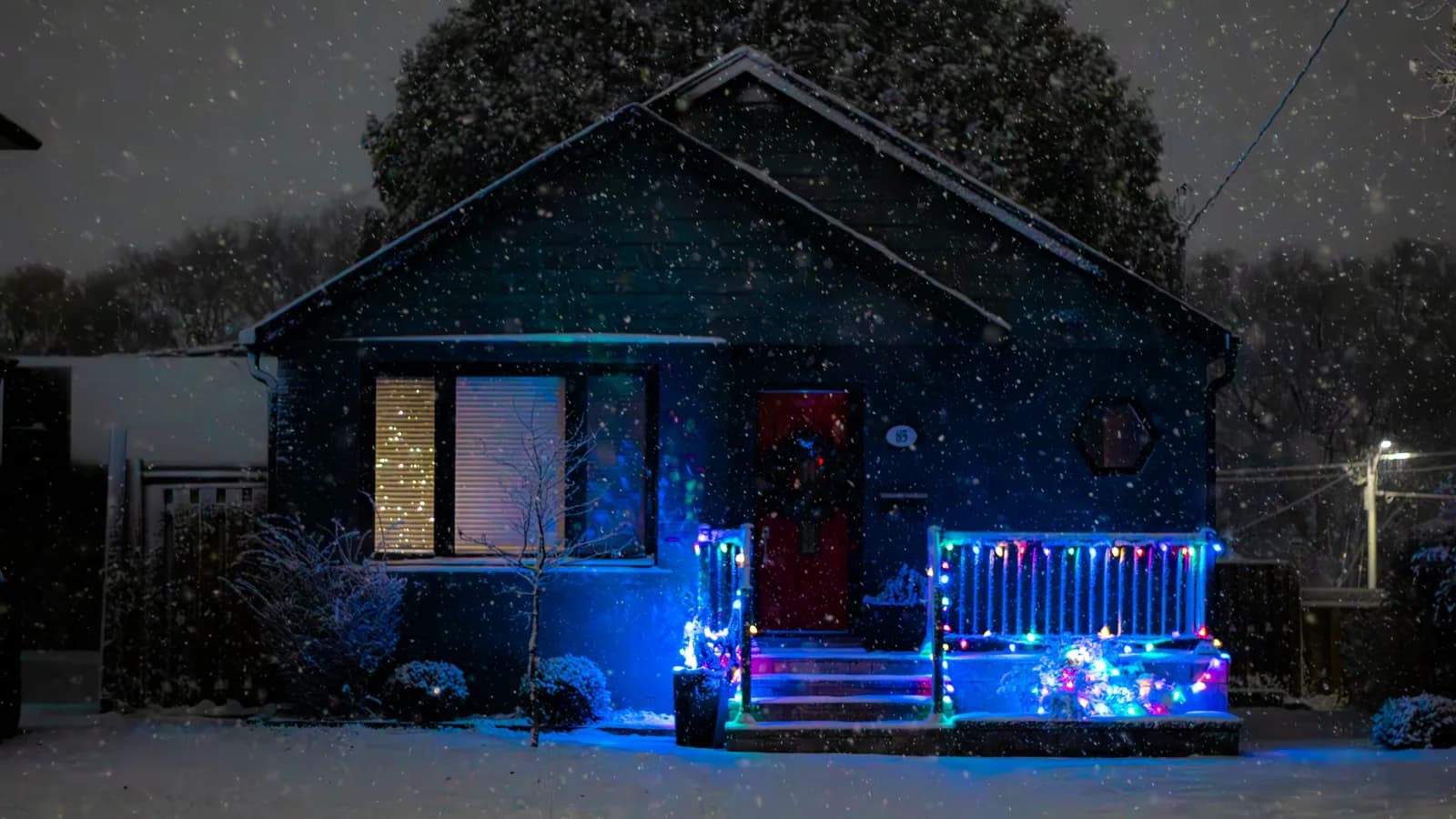
Plan a ground-reachable display when possible, use outdoor-labeled products on GFCI protection, follow each set's connection limit, and stay away from overhead lines.
To hang outdoor Christmas lights safely, plan a display you can install from the ground when possible, power it from GFCI protection, and use only products labeled for outdoor use. Follow each set's connection limit, use non-damaging clips, keep every ladder and cord away from overhead lines, and stop for wet, icy, or windy conditions.
The safe display is usually the simpler one. A short, ground-reachable run with one known power route is easier to inspect and remove than lights stretched across a roofline, multiple extension cords, and plugs sitting in snow. I would skip a difficult roof edge rather than turn seasonal decoration into a fall or electrical repair.
Start with the outlet, not the roofline
Sketch the display before opening the boxes. Mark the outdoor receptacle, each light run, the distance between them, doors and walks that must stay clear, downspouts, trees, and overhead service lines. Then reduce the plan until cords do not cross traffic areas and every connection can be positioned as the product instructions require.
ESFI recommends plugging outdoor electric decorations into GFCI-protected circuits. Test the receptacle with its TEST and RESET buttons according to the device instructions before installing the display. If the test does not interrupt power, the cover is broken, the receptacle is loose or warm, or there are scorch marks, do not use it. The electrical safety check explains the homeowner's visual boundary; a licensed electrician handles the repair.
A listed portable outdoor GFCI can add ground-fault protection where appropriate, but it is not a cure for defective wiring or a missing equipment ground. Do not use a three-to-two-prong adapter, defeat a grounding pin, or run power through a window or door that crushes the cord.
Read all four labels in the power route
The light set is only one part of the route. Check the labels and instructions for the lights, extension cord, timer or smart plug, and any power supply. Each item must permit the location and conditions where it will be used. “Indoor only” is a stop sign outdoors. “Water resistant” is not permission to submerge a connection or leave it in standing water.
| Check | What to confirm | Reject it when |
|---|---|---|
| Certification | A mark from a nationally recognized testing laboratory and a product identity that matches the package | The mark is missing, altered, or does not match the product |
| Location rating | Outdoor use is expressly allowed for the set, cord, timer, and power supply | Any component says indoor only or lacks readable instructions |
| Connection limit | The exact number or load that this set permits end to end | The limit is unknown or mixed products make it impossible to follow |
| Condition | Insulation, plug blades, sockets, strain reliefs, and covers are intact | There is cracking, exposed conductor, looseness, heat damage, corrosion, or water inside |
UL Solutions identifies ANSI/UL 588 as the safety standard for seasonal-use decorative lighting products. That correct standard matters because a certification mark does not turn every light set into an outdoor product. The location marking and instructions still control. Do not rely on a marketplace title that says “waterproof” while the physical label says something else.
Build and test the display on dry ground
- Lay out each run unplugged. Match strand lengths to the sketch and keep the cord relaxed. Do not stretch it to reach.
- Inspect every inch you can see. Remove damaged products from service. Tape does not restore the listing or weather resistance of a punctured cord.
- Install replacement bulbs or fuses only as directed. Use the exact type and rating specified for the set. Unplug it first.
- Connect only the permitted number of sets. The manufacturer's limit wins even if the breaker has more capacity.
- Test before hanging. On a dry surface, connect the planned run to the intended protected source and confirm normal operation. Unplug it before installing clips or repositioning the run.
A tripped breaker or GFCI is information, not an inconvenience. Unplug the display. Remove wet or damaged equipment and reduce the connected load according to the instructions. If protection trips again, leave the display off and have the circuit and products assessed. Do not repeatedly reset it or move the display to a less-protected outlet.
Use clips without injuring the cord or the house
Use clips made for both the light style and mounting surface. Keep them on the structure, never through the cord. Do not use nails, screws, or staples where they can puncture insulation. Avoid adhesives that the siding, trim, masonry, or paint maker does not approve; removal damage can cost more than the lights.
Leave gutters and downspouts able to drain. A light cord is not a support cable, and the gutter is not an extension-cord tray. If debris or drainage is already a problem, handle it separately with the ground-based gutter guide. Do not climb onto a wet roof to combine two jobs.
Arrange plugs and control boxes exactly as their instructions show. Keep them out of standing water and away from sprinkler spray, snow piles, and roof runoff. Use outdoor-rated connection protection only when the connected-product instructions permit it; wrapping a plug in a plastic bag can trap moisture.
Know where ladder work stops
ESFI advises wood or fiberglass ladders outdoors because metal conducts electricity. OSHA's familiar 4-to-1 setup rule applies to a non-self-supporting ladder used for access: one foot of base setback for every four feet of working length. It is not a general rule for stepladders, and it does not make electrical-line or roof-edge work safe.
Use the ladder type only as its label directs, on firm and level ground, with the locks fully engaged. Keep your body between the side rails, maintain three points of contact, and climb down to move it. Do not stand on prohibited steps, carry an awkward light bundle while climbing, lean sideways, or use a ladder on ice. Keep the ladder, poles, clips, cords, and your body well away from overhead lines. If the route is anywhere near a line, abandon that route and call the utility or qualified help for guidance.
Roof access, steep or high eaves, and a two-story display are reasonable points to hire a pro. A telescoping light-hanging pole can keep some work at ground level, but only if it can be used without approaching power lines or losing control of the strand.
The 4Homes weekly email
Every Tuesday: what changed for homeowners this week, plus our newest guides.
No spam. Unsubscribe anytime.
Cost, professional scope, and ways to save
Angi's 2026 national cost guide reports that professional Christmas-light installation commonly runs from $220 to $684, with a $444 average based on 2,242 verified projects. Home size, linear footage, height, display complexity, whether the installer supplies the lights, removal, and storage all affect a local quote. Ask whether the price includes materials, repairs, timers, removal, storage, and return visits.
Save money by shrinking the difficult part of the plan. Reuse intact labeled LED sets within their instructions, concentrate lights around ground-level shrubs and railings, and use one timer rated for the exact location and load instead of leaving the display on all night. Photograph the completed routes and label each set before storage. The cord-storage guide helps prevent the tight knots and crushed insulation that ruin next season's setup.
Call a licensed electrician for a failed GFCI, damaged receptacle, recurring trip, new outdoor circuit, or permanent lighting connection. Hire an insured installer for roof work or heights you cannot reach safely. Ask how the crew protects roofing, gutters, siding, landscaping, and electrical equipment, and how removal is handled.
Check the display during the season
Look from the ground after wind, rain, or snow. Shut the display off and unplug it before correcting a loose clip or moved cord. Stop using any run with flickering tied to cord movement, a warm plug, discoloration, buzzing, a damaged socket, or repeated protective-device trips. Keep children and pets away while it is disconnected.
Remove seasonal products on the schedule in their instructions. Dry them before storage, discard damaged pieces, and keep the label with the set. Next year, you should be able to tell at a glance which run is outdoor-rated, how many sets may connect, and which clips fit it.
Sources used
Electrical Safety Foundation International, Outdoor Decoration Safety Tips and Power Lines Safety Tips; UL Solutions, Seasonal Lighting Safety Testing and Certification Services for ANSI/UL 588; OSHA, portable ladder safety guidance; Angi, How Much Does Professional Christmas Light Installation Cost? (2026 data); and the labels and instructions supplied with each light set, cord, timer, clip, GFCI, and power supply.
Frequently Asked Questions
Can I use indoor Christmas lights outside?
No. Use a light set whose label or instructions specifically permit outdoor use. An indoor-only set has not been evaluated for the moisture and temperature conditions it may meet outside. The same rule applies to extension cords, timers, and power supplies.
How many strands of outdoor Christmas lights can I connect?
Use the end-to-end connection limit printed on that exact light set or in its instructions. The safe number varies with the product, bulb type, wattage, and construction, so there is no universal strand count. Never combine sets in a way the manufacturer does not permit.
How much does it cost to have someone hang Christmas lights?
Angi's 2026 national guide reports a common professional installation range of $220 to $684 and a $444 average. Height, linear footage, display complexity, supplied lights, removal, and storage change the quote. Ask for those items separately before comparing installers.
Can I staple Christmas lights to the house?
Do not drive staples, nails, or screws through or tightly against a light cord. Use clips made for the strand and the mounting surface, following both manufacturers' directions. A pinched or punctured cord should be taken out of service rather than taped over and rehung.
When should I hire someone to hang Christmas lights?
Hire qualified help when the plan requires roof access, work near overhead lines, an unstable or icy surface, a ladder you cannot use safely, new receptacles or permanent wiring, or a display that keeps tripping protection. A ground-based display is the safer DIY choice when height or electricity is uncertain.