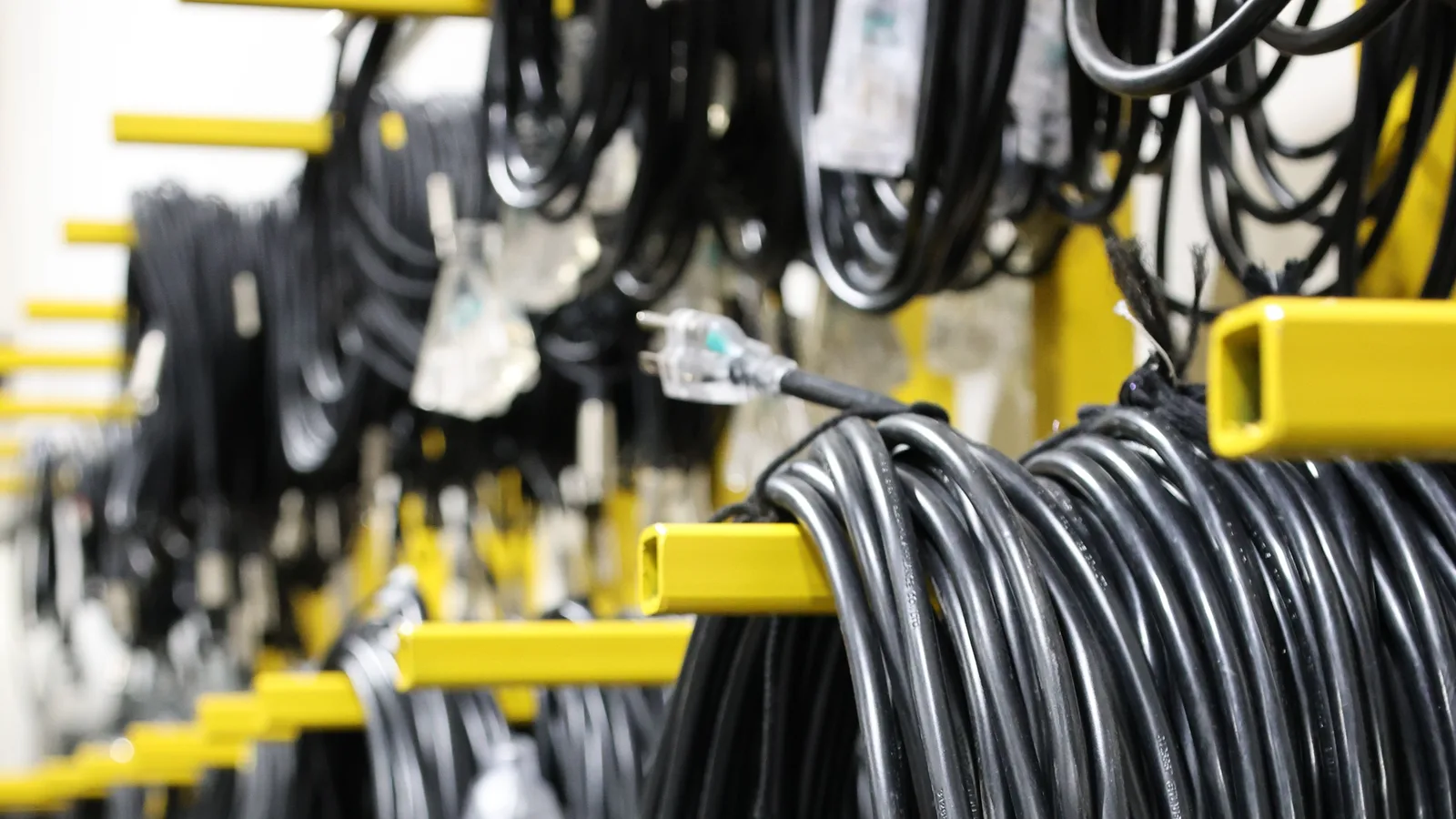
Inspect every unplugged cord, make broad untwisted loops, label the rating, and store each coil dry and protected from crushing, heat, chemicals, and pests.
Store extension cords unplugged, inspected, clean, dry, and wound in broad relaxed loops that do not twist or sharply bend the cable. Secure each coil with a reusable strap, label its rating and intended use, then hang or shelve it where moisture, sunlight, chemicals, pests, vehicles, sharp edges, and falling objects cannot damage it.
Start by taking unsafe cords out of the collection
Storage is the best time to inspect the whole cord because every inch is already in your hands. Disconnect it by gripping the plug. Lay it out without energizing it and look at both plug ends, the strain reliefs, every outlet, and the full jacket.
Remove a cord from service for cuts, cracks, fraying, flattened or melted areas, exposed conductors, a missing ground pin, bent or altered blades, a cracked plug body, loose connections, pulled strain relief, scorching, stiffness, or a history of unusual heat. CPSC says damaged extension cords should be replaced and warns against taping damaged insulation or altering plug blades. Do not put a suspect cord back on the hook with a plan to remember later.
| Inspection result | Storage decision | Next action |
|---|---|---|
| Sound jacket, plugs, grounding, and strain relief | Store after cleaning and drying | Label the cord's printed ratings and intended job |
| Dirty or damp but otherwise sound | Do not coil yet | Clean and dry only by the manufacturer's method |
| Cut, cracked, hot, scorched, loose, modified, or missing a safety feature | Keep out of service | Prevent reuse and follow local disposal or recycling rules |
| Condition or rating cannot be confirmed | Quarantine it away from usable cords | Ask the manufacturer or replace it with a properly marked listed cord |
Extension cords are temporary equipment. If one stays routed across a room, through a doorway, or behind furniture between uses, the real project is a suitable receptacle. The closed-panel electrical safety guide explains warning signs that should move the question to a licensed electrician.
Clean and dry without attacking the jacket
Follow the cord maker's care instructions. With the cord unplugged, ordinary dry soil may come off with a clean cloth. Do not soak a connector, spray solvent into an outlet end, scrape the jacket, or use a chemical just because it removes paint or grease. A product that looks clean but has a softened, swollen, sticky, brittle, or discolored jacket is not ready for service.
Outdoor cords can carry moisture and grit into storage. Let the unplugged cord dry in a protected, ventilated place away from heat and ignition sources. Open connector covers only as designed. Do not bake a cord in direct sun, drape it over a heater, or energize it to speed drying.
Make broad loops without adding twist
The Electrical Safety Foundation International tells consumers to store cords without sharp bends or twists. That is the useful rule. Exact loop diameter and winding method can vary with the cord jacket, gauge, temperature, and manufacturer, so a universal number would be false precision.
- Lay out the unplugged cord. Remove existing knots and let tight twists relax without pulling against either plug.
- Start at one end. Hold the cable, not the plug or strain relief, and make a broad natural loop.
- Rotate out twist. Let the free length turn as each loop forms. Do not force every loop into an identical circle if the cable resists.
- Keep bends relaxed. No kink should form at the plug, connector, strap, hook, or center of the coil.
- Secure the coil lightly. Put a reusable hook-and-loop strap around the bundle. Never tie the cord around itself or cinch a thin tie into the jacket.
An over-under coil can reduce twist for a flexible cord when the manufacturer allows it and the user knows the method. A simple same-direction coil can work when the free end is allowed to rotate. The test is not which internet method looks neater; it is whether the stored cord lies relaxed, unwinds without knots, and has no tight bend.
Use a hook, shelf, bag, or reel that supports the cord
A wide rounded hook can support a light coil. A shelf or ventilated tote can protect labeled household cords. A purpose-built reel can manage a long cord. Match the organizer to the coil's weight and size, and follow its load, mounting, winding, and electrical instructions.
| Organizer | Good fit | What to avoid |
|---|---|---|
| Reusable strap plus wide wall hook | One light or medium cord stored visibly | A nail, screw, or narrow hook that concentrates weight on the jacket |
| Shelf or ventilated tote | Several clean, dry, separately labeled coils | A sealed damp bin, piled metal tools, or heavy boxes crushing plugs |
| Manual storage reel | A compatible long cord that fits without crowding | Sharp flange edges, undersized drum, forced winding, or loose ends |
| Retractable powered reel | Only the location and loads covered by its listing and instructions | Treating it as permanent wiring or using a wound rating as if fully unwound |
UL 355 covers cord reels as products with flexible cord and a take-up mechanism. That does not mean every reel fits every cord or job. Confirm conductor gauge, length, connector type, amp rating, indoor or outdoor use, mounting position, and whether the rating changes while cord remains on the reel.
Choose a dry storage zone, not the nearest empty nail
Keep cords above the floor in a dry area with moderate conditions allowed by the manufacturer. Protect them from vehicle tires, garage-door tracks, ladders, snow shovels, mower blades, hot pipes, direct sun, roof leaks, pests, and shelves that can collapse. Do not store them beside gasoline, pool chemicals, fertilizer, solvents, or leaking batteries.
In a one-car garage, map the parking envelope and walking route before mounting anything. The one-car garage storage guide helps keep the cord wall outside door swings and vehicle contact. For outdoor equipment, keep the selected cord with its label record, not permanently attached to the machine.
Household cords deserve separation by purpose. Put indoor two-conductor cords, grounded indoor cords, outdoor-rated cords, specialty tool cords, and holiday-light cords in distinct labeled groups. Do not label a cord “heavy duty” from appearance. Copy its actual printed gauge, conductor count, maximum rating, length, and indoor/outdoor marking.
Create a label that prevents the wrong next use
A simple tag should state length, AWG and conductor count, maximum amps or watts from the cord label, indoor or outdoor rating, and the tool or job it was bought for. Keep the tag at the storage strap, not wrapped around a section that becomes hot in use. Photograph the cord markings because jacket printing fades.
Before the next job, use the extension-cord gauge and load guide to match the equipment manual, total length, environment, and cord rating. A neatly stored cord can still be wrong for a space heater, refrigerator, air conditioner, or power tool. Some equipment manuals prohibit extension cords entirely.
The 4Homes weekly email
Every Tuesday: what changed for homeowners this week, plus our newest guides.
No spam. Unsubscribe anytime.
Plan the storage purchase and the real savings
The lowest-purchase plan is often to inspect the cords, reuse a suitable shelf, and make broad coils secured with reusable straps already on hand. If you buy hooks, a tote, or a reel, compare its dimensions, support rating, mounting requirements, cord compatibility, listing, and return policy. Do not use the price or advertised cord length as evidence that an organizer fits a particular cord or load.
| Choice | Cost question | How it can save money |
|---|---|---|
| Reuse a shelf and straps | Can each coil sit without crushing or tangling? | Avoid an organizer purchase and see inventory before buying duplicates |
| Add wide hooks | Are the hooks and fasteners rated for the wall and loaded coil? | Keep cords off a wet floor and make damage visible |
| Buy a storage reel | Does it fit the exact cord and storage environment? | Reduce tangles and handling damage on a frequently used long cord |
| Replace a damaged cord | Does the new cord match the real load, length, and location? | Buy one correct cord instead of several near matches |
The savings are practical: fewer duplicate purchases, less plug and jacket damage, faster inspection, and less time untangling. Do not count an unsafe repair as savings. Check a specialty cord's purchase record in the home inventory, especially if warranty coverage or a recall could matter.
When an electrician is the better storage solution
Call a licensed electrician when cords have become permanent room wiring, the only route crosses a doorway or wet area, an outlet is loose, hot, scorched, buzzing, or damaged, or breakers and GFCIs repeatedly trip. Ask for a written scope for receptacle location, circuit capacity, required protection, permits, wall repair, and testing.
Do not install hooks or reels where drilling may hit wiring, plumbing, or other hidden services. A mounted powered reel adds product, support, location, and electrical requirements that a loose storage hook does not. Compare larger proposals using the contractor quote comparison guide.
Extension cord storage checklist
- Unplug by the plug and inspect both ends, strain reliefs, and the full jacket.
- Remove damaged, modified, hot, scorched, stiff, or questionable cords from service.
- Clean and dry only by the manufacturer's approved method.
- Form broad relaxed loops without knots, sharp bends, or trapped twist.
- Use a reusable strap and a wide support, shelf, tote, or compatible reel.
- Label length, AWG, conductors, rating, environment, and intended job.
- Store above a dry floor away from chemicals, heat, sunlight, pests, tools, and vehicles.
- Reinspect and match the cord to the equipment before every use.
Sources used
U.S. Consumer Product Safety Commission extension-cord safety guidance; Electrical Safety Foundation International, Use Extension Cords Safely and cord-related hazard guidance; UL Standards & Engagement, UL 355 Standard for Cord Reels; exact cord and reel manufacturer instructions; and applicable local electrical and fire requirements.
Frequently Asked Questions
What is the best way to wrap an extension cord for storage?
Unplug it, inspect it, remove twists, and form broad relaxed loops without sharp bends. Use the winding method and minimum bend guidance supplied by the cord or reel manufacturer when available. Secure the finished coil with a reusable strap around the coil, not a tight knot in the cord.
Can extension cords be stored in a garage?
Only when the cord's manufacturer permits the garage's temperature and humidity range and the storage spot stays dry, clean, and protected from vehicles, pests, chemicals, sunlight, sharp tools, and falling objects. Keep cords off the floor and away from fuel, fertilizer, batteries, and hot equipment.
Should extension cords be stored on a reel?
A listed reel can organize a compatible cord when its instructions cover that cord type, length, gauge, connector, winding direction, mounting, and storage environment. Do not force a cord onto an undersized reel. A storage reel's electrical rating also matters if it will be used while the cord remains wound.
Can I tape a damaged extension cord before storing it?
No. CPSC says not to make inadequate repairs such as taping damaged insulation, and damaged cords should be replaced. Unplug the cord, mark it so nobody reuses it, and follow local disposal or electrical-recycling rules. A storage bin should never become a holding area for questionable cords.
Why should extension cords be unplugged before storage?
An extension cord remains energized while plugged in even when nothing is connected at the far end. CPSC directs consumers to unplug cords when they are not in use. Storage starts only after the cord is disconnected by grasping the plug, not by pulling the cable.