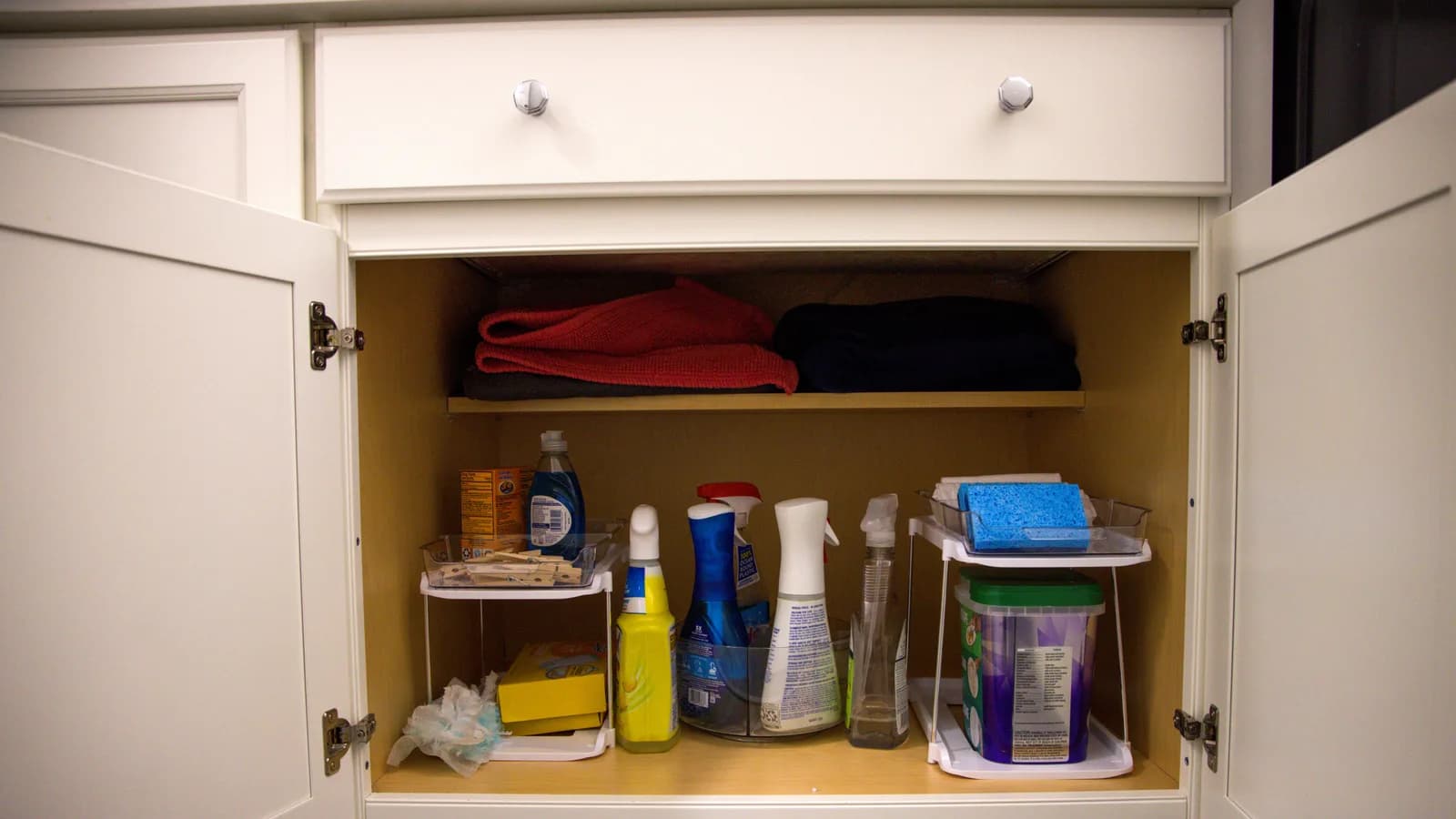
Create one controlled stock area, build room-by-room task kits without duplicate hazardous products, and keep labels, access, ventilation, and disposal visible.
Organize household cleaning supplies by keeping hazardous products in one controlled, locked stock area and placing only the few task supplies each room actually needs nearby. Leave every chemical in its original labeled container, separate products as their labels direct, and choose storage that stays dry, accessible to an adult, and out of reach of children and pets.
The goal is not a matching row of bottles. It is a house where nobody has to guess what a product is, where it belongs, or what to do when its package is damaged.
Start with a whole-home product audit
Check the kitchen, bathrooms, laundry area, utility closet, garage, basement, and any cleaning caddy. Work one location at a time so open cabinets are never left unattended. Keep children and pets out of the work area, wear protection required by the labels, and do not open an unknown, leaking, swollen, rusted, or crusted container to identify it.
Write an inventory on paper or in a phone note. Record the product name, storage location, label category, package condition, and any printed expiration or disposal direction. The list is for tracking; do not write over warnings or cover the product label. Photograph the front and back of specialty products so the directions remain available if the bottle is later damaged.
| Audit result | Next move | Do not do |
|---|---|---|
| Current, intact, regularly used | Keep if the planned location satisfies the label | Do not decant it for appearance or convenience. |
| Duplicate or rarely used | Keep one usable package and move reserve stock to the controlled area | Do not scatter extra hazardous stock around the house. |
| Expired under its label or manufacturer guidance | Follow the label and local disposal program | Do not pour it into another bottle or combine leftovers. |
| Leaking, corroded, bulging, or unreadable | Keep people away and call the local hazardous-materials or solid-waste authority | Do not sniff, test, open, or transport it without instructions. |
| Unknown contents | Treat it as a disposal question and preserve the container as found | Do not guess by color, odor, or where it was stored. |
The U.S. Environmental Protection Agency says not to mix household hazardous waste with other products and to ask local environmental, health, or solid-waste agencies about disposal. Set questionable items aside only in the safe way their labels or local officials direct. A random “discard” tub can put damaged or incompatible packages together.
Choose one controlled stock area
Pick the best location the house actually has, not the most convenient empty shelf. It should be dry, stable, protected from impact, and large enough for containers to stand upright with labels facing forward. It also has to satisfy each label's temperature, sunlight, flame, ventilation, and separation directions. Keep food, beverages, medicine, pet food, and food-contact tools elsewhere.
When children, visiting children, pets, or a vulnerable adult could gain access, use a cabinet or box that locks. The U.S. Consumer Product Safety Commission says chemicals and cleaning supplies should be stored in a locked cabinet or box out of children's reach and kept in their original child-resistant containers. A decorative basket on a high shelf is not the same control. Neither is a door that is usually closed.
Do not treat “chemicals” as one compatible category. Read the storage section on every label and create separate trays or shelf zones where the directions require separation. Bleach products, ammonia products, acidic toilet or rust cleaners, solvents, aerosols, pesticides, and pool or automotive chemicals can have different rules. Never invent a transfer, dilution, or storage pairing to make the shelf symmetrical.
Build task kits without duplicating hazardous stock
Separate tools from chemicals. A bathroom kit can hold clean cloths, a brush, gloves, and an empty caddy. A floor kit can hold pads and the model-approved mop attachment. Bring the correctly labeled product from locked stock for the task, use it with the ventilation and protective steps on its label, then return it and lock the door. That is slower than leaving a strong cleaner beside every toilet. It is also easier to inventory and harder to misuse.
Keep a daily-use product in a room only if its label permits the location and the household access plan remains secure. Do not buy a second bottle merely to fill a caddy. Duplicates create more open packages, more aging stock, and more places to inspect. If one product legitimately serves several rooms, one bottle can travel with the caddy and return to the controlled cabinet.
Use the task-zone method from the kitchen cabinet organization guide, but keep household chemicals away from dishes, food, and medicine. The separate medicine-cabinet safety guide covers dry storage, child-resistant access, expired-item disposal, and inventory. For larger utility storage, the one-car garage organization guide explains how to protect routes, shutoffs, panels, and heavy-item zones.
Keep ventilation and access in the plan
Storage ventilation and use ventilation are different questions. Do not improvise holes, fans, or a sealed container around chemicals. Follow the package directions for storage, then use the product only with the fresh-air or exhaust steps its label requires. Poison Control advises opening a window or door and running an exhaust fan when cleaning small spaces. The storage system should let an adult retrieve one product without shifting several unfamiliar bottles or blocking the room's door or vent.
Leave space to read every label and close every cap before the product goes back. Keep aerosols and other products away from stoves, radiators, furnaces, direct sun, and heat sources as their labels require. A basement that floods, a cabinet beside leaking plumbing, or a garage that freezes or overheats may fail even if it has plenty of shelf room.
Walk the route from the stock cabinet to each task. A caddy should remain level, clear stairs and doorways, and never ride with food or medicine. If the route is awkward, move the nonchemical tools closer to the task rather than creating another chemical cache.
Track age, damage, and disposal
Once each season, compare the shelf with the inventory. Check that caps are secure, labels are readable, containers are upright, and no package shows a leak, rust, swelling, brittleness, residue, or heat damage. Use any manufacturer date or expiration exactly as directed. If no usable date exists, ask the manufacturer; do not make up a universal shelf life for unlike products.
Record the check in the seasonal home-care calendar. Put the next disposal event or local drop-off instructions in the same note. EPA advises reading labels for disposal directions because products can leak, ignite, react, or mix during transport. Even an apparently empty household-hazardous-waste container can retain residue.
Never pour an unknown product down a drain, onto the ground, into a storm sewer, or into another bottle. Do not combine leftovers to save space. Contact the local program before moving a compromised container; EPA specifically directs homeowners with corroding containers to seek local hazardous-materials or fire-department instructions.
The 4Homes weekly email
Every Tuesday: what changed for homeowners this week, plus our newest guides.
No spam. Unsubscribe anytime.
Typical costs for a safer setup
A useful reset can cost $0 when the home already has a sound locking cabinet, shallow trays, and a handled caddy. Home Depot listings checked for this guide showed basic cleaning caddies around $8 to $31, child-safety locks and latches roughly $2 to $27, and small lockable wall cabinets around $79 to $178. Prices and stock vary, and no organizer makes an unsuitable location safe.
Spend first on access control. After that, buy only enough washable trays to keep label-directed groups stable and visible. Skip matching dispenser bottles, decorative jars, and a different chemical set for every bathroom. Installation of a wall cabinet may require a qualified handyman or contractor when the wall, anchors, cabinet load, utilities, or required clearances are uncertain.
Save money by buying fewer products
Use what the label says is appropriate for the task and buy the smallest amount the household will use. EPA recommends reducing purchases of products with hazardous ingredients where practical. One suitable general cleaner may replace several specialty bottles, but only when the surface instructions and product label support that use.
Run the new system for two weeks before adding bins. During the weekend home reset, return tools, lock the stock cabinet, and note anything that drifted. If a bottle keeps landing in a bathroom, fix the return routine or caddy first. Do not solve it automatically by buying another bottle.
When to call Poison Control or disposal professionals
After a suspected swallow, splash, skin exposure, accidental mixture, or concerning fume exposure, use webPOISONCONTROL or call Poison Control at 1-800-222-1222 in the United States. Keep the original container available and do exactly what the expert says rather than trying a home remedy. Call 911 for collapse, seizure, severe trouble breathing, or another life-threatening emergency, and leave an area with irritating fumes without re-entering to organize it.
Call the local household-hazardous-waste program, environmental or solid-waste agency, hazardous-materials official, or fire department for unknown contents, damaged packages, prohibited disposal, or transport questions. Hire qualified help to install a loaded wall cabinet, correct water or electrical damage in the storage location, or deal with a spill outside the product label's household cleanup directions. The shelf can wait. People, air, and safe containment come first.
Frequently Asked Questions
Where is the safest place to store household cleaning supplies?
Use a dry, stable cabinet or box that meets every product label and can be locked when children, pets, or vulnerable adults may have access. Keep products upright in their original containers, away from food and medicine, and away from heat, flames, direct sun, freezing, or moisture when the label warns against those conditions.
Should cleaning products be transferred into matching bottles?
No. Poison Control and the U.S. Environmental Protection Agency advise keeping cleaners and hazardous household products in their original containers with the labels intact. The original package carries directions, warnings, first-aid information, and the closure intended for that product. Never use a food or drink container for a cleaner.
Can cleaning supplies be stored in a garage?
Only when each product label allows the garage conditions. Heat, freezing, direct sun, moisture, ignition sources, and vehicle impact can make a garage a poor location. Never assume one garage shelf suits every product. Move anything whose label requires controlled temperature or different separation to a compliant locked location indoors.
When should I call Poison Control about a cleaning product?
Use webPOISONCONTROL or call 1-800-222-1222 in the United States after a suspected swallow, eye or skin exposure, accidental mixture, or concerning fume exposure. Have the original container available and follow the expert's directions. Call 911 immediately for collapse, seizure, severe trouble breathing, or another life-threatening emergency.