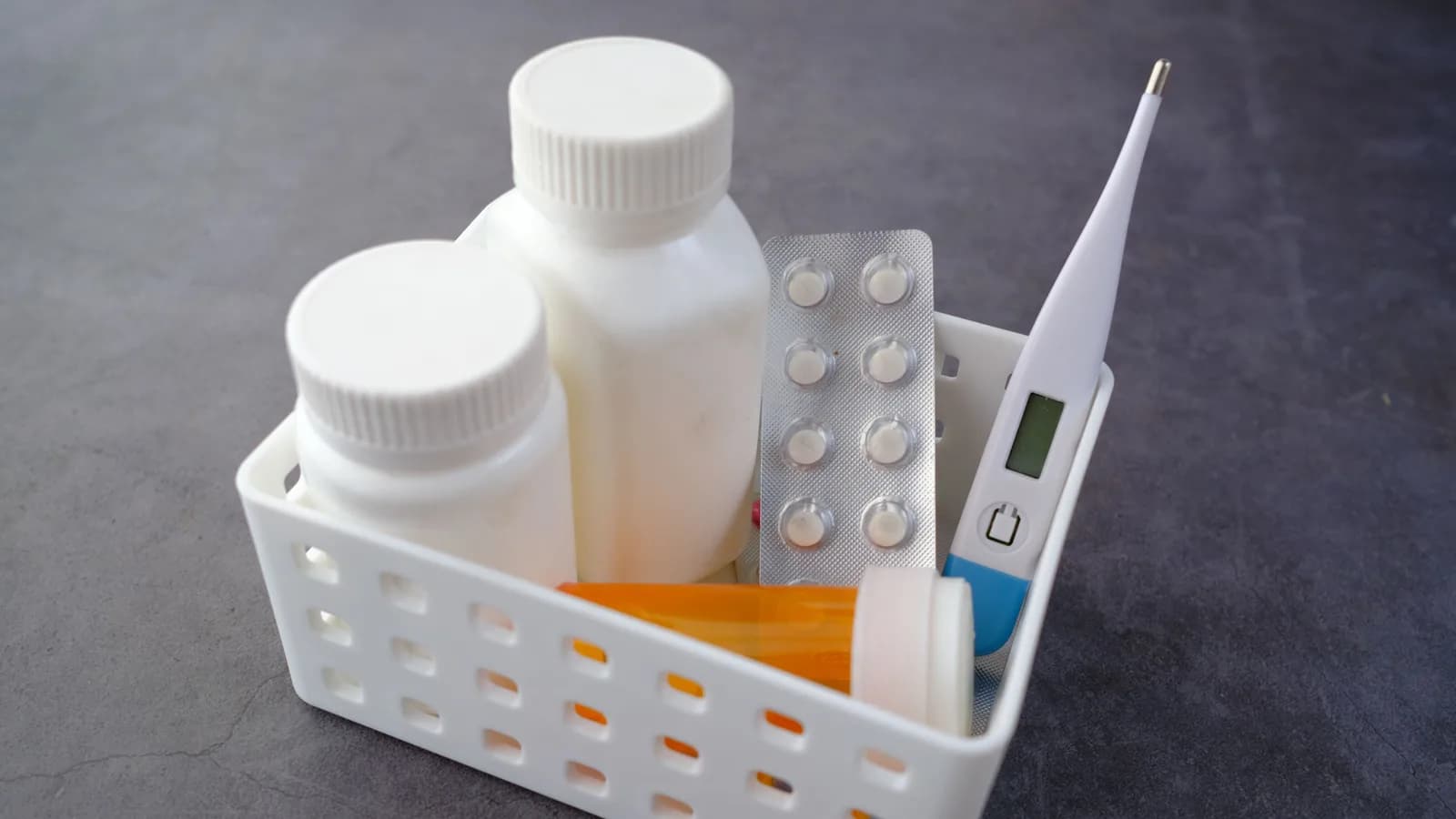
Choose dry, controlled medicine storage, sort expired items safely, and keep a simple inventory without loose pills or easy child access.
To organize a medicine cabinet safely, first decide whether the cabinet is a suitable place for medicine at all. Move medicines away from bathroom heat and moisture unless their labels permit that location, keep them in original child-resistant containers, separate active items from expired or unwanted ones, and store them up, away, out of sight, and locked when children, visitors, or other household risks make access a concern.
Build a small inventory with the medicine name, strength, owner, expiration date, and location. The goal is not a prettier shelf. It is fewer mix-ups and a reliable answer to “what do we already have?”
1. Choose the location before buying organizers
A mirrored cabinet above a bathroom sink is convenient, but that does not make it good medicine storage. FDA guidance warns that damp bathrooms can reduce medicine effectiveness before the printed expiration date. MedlinePlus recommends a cool, dry place away from sinks, stoves, and hot appliances.
Read every label first. A medicine that requires refrigeration, protection from light, a particular temperature range, or another special condition follows its own instructions. Do not put a refrigerated medicine in a household bin merely to keep the categories together.
For most room-temperature medicines, pick a dry location with stable conditions and controlled access. A high closet shelf inside a lockable box can work better than a steamy bathroom. “High” is not enough when a child can climb or another person might misuse or confuse containers. Add a working lock where the risk calls for one.
Keep pet medicines separate enough to prevent a person from grabbing them by mistake, but apply the same child and pet access rules. Never store medicine beside household cleaners. The 4Homes guide to organizing cleaning supplies safely explains how to keep that chemical stock in its own controlled zone.
2. Sort without creating a loose-pill hazard
Clear a well-lit table or counter that children and pets cannot reach. Work with one person’s medicines at a time. Keep every cap closed while you read the label, and do not pour pills into piles or combine two bottles because they look alike.
Make four groups:
- Active medicine that is still needed, within date, and stored as its label directs
- Active medicine with a question about appearance, instructions, duplication, or storage
- Expired, discontinued, unneeded, damaged, or unidentified medicine for disposal
- Non-medicine items that belong in first aid, grooming, dental, or another household zone
Do not decide on your own to keep taking an old prescription, stop a current one, merge duplicate prescriptions, or use medicine prescribed for someone else. Put questionable items in a closed, clearly marked holding box and ask a pharmacist or the prescriber. If a label is unreadable or pills are loose and unidentified, do not guess from color or shape.
Check liquids, creams, drops, inhalers, patches, vitamins, and supplements too. CDC medication-safety guidance includes vitamins and supplements because children may mistake them for treats.
3. Remove expired and unwanted medicine safely
The FDA says the preferred disposal route for most unused or expired prescription and over-the-counter medicines is a take-back option: a permanent collection site, a take-back event, or an authorized mail-back envelope. The Drug Enforcement Administration provides a collection-site locator and sponsors National Prescription Drug Take Back Day. A pharmacist can also explain local options.
If a take-back option is not readily available, check the current FDA directions for the exact medicine. Only medicines on the FDA Flush List should be flushed when take-back is not readily available. For other medicines, FDA household-trash instructions call for removing the medicine from its container, mixing it without crushing with something undesirable such as used coffee grounds, dirt, or cat litter, placing the mixture in a closed container, and removing personal information from empty packaging.
Different products can need different handling. Ask a pharmacist about inhalers, needles, syringes, lancets, chemotherapy medicines, or anything whose label gives special disposal instructions. Do not place loose sharps in a medicine-disposal box or ordinary trash.
4. Build a safer cabinet layout
Arrange storage around access control first. A setup that leaves a non-child-resistant pill organizer on the counter does not meet the safety goal.
| Zone | What belongs there | Safety rule |
|---|---|---|
| Locked active zone | Current prescriptions, over-the-counter medicines, vitamins, and supplements | Original labeled containers; caps fully relocked; access limited to the intended users or caregiver |
| Daily-use section | Only the current medicines used on a regular schedule | Still inside controlled storage; no loose pills or reminder doses on counters |
| Occasional-use section | Current pain, allergy, cold, stomach, and similar products | Group broadly, keep Drug Facts labels visible, and avoid buying a duplicate active ingredient by mistake |
| Question box | Closed containers needing pharmacist or prescriber review | Mark “do not use” and keep it secured until the question is resolved |
| First-aid zone | Bandages, gauze, tape, thermometer, and other non-drug supplies | Keep medicine-containing creams, sprays, or antiseptics under the medicine access rules |
Do not organize by bottle color. Use a broad label such as “Alex — current prescriptions” or “occasional-use medicine,” while leaving pharmacy and manufacturer labels visible. If several people use the storage, separate by person before separating by symptom. That makes it harder to take someone else’s prescription.
Pill organizers can help with a schedule, but many are not child-resistant. Ask a pharmacist whether one fits the prescription routine, keep the original labeled containers, and store the filled organizer inside the controlled zone. A 2020 CDC study of poison-center calls identified child-access cases involving pills moved into non-child-resistant organizers or bags, left out as reminders, or dropped during transfer.
5. Keep a repeatable medicine inventory
Use paper, a note on a secured phone, or a simple spreadsheet. Record only what the household needs; this does not replace a medication list requested by a clinician or pharmacist.
| Field | Example of what to record |
|---|---|
| Medicine | Full label name and strength |
| Owner | Household member or pet |
| Purpose or prescriber | Optional short reference that prevents mix-ups |
| Amount | Approximate supply or unopened backup count |
| Expires | Printed month and year |
| Location | Locked bedroom closet box, refrigerator bin, or other exact place |
| Next action | Refill, ask pharmacist, take back, or none |
Update the line when medicine enters or leaves the house. Each month, scan for low supplies, damaged caps, loose tablets, and the next expiration date. Do a full label-and-expiration review at least once a year.
Keep the inventory where an adult caregiver can find it but a casual visitor cannot. A photo of the current list can help during an appointment, but protect it as personal health information. The same short, location-based method works for the simple freezer inventory, though medicine access and privacy need tighter control.
The 4Homes weekly email
Every Tuesday: what changed for homeowners this week, plus our newest guides.
No spam. Unsubscribe anytime.
What organizers and locks can cost
| Option | Planning cost | What to know |
|---|---|---|
| Reuse a sturdy box or existing cabinet | $0 | Only if the location is dry and access is already controlled |
| Simple labels or index cards | A few dollars | Do not cover pharmacy directions, warnings, or expiration dates |
| Basic cabinet latch | Budget option; compare current local prices | A child-resistant latch can slow a young child, but it is not security against an older child or determined adult |
| Lockable medicine box | Usually costs more than a latch; compare size and lock type | Measure the largest bottles and confirm the box does not violate temperature or refrigeration instructions |
| Pharmacist review | Ask whether there is a charge | Useful when medicines appear duplicated, storage directions conflict, or an organizer is being considered |
Prices and stock change. Child-resistant does not mean child-proof. For diversion, confusion, memory loss, or intentional-access concerns, ask a pharmacist or other qualified professional about a stronger plan rather than relying on a light adhesive latch.
How to save money without weakening safety
Sort before shopping. Most households need less storage after expired and unwanted medicine leaves through the right disposal route. Reuse a dry cabinet or sturdy box when it already provides the required control, and use handwritten labels instead of buying a matched organizer set.
Keep one active container rather than buying duplicates you may not finish before expiration. Check the inventory before purchasing another cold, allergy, or pain product, and compare active ingredients with a pharmacist so low price does not create unsafe duplication. Do not split a prescription among unlabeled bags to save space.
Add the annual review to the seasonal home-care calendar and use the weekend home reset for a quick monthly cap-and-location check.
When to call a pharmacist, clinician, or Poison Control
Call a pharmacist or prescriber when you find duplicate prescriptions, conflicting labels, medicine stored outside its stated conditions, a changed appearance, an unreadable label, loose unidentified pills, or an old prescription you are considering restarting. Ask before crushing tablets, combining containers, pre-splitting a whole supply, or moving medicine into an organizer.
For a possible human exposure in the United States, call Poison Control at 1-800-222-1222 right away. Have the container nearby, but do not make the person vomit unless Poison Control or a medical professional says to. Call 911 for collapse, seizure, severe trouble breathing, or another life-threatening emergency.
For a pet that may have swallowed, touched, or inhaled medicine, call a veterinarian or emergency veterinary clinic right away; ASPCA Animal Poison Control or Pet Poison Helpline can also advise on the product and dose. Do not use the human Poison Control number as the pet plan, and do not induce vomiting unless a veterinary professional directs it.
If a household member repeatedly takes the wrong medicine or cannot manage caps, labels, or a schedule, treat storage as a care-plan issue. A pharmacist, clinician, occupational therapist, or qualified caregiver can help choose a suitable container, lock, label, and reminder system.
Final safety checklist
- Every medicine follows its own temperature, light, moisture, and refrigeration instructions
- Room-temperature stock is in a cool, dry place rather than a damp bathroom
- Original labels are readable and child-resistant caps are fully relocked
- Medicine, vitamins, supplements, pet medicine, and filled pill organizers are up, away, out of sight, and locked when needed
- Expired and unwanted items are secured for take-back or handled by current FDA disposal directions
- No unidentified pills, loose reminder doses, or medicine-filled bags remain on counters or in purses within reach
- The inventory has an owner, strength, expiration date, location, and next action for each active item
- Human Poison Control, 1-800-222-1222, and the veterinarian or emergency veterinary clinic are saved in household phones
Frequently Asked Questions
Should medicine be stored in a bathroom medicine cabinet?
Usually not. FDA and MedlinePlus guidance says heat and moisture from a bathroom can damage many medicines. Follow each label, but a cool, dry, locked cabinet or box outside the bathroom is often the better household location.
What should I do with expired medicine?
Remove it from active storage and use a drug take-back location or prepaid mail-back envelope when available. If that is not readily available, follow the FDA disposal directions for that medicine. Do not flush it unless it is on the FDA Flush List.
Is a pill organizer safe around children?
Many pill organizers are not child-resistant. CDC and Poison Control guidance recommends keeping medicines in original child-resistant containers when possible and storing any organizer up, away, out of sight, and locked when household risk calls for it.
How often should I clean out a medicine cabinet?
Do a full label-and-expiration review at least once a year, and update the inventory whenever a prescription starts, stops, moves, or is disposed of. A short monthly check catches low supplies and loose containers.
When should I call Poison Control about medicine?
In the United States, call Poison Control at 1-800-222-1222 right away if a person may have swallowed, touched, or used the wrong medicine. Call 911 for collapse, seizure, severe trouble breathing, or another life-threatening emergency. For a pet exposure, call a veterinarian, emergency veterinary clinic, or animal poison-control service instead.