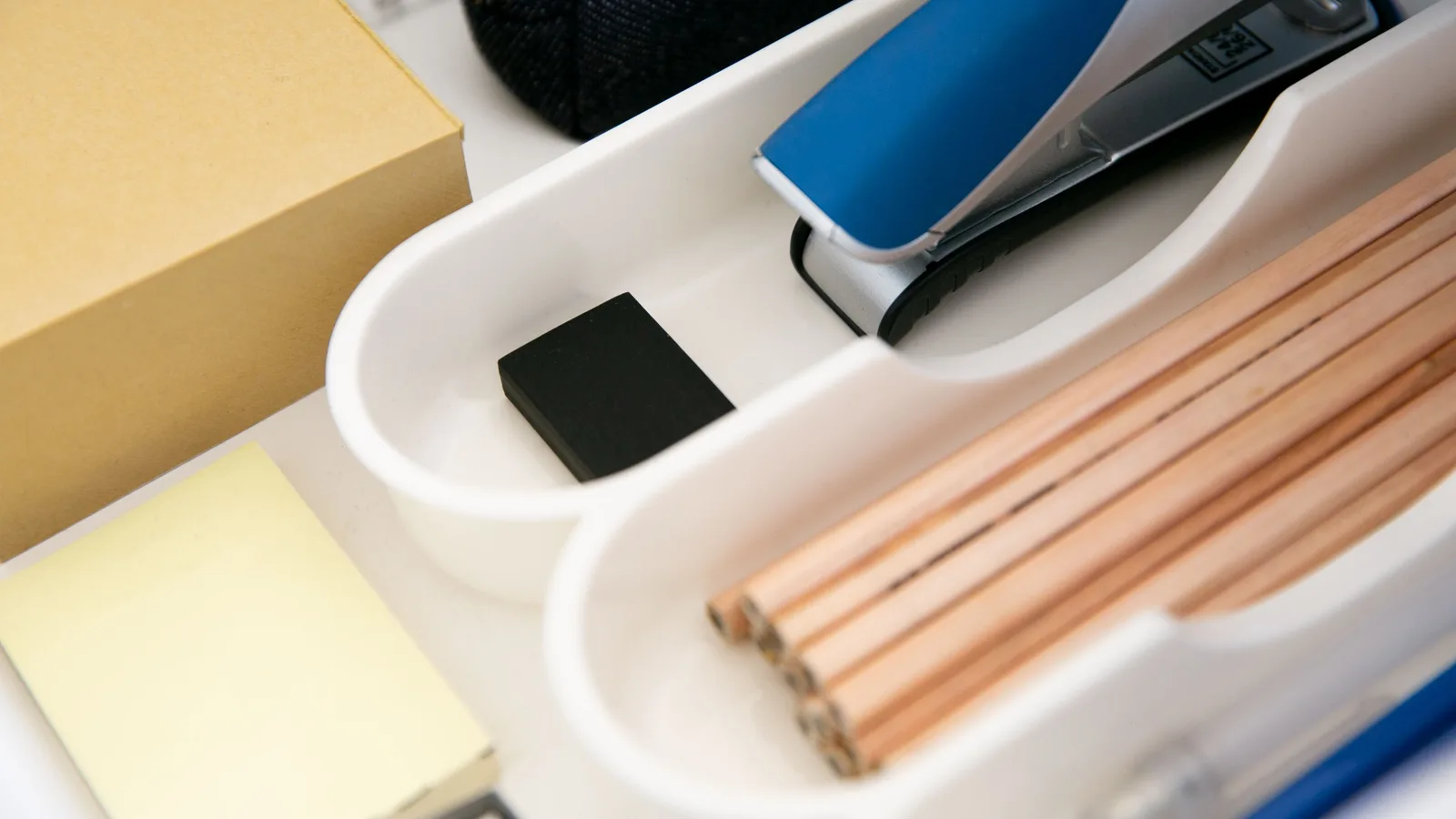
Give the drawer one useful job, sort items by destination, then test measured zones before buying organizers.
Organize a junk drawer by deciding what job the drawer serves, removing everything, and giving only its useful small items a measured return zone. Do not begin with an organizer purchase. First separate daily-use supplies from hazards, backstock, papers, and things that belong elsewhere; then test a simple layout that can be reset in minutes.
A junk drawer is a small convenience station, not a home for every unassigned object. It works when a person can find an item and put it back without moving a pile. Batteries, medicines, records, sharp tools, and mystery hardware need different conditions.
Give the drawer one clear job
Start at the drawer’s actual location. A kitchen drawer might hold a pen, scissors, tape, and a flashlight; an entry drawer might hold a shoehorn, bag clips, or spare house keys. Keep only what solves a nearby recurring need, not a vague category of “miscellaneous.”
Ask whether each item is compact, used nearby and often, and safe to store there. A yes to all four is a reasonable keep. If one answer is no, assign a different home before the drawer closes again.
| Item group | Drawer decision | Better boundary when it does not belong |
|---|---|---|
| Writing tools, tape, small scissors | Keep a limited working set | Move duplicates and craft supplies to a labeled supply area |
| Loose batteries, chargers, cords | Do not mix loose items | Use labeled battery storage and a cable home away from heat and metal |
| Medicine, supplements, chemicals | Do not keep as casual drawer stock | Use original containers and the product’s storage instructions |
| Receipts, warranties, spare keys | Keep only an active, defined set | File records and label keys after confirming the lock they serve |
| Unknown hardware and small tools | Hold briefly only with a purpose label | Move project parts to a labeled bin or dispose of unidentified sharp items safely |
Empty it safely before sorting
Clear a nearby surface and use a tray or towel so small parts do not roll away. Remove everything in one pass. Look for blades, pins, leaking batteries, broken glass, or a sticky spill before reaching in. Wear gloves around sharp objects; do not reach into an unseen tangle of cords and hardware.
Wipe the empty drawer by its finish instructions and let it dry. A liner is optional: use one only to protect a finish or stop containers from sliding, not to hide a drawer with too many jobs.
Sort into five decisions, not one keep pile
Make five groups: keep here, move to a named home, recycle or dispose, repair or identify, and decide later. The important group is “move to a named home.” An object without a destination usually returns by habit. Complete that move before installing dividers.
Test pens and markers, discard expired coupons, and match keys to a current lock. Put project parts with that project. Give an item with no known purpose a short decision deadline rather than a permanent mystery compartment.
Battery safety deserves its own stop point. Do not store loose household batteries with coins, keys, foil, screws, or other metal that can bridge terminals. The U.S. Environmental Protection Agency's Used Household Batteries guidance says used lithium-ion batteries should have their terminals covered with non-conductive tape or be placed in separate plastic bags before separate recycling or household-hazardous-waste collection. Its lithium-ion FAQ says lithium-ion batteries must not go in household garbage or curbside recycling bins. Those EPA directions are for used lithium-ion batteries, not a universal storage rule for every household chemistry. Follow the manufacturer's storage instructions and contact your city or county solid-waste authority or a participating retailer for the local program that accepts the chemistry you have. Do not put a damaged, swollen, leaking, or questionable rechargeable battery into ordinary trash. Our battery storage guide explains the separate storage and disposal plan.
Measure first, then make flexible zones
Measure the inside width, depth, and usable height with the drawer closed. Note rails, latches, a bowed bottom, or hardware that reduces space. Put the most-used category at the front and size each boundary to what you actually kept.
Shallow boxes, sturdy lids, pouches, and removable trays make a no-cost trial. They should lift out easily and let the drawer close without scraping. Avoid tall containers that create a second layer of loose objects.
Leave a small buffer instead of filling every inch. If a category overflows, reduce it or move it; do not automatically add a larger organizer.
Use a seven-step reset
- Name the drawer’s job. Write a one-sentence purpose based on its room and users.
- Empty and inspect it. Protect hands from sharp, leaking, or unknown items.
- Sort by destination. Make separate keep, move, dispose, repair, and decide-later groups.
- Measure the drawer. Record interior dimensions and obstructions before choosing containers.
- Set limited categories. Give each keep group one shallow, easy-to-return zone.
- Test the full drawer. Close it, open it, retrieve a common item, and return it without shifting other groups.
- Review the overflow. Revisit after one week and remove anything that still lacks a practical home.
Keep hazards and records out of the convenience zone
A kitchen or entry drawer is often warm, humid, reachable by children, and shared by visitors. That makes it a poor default for medication, matches, lighters, chemicals, financial documents, sharp blades, and backup batteries. Keep cleaning products in their original labeled containers and follow their storage instructions. Store important home records in a deliberate system, not beside crumbs and tape.
For emergency items, think about access and reliability. A flashlight can be useful in a known front section, but it should be checked and maintained. A fire extinguisher should remain in an accessible, visible location selected for the home, not tucked into a drawer. Use the fire extinguisher guide for that separate decision.
The 4Homes weekly email
Every Tuesday: what changed for homeowners this week, plus our newest guides.
No spam. Unsubscribe anytime.
Spend only after the trial layout fails
Most drawers need no purchase beyond containers already at home. If the trial reveals a real problem, price a shallow adjustable divider, a nonslip tray, or small removable bins only after measuring. Compare the complete fit: interior dimensions, divider height, whether it can be cleaned, whether it blocks the drawer glide, and whether it works when the drawer is not perfectly square.
Save money by limiting duplicates and reusing sound containers. As current retail planning examples, The Container Store lists Everything Organizer Drawer Organizers from $2.99 and the Cambridge 5-Section Expandable Drawer Organizer at $23.99; an off-the-shelf trial can therefore run roughly $2.99 to $23.99 before tax and shipping. That is a supplies range, not a reason to buy one: do not purchase a fitted organizer to preserve a category that should move elsewhere. For larger household storage decisions, the utility closet guide helps establish no-storage zones and a return routine.
Make the return habit obvious
Use a simple rule: when a section is full, edit it before adding another object. Put a short reset on the seasonal list after a move, project, holiday, or school-year change.
If the drawer still fails, create a real home for the category instead of repeatedly reorganizing it. The home maintenance records guide can keep manuals and warranty details out of the catchall.
Sources used
Better Homes & Gardens, How to Clean Out Your Junk Drawer and Keep It Clutter-Free; Reviewed, How to Organize a Junk Drawer; U.S. Environmental Protection Agency, Used Household Batteries and Frequent Questions on Lithium-Ion Batteries; The Container Store drawer-organizer listings for the dated supply-planning range; the named city or county solid-waste authority or participating retailer that accepts the household's battery chemistry; and the storage instructions for the household's own products.
Junk drawer organization FAQs
What should be kept in a junk drawer?
Keep compact, frequently used household items that solve a real need at that location, such as writing tools, tape, a flashlight, or a small set of keys. Medicines, loose batteries, sharp tools, important documents, chemicals, and large backstock need safer or more specific homes.
How do I organize a junk drawer without buying organizers?
Empty the drawer, sort by actual use, measure its interior, and make temporary boundaries with clean shallow boxes, lids, or pouches that fit. Test the layout for a week before buying anything. A container is useful only when it stops a recurring mix-up.
How often should I clean out a junk drawer?
Use a short reset when an assigned section overflows or an item cannot be found, then do a fuller review once or twice a year. The right interval depends on how many people use it and what the drawer is asked to hold.
Can I store batteries in a kitchen junk drawer?
Do not leave loose batteries mixed with keys, coins, foil, or tools. EPA says used lithium-ion batteries should have their terminals taped with non-conductive tape or be placed in separate plastic bags before separate recycling or household-hazardous-waste collection; that direction is not a storage rule for every household battery chemistry. For storage, follow the manufacturer’s instructions for the battery chemistry and keep it in its original packaging or a purpose-made organizer, not a catchall drawer.
How much empty space should a junk drawer have?
Leave enough open space to return the drawer’s normal items without piling them on top of one another. A small intentional buffer is more useful than adding another tightly packed divider, because overflow tells you the category needs editing.
Frequently Asked Questions
What should be kept in a junk drawer?
Keep compact, frequently used household items that solve a real need at that location, such as writing tools, tape, a flashlight, or a small set of keys. Medicines, loose batteries, sharp tools, important documents, chemicals, and large backstock need safer or more specific homes.
How do I organize a junk drawer without buying organizers?
Empty the drawer, sort by actual use, measure its interior, and make temporary boundaries with clean shallow boxes, lids, or pouches that fit. Test the layout for a week before buying anything. A container is useful only when it stops a recurring mix-up.
How often should I clean out a junk drawer?
Use a short reset when an assigned section overflows or an item cannot be found, then do a fuller review once or twice a year. The right interval depends on how many people use it and what the drawer is asked to hold.
Can I store batteries in a kitchen junk drawer?
Do not leave loose batteries mixed with keys, coins, foil, or tools. EPA says used lithium-ion batteries should have their terminals taped with non-conductive tape or be placed in separate plastic bags before separate recycling or household-hazardous-waste collection; that direction is not a storage rule for every household battery chemistry. For storage, follow the manufacturer’s instructions for the battery chemistry and keep it in its original packaging or a purpose-made organizer, not a catchall drawer.
How much empty space should a junk drawer have?
Leave enough open space to return the drawer’s normal items without piling them on top of one another. A small intentional buffer is more useful than adding another tightly packed divider, because overflow tells you the category needs editing.