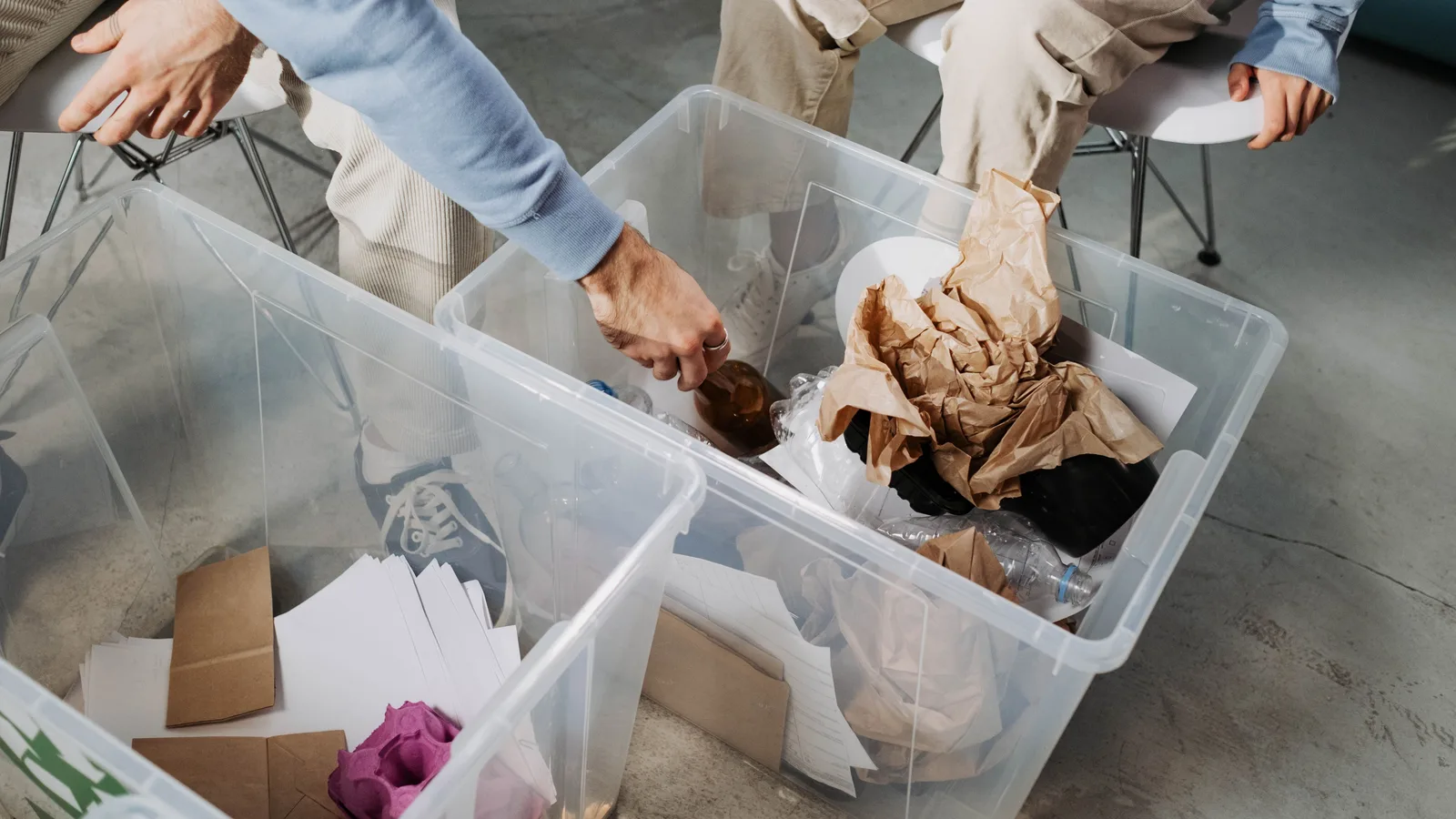
Match the local collection rules, build only the streams the household needs, and keep special or uncertain materials out of curbside bins.
Build a home recycling station from the rules of the program that actually collects your material, not from the chasing-arrows symbol on a package. List the accepted curbside streams, give each one a washable container close to where it is used, and keep depot-only, hazardous, and uncertain items out of the main bins.
The best station is not the one with the most compartments. It is the one every person in the home can use correctly in a few seconds. My view: a plain bin with a current local label beats a polished five-bin cabinet that sorts materials the hauler later asks you to combine.
Start with the local rules
Find the current list from the city, county, transfer station, or contracted hauler. Record whether collection is single-stream or separated, what containers are accepted, whether lids stay on, how clean and dry material must be, and whether cardboard has a size limit. Save the page or pickup calendar in the home maintenance records so the household can check it after a program change.
Do not sort by the resin number alone. EPA explains that the number inside the triangle identifies plastic resin but does not necessarily mean the item is accepted in the community. The local list controls. Packaging that looks recyclable may be excluded because of its size, coating, shape, food residue, mixed materials, or the equipment used by the local processor.
| Material | Station decision | Common mistake |
|---|---|---|
| Accepted curbside containers | Use the exact local stream and preparation rule | Adding an item because its package shows a recycling symbol |
| Clean paper and cardboard | Keep dry; flatten or size as directed | Mixing wet or food-soiled paper with usable fiber |
| Plastic bags and film | Use only a confirmed retail or depot program | Bagging curbside recyclables in plastic |
| Batteries, bulbs, electronics, paint | Create a separate controlled route | Treating special collection as another open kitchen bin |
| Unknown item | Put it in a question box until the rule is verified | Wish-cycling it into the accepted stream |
Measure the waste route before buying bins
For one ordinary week, note where accepted cans, bottles, paper, and boxes are discarded. Measure the available width, depth, height, door swing, drawer travel, plumbing, vents, receptacles, and carrying route to the outdoor cart or collection point. A large bin that blocks a dishwasher, narrows an exit, or becomes too heavy to lift is not an improvement.
Choose the smallest indoor capacity that reaches the next convenient emptying time without overflow. Frequent transfer keeps residue and insects from building up. In a small kitchen, one mixed-recycling tote may match a single-stream program better than several narrow compartments. Where sorting is required, give the highest-volume stream the largest container instead of dividing the cabinet evenly.
Do not mount pull-outs or hooks until you know what is behind the cabinet. Plumbing, wiring, appliance clearances, and thin cabinet panels can turn a storage project into damage. Use a cabinet professional when installation requires drilling near unknown utilities, altering a pull-out, or repairing water-damaged material.
Use labels that answer the real questions
Label each container with three to six accepted examples and two or three common exclusions. “Mixed recycling” is less useful than “empty cans, bottles, jars, mail; no bags, food, or cords.” Use the same names and images as the local program. If a bilingual or picture label helps the household, make that the main label rather than a small footnote.
Put a small lidded question box nearby for clean, dry uncertain items. Check it on collection day. This slows one doubtful package without slowing the whole routine. Never use the question box for leaking products, loose medicine, damaged batteries, needles, chemicals, or anything that creates a fire, poisoning, or puncture risk.
Prepare material without turning recycling into dishwashing
- Empty the contents. Food and liquid belong in the route required by the local program, not in recycling.
- Scrape or rinse only as needed. EPA describes “spatula-clean” as clean enough for food residue in its general guidance; local requirements can differ.
- Let wet containers drain. Keep moisture away from paper and closed cabinets.
- Flatten only when directed. Flatten accepted boxes to save space, but do not crush containers when the program needs their shape for sorting.
- Leave or remove parts as directed. Caps, labels, pumps, and sleeves are program-specific.
- Transfer loose. Do not put a sealed plastic bag of recyclables into a curbside cart unless the collector explicitly requests it.
EPA says plastic bags and wraps generally do not belong in household recycling bins, although some stores accept them separately. A drop-off program may reject wet, dirty, painted, or non-film material. Confirm the location is still participating before storing a large pile.
Keep special materials out of the kitchen stream
Batteries, electronics, lamps, paint, chemicals, used oil, medical sharps, and propane cylinders have their own hazards and local pathways. Do not create one “special recycling” tub that lets incompatible, leaking, sharp, or energized items collect together. Use the household battery storage guide for terminal protection and damaged-battery boundaries, and the leftover paint guide for container and disposal decisions.
Stop and get program-specific help for a battery that is swollen, hot, hissing, leaking, damaged, or recalled; a leaking chemical; an unknown liquid; a sharp object; or a container with pressure or fuel remaining. Keep people and pets away. Do not place it in a curbside cart, compact it, or improvise a mixed storage container.
The 4Homes weekly email
Every Tuesday: what changed for homeowners this week, plus our newest guides.
No spam. Unsubscribe anytime.
Plan costs from zero upward
Start with a no-purchase trial: reuse washable containers, a sturdy paper bag for clean dry paper, and labels made from scrap card. That test will show whether the household needs one container, several separated streams, lids, or a different carrying route before money is spent.
Compare the complete usable system rather than a bin by itself: containers, lids, liners if the program allows them, labels, cabinet hardware, delivery, installation, and the cost of replacing a bin that cannot be cleaned. Get a written installed quote if the plan requires a pull-out, cabinet alteration, or drilling near utilities. Buy only after a one-week cardboard-box trial proves the dimensions and stream split.
Save money by matching the program instead of the catalog. Reuse existing containers, add one bin at a time, and keep the carrying distance short enough that the station is emptied on schedule. Reducing and reusing come before recycling in EPA's waste-management hierarchy, so preventing an unnecessary purchase can be a better result than buying a container for it.
Run a weekly reset
- Move accepted material to the outdoor cart before indoor bins overflow.
- Resolve the question box against the current local list.
- Wipe and fully dry any soiled container by its care instructions.
- Remove paper from any area that has become damp.
- Check the floor, cabinet base, and wall for leakage or pest evidence.
- Return depot-only items to their controlled storage route.
If the station repeatedly smells, leaks, or attracts pests, reduce indoor holding time and verify that containers are emptied and prepared correctly. Fix a plumbing leak or wet cabinet before reorganizing around it. The under-sink organization guide can help preserve access to pipes and shutoffs when that is the only available zone.
Sources used
U.S. Environmental Protection Agency guidance on recycling basics and common recyclables, plus the current city, county, or hauler acceptance list for the home.
Home recycling station FAQs
How do I set up a recycling station at home?
Copy the categories and preparation rules from your current local hauler or public-works list, then place one easy-to-clean container for each accepted stream near the place those items are discarded. Add a small question box for uncertain items, label with examples instead of symbols alone, and empty the indoor containers before they overflow.
Should recycling be rinsed before it goes in the bin?
Use your local program's preparation rules. EPA says containers with food debris cannot be recycled and describes scraping or rinsing residue until a container is spatula-clean as sufficient in its general guidance. Do not waste hot water trying to make packaging look new, and do not put a wet paper item into a dry-paper stream.
Can plastic bags go in a curbside recycling bin?
Usually not. EPA says plastic bags, wraps, and films cannot go in household recycling bins even though some retail collection programs accept them. Confirm a participating drop-off and its exact preparation rules; otherwise follow the local disposal direction rather than putting a bag of bags into curbside recycling.
How can I organize recycling in a small kitchen?
Use the fewest containers your local collection actually requires. A washable tote, paper bag for clean dry paper, or narrow pull-out can work when it remains stable, does not block plumbing or exits, and can be carried safely. Flatten accepted cardboard and move depot-only items to a separate controlled location instead of adding a bin for every material.
Where should batteries and electronics be stored for recycling?
Keep them out of the ordinary curbside station unless the local program explicitly accepts them. Follow the product and local collection instructions, protect battery terminals when required, separate damaged or recalled batteries, and use a dry location away from heat, children, pets, and combustible clutter. A swollen, leaking, hot, or damaged battery needs immediate program-specific guidance.
Frequently Asked Questions
How do I set up a recycling station at home?
Copy the categories and preparation rules from your current local hauler or public-works list, then place one easy-to-clean container for each accepted stream near the place those items are discarded. Add a small question box for uncertain items, label with examples instead of symbols alone, and empty the indoor containers before they overflow.
Should recycling be rinsed before it goes in the bin?
Use your local program's preparation rules. EPA says containers with food debris cannot be recycled and describes scraping or rinsing residue until a container is spatula-clean as sufficient in its general guidance. Do not waste hot water trying to make packaging look new, and do not put a wet paper item into a dry-paper stream.
Can plastic bags go in a curbside recycling bin?
Usually not. EPA says plastic bags, wraps, and films cannot go in household recycling bins even though some retail collection programs accept them. Confirm a participating drop-off and its exact preparation rules; otherwise follow the local disposal direction rather than putting a bag of bags into curbside recycling.
How can I organize recycling in a small kitchen?
Use the fewest containers your local collection actually requires. A washable tote, paper bag for clean dry paper, or narrow pull-out can work when it remains stable, does not block plumbing or exits, and can be carried safely. Flatten accepted cardboard and move depot-only items to a separate controlled location instead of adding a bin for every material.
Where should batteries and electronics be stored for recycling?
Keep them out of the ordinary curbside station unless the local program explicitly accepts them. Follow the product and local collection instructions, protect battery terminals when required, separate damaged or recalled batteries, and use a dry location away from heat, children, pets, and combustible clutter. A swollen, leaking, hot, or damaged battery needs immediate program-specific guidance.