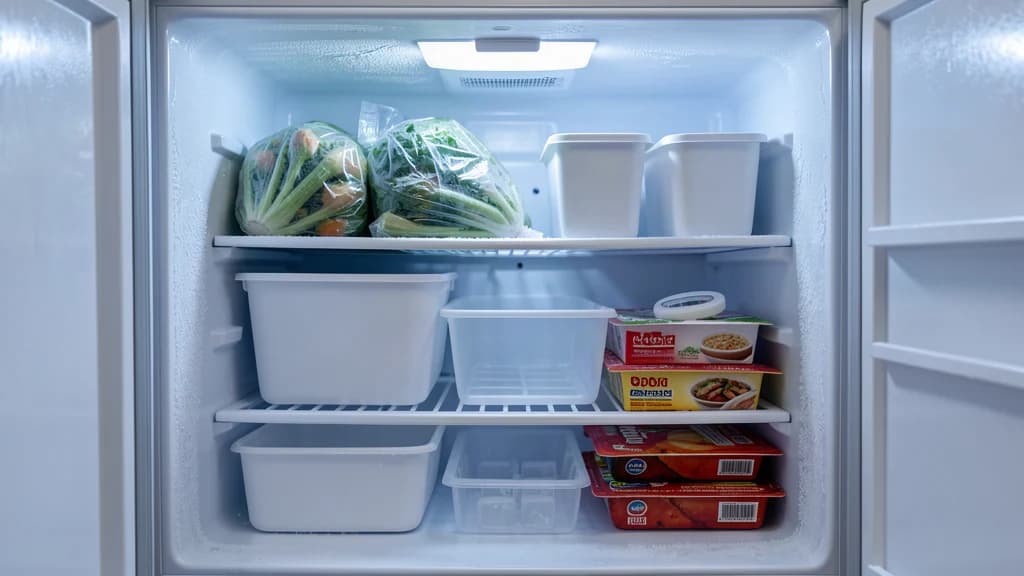
Create visible food zones, keep a short quantity list, hold 0°F, and use older food first without confusing quality dates with safety cutoffs.
A clean, labeled freezer with a one-page inventory list keeps food safe, cuts waste, and makes a power outage less stressful. You do not need a system of forty bins—just a few zones, a thermometer, and a habit of checking the list every time you open the door.
Know Your Freezer's Zones
Different freezer styles store food in different ways. The table below lays out the practical differences so you can match your layout to the space you actually have.
| Zone / Style | What It Handles Best | Watch Out For |
|---|---|---|
| Top-freezer refrigerator | Everyday food in a compact compartment above the refrigerator | Items at the back can be forgotten; confirm that bins do not block vents or the door seal |
| Bottom-freezer refrigerator | Frequently used frozen food kept below the refrigerator compartment | Access may be through a door, drawer, or baskets; organize around the exact model's layout |
| Drawer freezer | Small everyday items grouped in shallow sections | Limited vertical space; overfilled bags or bins can obstruct closing |
| Upright (standing) freezer | Shelves let you sort by category and see items at a glance | Packages can fall forward or block vents when shelves are overfilled |
| Chest freezer | Long-term storage, bulk buys, backup for outages | You bend down; items buried at the bottom are the first to be forgotten |
No matter which style you have, group by category and label by date. Follow the appliance manual for vent locations, loading limits, and required air clearances rather than leaving arbitrary empty space.
Set the Right Temperature
USDA Food Safety and Inspection Service guidance says to keep a freezer at 0 °F or below. Use a dedicated appliance thermometer and check the reading once a month. Place it where the appliance instructions recommend and wait long enough for the temperature to stabilize before changing the control.
Build the Inventory in Ten Minutes
You do not need an app. A small index card or a page taped to the inside of the freezer door works.
- Column 1 – Item name (e.g., "chicken thighs, 2 lb bag")
- Column 2 – Date frozen
- Column 3 – Use-by / quality window
USDA FSIS notes that food held continuously at 0 °F remains safe indefinitely, but quality—flavor, texture, color—declines over time, and the window varies by food type. Use the food-specific USDA freezer-storage chart or the package guidance rather than applying one date to every item. Write that quality window on the card so you use food before texture and flavor decline.
Every time you put something new in, add one line. Every time you take something out, cross it off. That is the whole system. For a similar list with tighter privacy, expiration, and access rules, use the safe medicine-cabinet inventory.
A Simple Monthly Reset Checklist
Tie this to your weekend-home-reset routine so it does not slip. Once a month, set a timer for twenty minutes:
- Check the thermometer reading. If it sits above 0 °F, follow the appliance manual before changing the control.
- Pull the inventory card. Cross off anything you used; add anything new.
- Look for freezer burn (white, dry patches) or off smells. Move older food to a use-next bin; a quality window is not an automatic safety discard date.
- Wipe ordinary spills and note unusual frost; follow the appliance manual before defrosting or removing ice.
- Make sure the door seals flat. If you notice a gap or the seal looks cracked, run through the refrigerator-door-not-sealing-first-checks steps before calling anyone.
- Rearrange: move the oldest items to the front, newest to the back.
- Note the freezer's fill level on the card (full, ¾, ½). This matters during outages—see below.
Outages and the "Keep It Full" Rule
USDA guidance is straightforward: an unopened full freezer keeps food safe for roughly 48 hours; a half-full freezer drops to about 24 hours. If a storm is forecast, fill some empty space with sealed containers of potable water or foods you already use, while preserving the air clearances required by the appliance manual. Keep the door closed during the outage. This low-cost preparation fits neatly into a monthly home-cost audit.
The 4Homes weekly email
Every Tuesday: what changed for homeowners this week, plus our newest guides.
No spam. Unsubscribe anytime.
When to Call an Appliance Pro
Owner work should stay within the appliance manual: checking settings, temperature, packaging, clearance, and an accessible gasket. Call a qualified appliance technician when:
- The freezer remains above 0 °F after settings and door closure are checked by the manual, or food is thawing.
- You hear a loud grinding, clicking, or continuous humming that was not there before.
- Abnormal or recurring ice buildup returns after you follow the appliance manual's defrost procedure.
- The unit runs continuously, trips protection, smells hot, or has damaged wiring or a wet electrical area.
- The door gasket is torn or warped and you cannot get a proper seal after the first-checks steps above.
Ask for diagnosis, labor, parts, sealed-system work, and warranty coverage as separate line items. Compare a repair quote with replacement only after the fault is identified; keep the model, serial number, warranty, and service records with the house file.
Organizers and What They Cost
You do not need a matching set of acrylic bins. A few stackable plastic or wire bins, a roll of freezer-safe labels, and a permanent marker will do.
- Simple freezer bins: Walmart examples ranged from $9.62 for one Walmart freezer-safe bin to $39.99 for a four-bin Walmart set. Target listed freezer-safe bins at $14 for one extra-large bin and $22.49 for a two-pack. Measure first; ordinary food-safe containers you already own may cost nothing.
- Appliance thermometer: Home Depot listed one freezer thermometer at $11.99. Check the appliance manual before choosing its placement.
- Inventory card and labels: reuse an index card, paper, tape, and a marker already in the house when possible, then replace only what will not remain legible at freezer temperature.
A basic system can cost $0 when you reuse suitable containers and paper. If you buy bins and a thermometer, use the dated examples above as comparison points rather than a promised total.
Ways to Save Money and Avoid Waste
- Batch-cook and freeze in meal-sized portions. Label each bag with the recipe name and date. You skip the "what's in this bag?" problem and the "we'll order takeout" default.
- Freeze in the order you will use it. Oldest items in front, newest in back. This is the single biggest waste-reducer.
- Prepare for outages. USDA's 48-hour estimate applies to a full unopened freezer, compared with about 24 hours for a half-full unopened freezer. Keep the door closed and make room for foods you actually use rather than filling every air path.
- Follow the appliance manual for defrosting. Frost patterns and defrost procedures vary by model. Tie the manual's inspection and cleaning steps to your monthly reset checklist.
- Check the door seal monthly (part of the checklist above). A failed seal lets warm, moist air enter and deserves correction.
- Track what you throw out. If you find yourself tossing the same item every month, adjust how much you buy or how you portion it. This feeds directly into your monthly-home-cost-audit.
Freezer organization FAQs
How often should I check the freezer thermometer?
Monthly is a practical routine for a stable unit. Check again after an outage, a move, a setting change, or any sign that food is softening.
Does food become unsafe when its freezer quality window ends?
Not automatically. USDA says food held continuously at 0°F remains safe, although quality declines. Time above safe temperatures, contamination, damaged packaging, and outage history are separate safety questions.
Can raw meat and cooked food share a freezer?
Yes, when each item is sealed against leaks and cross-contact and the freezer remains at 0°F or below. Use separate bins or shelves so a damaged raw package cannot drip onto ready-to-eat food.
How do I keep food from disappearing at the bottom of a chest freezer?
Use a few lift-out category bins, keep a use-next bin near the top, and maintain a simple quantity list outside the freezer. Update it when food goes in or comes out.
Frequently Asked Questions
How often should I check the freezer thermometer?
Monthly is a practical routine for a stable unit. Check again after an outage, a move, a setting change, or any sign that food is softening.
Does food become unsafe when its freezer quality window ends?
Not automatically. USDA says food held continuously at 0°F remains safe, although quality declines. Time above safe temperatures, contamination, damaged packaging, and outage history are separate safety questions.
Can raw meat and cooked food share a freezer?
Yes, when each item is sealed against leaks and cross-contact and the freezer remains at 0°F or below. Use separate bins or shelves so a damaged raw package cannot drip onto ready-to-eat food.
How do I keep food from disappearing at the bottom of a chest freezer?
Use a few lift-out category bins, keep a use-next bin near the top, and maintain a simple quantity list outside the freezer. Update it when food goes in or comes out.