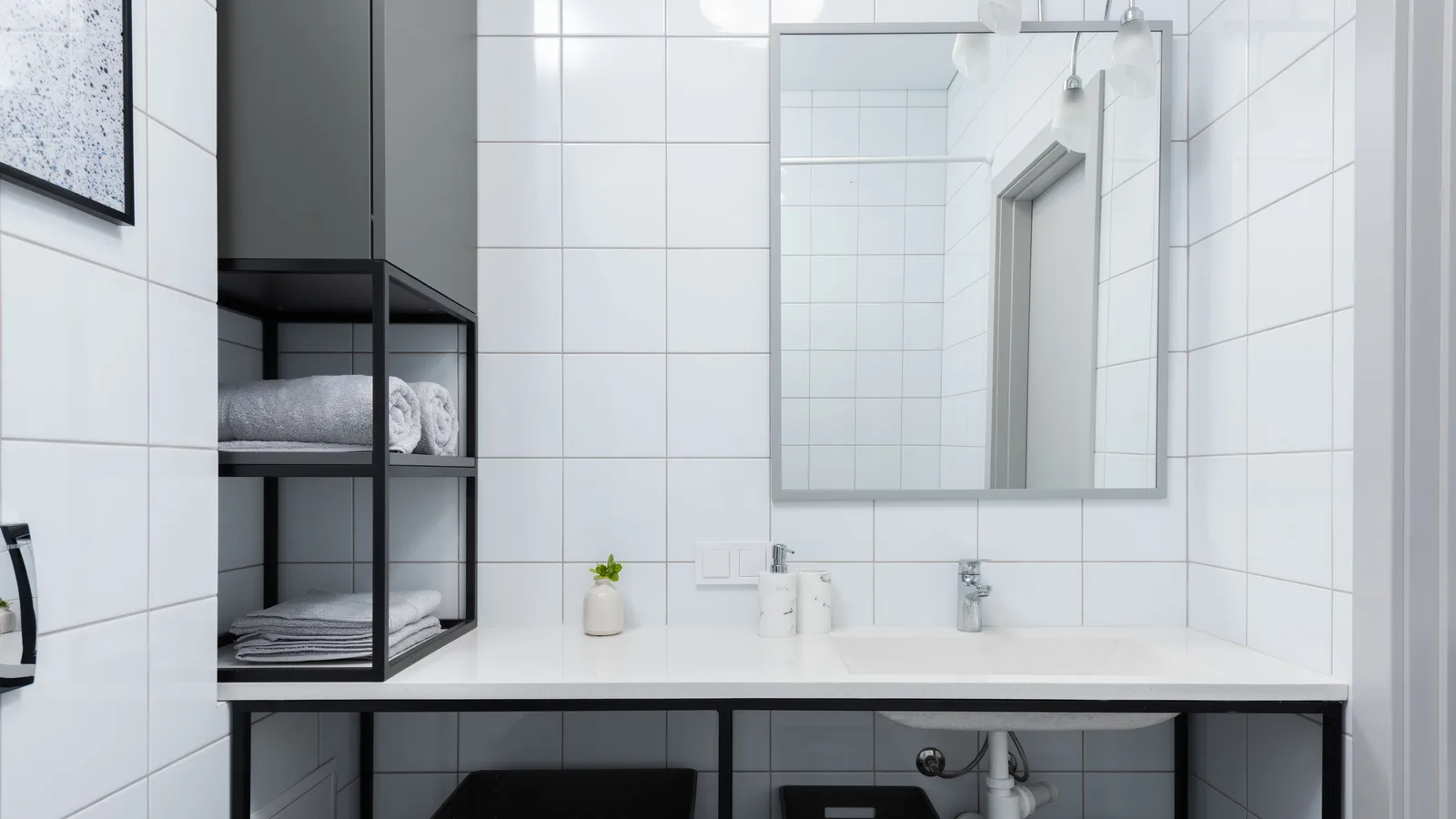
Measure around the plumbing, give daily supplies an easy return path, and keep every leak clue and shutoff visible.
Empty the cabinet, check for leaks, then measure around the plumbing before buying organizers. Keep daily toiletries in removable bins at the easiest reach, put limited backstock behind or above them, and leave every shutoff, drain joint, outlet, and wet spot visible. Medicines and hazardous cleaners generally belong somewhere cooler, drier, and secured.
Make the cabinet safe before making it neat
Take everything out and set it on a towel. Look at the cabinet floor, back wall, supply lines, shutoff valves, drain trap, faucet connections, and any outlet. A warped base, swollen particleboard, peeling finish, staining, corrosion, active drips, musty odor, or softened material is not an organizing problem. Photograph what you find and fix the water source first.
Do not tighten plumbing joints just because they look damp, and do not handle or reenergize water-damaged electrical equipment. Stop using the sink and call a plumber for an active leak you cannot isolate safely. The Electrical Safety Foundation International recommends having water-damaged electrical equipment evaluated by a qualified electrician. For mold, the U.S. Environmental Protection Agency says homeowners can usually handle an area under about 10 square feet; consult its remediation guidance when growth covers more than 10 square feet or there has been a lot of water damage. Fix the moisture source and dry the cabinet before filling it again.
Now edit what came out. Throw away empty packaging and dispose of unwanted products according to their labels and local rules. Do not pour mixed leftovers down the drain. The cleaning-supplies safety guide covers original containers, locked storage, incompatible products, and disposal planning in more detail.
Keep the wrong things out
A bathroom sink cabinet is low, often humid, and directly below water connections. That makes it a poor default home for several common categories.
| Item | Better decision | Reason |
|---|---|---|
| Prescription and over-the-counter medicine | Use a secure cool, dry location that follows the label | The FDA says damp bathroom storage can reduce effectiveness |
| Hazardous cleaners | Keep in original containers in locked storage away from children | CPSC and Poison Control warn against accessible low cabinets |
| Paper backstock | Store in a dry linen or supply area | A slow leak can ruin an entire package before it is noticed |
| Hair dryers, trimmers, and other electrical tools | Store dry and unplugged away from the leak zone | Cords and appliances should not sit below plumbing |
| Daily toiletries | Use washable removable bins | The whole category can be lifted out for cleaning and leak checks |
Child-resistant packaging is not a substitute for secure storage. The U.S. Consumer Product Safety Commission says medications and household cleaners should be locked up and kept out of children's reach. Poison Control calls an unlocked low kitchen or bathroom cabinet one of the most dangerous places for cleaners. If a child, pet, guest, or vulnerable adult can reach the cabinet, choose a different location or a lock that controls the whole hazardous category.
Measure the cabinet as four separate spaces
Under-sink storage fails when the cabinet is treated as one empty box. It is really four spaces: left of the plumbing, right of the plumbing, below the trap, and the door zone. Each has a different height and depth.
- Measure the clear opening. Record the width and height between the face frame, hinges, and door hardware. The interior can be wider than the opening, which does not help a rigid organizer get through the door.
- Map the plumbing. Measure from each side wall to the nearest pipe, from the cabinet floor to the lowest part of the trap, and from the door opening to the back wall. Note valves, flexible supply lines, cleanouts, disposal switches, and outlets.
- Test door and drawer travel. Open both doors fully. Mark where hinges, knobs, and a center stile reduce usable width. A pull-out must clear all of them while loaded.
- Protect a service lane. Leave enough open space to see and reach shutoffs and drain joints without unloading a fixed shelf. A plumber should not have to dismantle the storage system to stop water.
Use cardboard to mock up a bin or drawer before ordering. Cut the footprint, stand a second piece at the proposed height, and move it through the door opening. This catches the classic mistake: an organizer fits inside the cabinet but cannot pass the hinge or clear the trap when pulled forward. The same measure-first habit works in the kitchen cabinet organization guide, but the bathroom version gives plumbing access priority.
Build a simple daily-use layout
Put the items used every day in one front bin per person or routine. Skin care can be one category; hair care another. Small loose items need a shallow tray or divided cup inside the bin, not a deeper bin that becomes a junk drawer. Keep tall bottles upright where the cap cannot catch the trap or shelf above.
Backstock gets one bounded bin behind or beside daily supplies. One open bottle plus one replacement is usually easier to manage than several partial duplicates, but let actual use set the limit. Write the category on the front rather than the lid so it stays readable in the cabinet.
Use the low middle only for a shallow, removable item that does not touch or hide the trap. Keep a clear patch of cabinet floor under vulnerable joints so a drip is visible. A light-colored washable tray can make water easier to spot, but it is not waterproofing and should not conceal the cabinet base. A simple leak alarm may add warning in a high-consequence location; the leak-detector buying guide explains local alarms, placement, and testing.
Our view: a little unused space around plumbing is better than a cabinet packed to its theoretical capacity. That empty lane is what lets you find a leak, close a valve, clean the base, and remove a bin without an avalanche.
Choose organizers that can come back out
Start with containers you already own. A washable shoebox-size bin, small caddy, or low tray may solve the problem without a fitted system. Clear sides help with inventory; opaque sides reduce visual clutter. Handles matter more than matching colors because the useful move is lifting a whole category out.
A two-tier organizer can use vertical space beside the trap, but measure the loaded height of both levels. Check that bottles clear the upper shelf and that the top does not press against supply lines. Freestanding pull-outs need a stable base and enough forward clearance. Load one with the actual products, pull it through its full travel, and make sure it does not tip, rack, scrape the door, or tug a pipe.
Avoid permanent drilling unless the organizer instructions, cabinet construction, and hidden conditions are known. Sink cabinets can have plumbing and wiring immediately behind their panels. Adhesive mounts also need a clean compatible surface and may damage weak finishes. When the cabinet is rented, recently repaired, or made from swollen material, removable bins are the safer bet.
The 4Homes weekly email
Every Tuesday: what changed for homeowners this week, plus our newest guides.
No spam. Unsubscribe anytime.
What under-sink organization costs in 2026
A retail snapshot checked October 12, 2026 gives a useful budget ladder without pretending every cabinet needs the same product. The Container Store listed its Narrow Stackable Plastic Utility Bin Clear at $4.49 on sale, with a regular price of $8.99. The regular prices were $39.99 for its Double Drawer Wire Pull-Out Cabinet Organizer and $49.99 for its Expandable Under Sink Organizer. These are verified item prices, not a market-wide range; sale prices, stock, dimensions, and promotions can change.
| Approach | Typical cost basis | Best use |
|---|---|---|
| Reuse containers already owned | $0 before labels or shelf liner | Testing categories and positions |
| Simple removable bin | $4.49 sale price; $8.99 regular price for the named Container Store utility bin | Daily toiletries and controlled backstock |
| Pull-out or pipe-fitting system | Regular prices of $39.99 for the named double-drawer pull-out and $49.99 for the named expandable under-sink organizer at The Container Store | Deep side zones with verified clearance |
| Plumbing or cabinet repair | Written local quote after diagnosis | Leaks, damaged shutoffs, swollen material, or hidden moisture |
Do not buy a cabinet-wide kit before the leak check and cardboard test. The organizer is the last decision, not the first.
Save money by running a two-week test
Reset the cabinet with reused containers, then live with it for two weeks. Notice what gets left on the counter, what falls behind a bin, and which category is hard to return with one hand. Move the category before buying a different container. This test also shows whether the household needs less inventory rather than more storage.
Buy one organizer at a time and keep the receipt until it passes loaded clearance. Compare outside dimensions, usable inside dimensions, handle projection, and return terms. A cheaper bin that wastes half the opening is not cheaper; neither is an elaborate pull-out that has to be removed whenever a shutoff is needed.
Add the finished cabinet to a short weekend home reset: lift the front bins, look for moisture, wipe the base, and return stray items. If a broader bathroom update is planned, settle leaks and ventilation before storage and finishes with the bathroom refresh priorities.
Under-bathroom-sink checklist
- Empty the cabinet and photograph plumbing, valves, outlet, and cabinet condition.
- Stop for active leaks, wet electrical equipment, swollen material, or suspected hidden mold.
- Move medicines to a label-approved cool, dry, secure location.
- Move hazardous cleaners to locked storage out of children's reach.
- Measure the opening, left zone, right zone, under-trap height, hinges, and door swing.
- Keep shutoffs, drain joints, and the cabinet base visible and reachable.
- Put daily supplies in front and cap backstock with one defined bin.
- Test organizer footprints with cardboard and test pull-outs while loaded.
- Run the layout for two weeks before buying the next container.
- Lift bins and check for moisture during a brief weekly reset.
Frequently Asked Questions
What should not be stored under a bathroom sink?
Do not use a damp, unlocked bathroom cabinet for medicines or hazardous cleaners. The FDA says bathroom moisture can reduce the effectiveness of many medicines, and the U.S. Consumer Product Safety Commission says medicines and cleaners should be locked up and kept out of children's reach. Also move paper goods, spare electronics, and anything that would be ruined by a small leak to a dry location.
How do I organize around the drain pipe?
Measure the cabinet as separate left, right, and under-trap zones instead of one rectangle. Put narrow bins or a short drawer unit beside the pipe, reserve the low middle area for shallow items if it stays clear of the trap, and leave a visible service lane to every shutoff, slip joint, cleanout, and outlet.
Are pull-out organizers safe under a sink?
A freestanding pull-out can work if its loaded drawer clears the plumbing, hinges, door, and cabinet lip through its entire travel and cannot tip. Do not drill into a cabinet wall or floor until you know what is behind it. Skip a pull-out that hides a leak, blocks a shutoff, or requires forcing the door around it.
How do I keep an under-sink cabinet organized?
Give the cabinet a strict job: daily bathroom supplies in front, limited backstock in a labeled bin, and no unrelated overflow. Return items to the same category, wipe the base during a quick weekly check, and reassess after two weeks. If a category keeps landing outside its bin, the bin or category is in the wrong place.