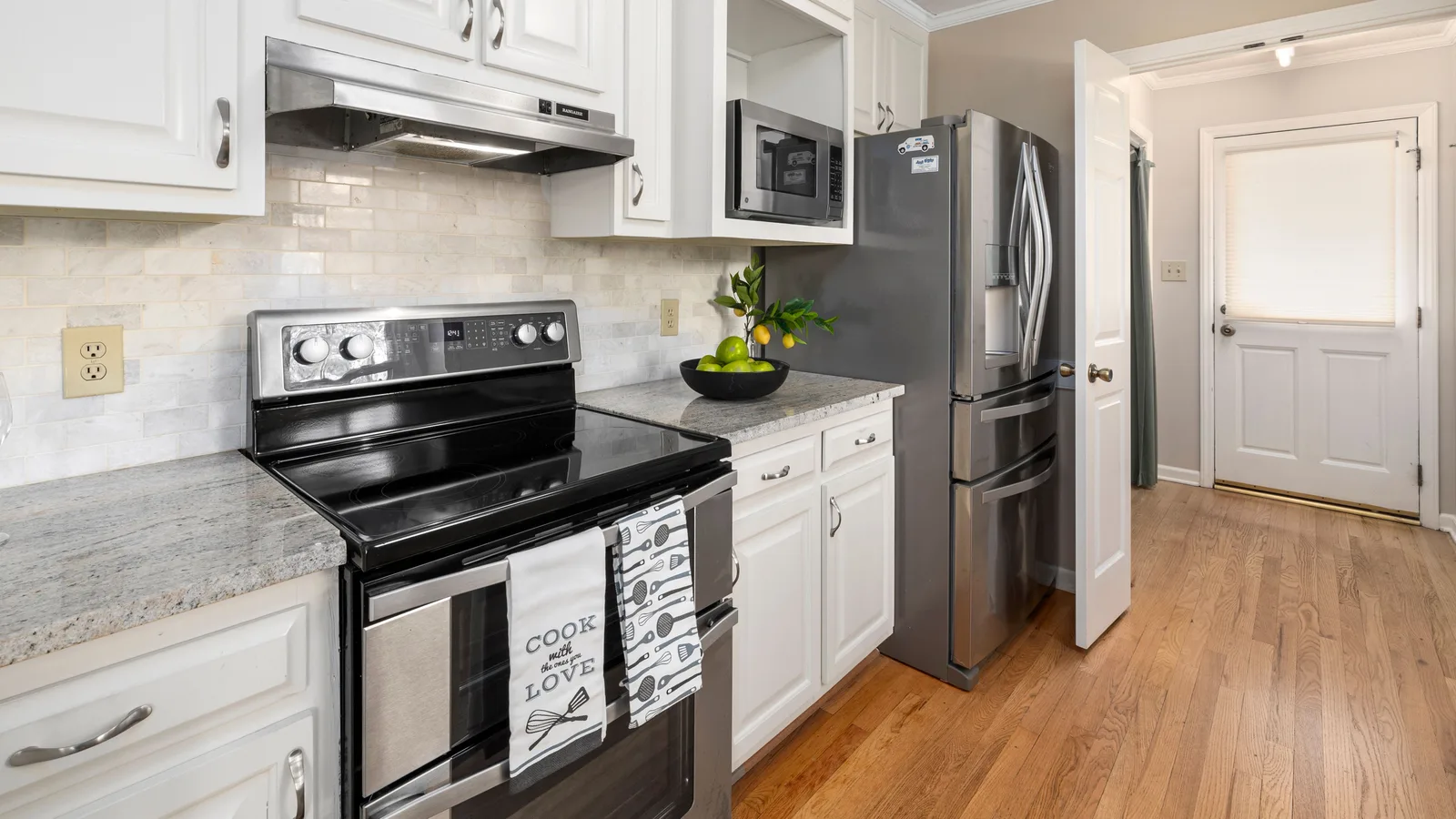
Measure the cabinet and largest pan, then create a stable one-at-a-time storage path before buying a baking-sheet organizer.
Organize baking sheets by storing dry pans upright where you can remove one without lifting a stack, but measure the opening and the largest pan before buying a divider or pull-out. A simple rack in the right cabinet is usually better than an expensive organizer that blocks a door, scratches a coating, or creates a new heavy-item problem.
Baking-sheet organization is a storage system for flat cookware: sheet pans, cookie sheets, cooling racks, muffin tins, pizza pans, and shallow trays. The goal is one-at-a-time access, not filling every inch of a cabinet.
Take inventory before choosing a location
Gather every flat piece, then separate daily sheet pans, occasional roasting pans, cooling racks, specialty pans, and pieces that are warped, flaking, or no longer safe under their manufacturer instructions. Match any lid or rack that always travels with a pan. Let every piece cool and dry before it enters storage.
| Measure | How to record it | Decision it supports |
|---|---|---|
| Largest pan | Length, width, depth, handle projection | Whether it can enter and stand in the proposed zone |
| Clear opening | Narrowest width and height with door and hinges in place | Whether a rack can enter, not merely fit inside |
| Usable depth | Front edge to back obstruction | Whether pans can stand without hitting plumbing or a hinge |
| Loaded access | Pull one real pan out and return it | Whether the layout works with actual weight and noise |
Use painter's tape or cardboard to mock up the rack footprint. Open doors and drawers through their whole travel. A cabinet that holds a vertical sheet may still fail because the pan catches a hinge, cannot clear a shelf, or requires an awkward sideways lift.
Choose the storage method by the cabinet you have
A tall cabinet or deep drawer often supports upright filing. A shallow shelf may be better for a short freestanding rack or a controlled flat stack with a protective separator. A wall-mounted rail or custom pull-out is a project, not a default purchase.
| Method | Best fit | Stop point |
|---|---|---|
| Freestanding vertical rack | Sound cabinet base with a measured opening | Rack tips, slots pinch pans, or doors cannot close |
| Drawer dividers | Deep drawer with a stable base and enough height | Divider has no stated load or the drawer drags when loaded |
| Flat stack with separators | Few lightweight pans and no workable vertical option | Every use means lifting heavy pans or scraping a coating |
| Pull-out or built-in slots | Verified cabinet structure and a long-term kitchen need | Fastening, utilities, doors, or cabinetry condition are uncertain |
Do not place a rack in the oven or in an under-oven drawer until the exact range manual says that location is storage and identifies permitted contents. The oven-rack care guide covers the different cleaning boundaries for racks and coatings.
Use the cabinet test before installing anything
Load the proposed spot with the actual pans, then run an ordinary dinner routine. Open the nearby cabinet, oven, dishwasher, and refrigerator as the kitchen is normally used. Watch for a rack that shifts when one pan comes out, a sheet that catches a hinge, a cabinet door that needs to be forced, or a pan edge that reaches into the walkway. A successful layout works when someone is carrying dinner, not only when the cabinet is empty and carefully posed.
Do not use a stool to make a high baking-sheet location seem practical. Flat cookware can be awkward, sharp-edged, and hot shortly after use. Move a daily sheet to a lower slot or reduce the collection instead. When a rack shares a cabinet with food, keep crumbs and pan residue out of the storage zone; clean and dry pans fully before filing them. That simple reset protects the organizer and makes it easier to notice a warped pan before it becomes the one that will not slide out.
Build a one-motion return path
- Put everyday pans nearest the oven. Choose the slot reached without a stool or crossing the kitchen.
- File by size and shape. Keep sheet pans together; give cooling racks and fragile coated pieces their own stable lane.
- Keep heavy pieces low. A roasting pan or cast-iron item belongs below waist height, not at the back of a high cabinet.
- Test the loaded rack. Pull every item out one at a time. Nothing should snag, scrape, tip, or require the other pans to be moved.
- Run the layout for a week. If pans return to the counter, change the location before buying more hardware.
For the rest of the cabinet, pair this system with the kitchen-cabinet organization guide, the pots-and-pans guide, and the food-container guide. Each addresses a different item shape, so one organizer should not be forced to solve all three.
Protect the pans and the kitchen
Read the care information for coated, anodized, nonstick, glass, or specialty pans. Do not assume metal-on-metal contact, dishwasher cleaning, stacking, or an abrasive divider is harmless. Use smooth, stable separators only where the manufacturer permits them, and replace a rack that develops sharp edges, loose welds, or a tipping base.
Skip drilling through a cabinet floor or side until you know what is behind it. Plumbing, wiring, appliance clearances, thin cabinet material, and drawer hardware can be close. A freestanding rack or removable divider is a safer trial for a renter, an older cabinet, or a kitchen where the workflow is still changing.
The 4Homes weekly email
Every Tuesday: what changed for homeowners this week, plus our newest guides.
No spam. Unsubscribe anytime.
Cost planning without organizer creep
The Container Store listings reviewed for this guide included an expandable bakeware stand at $11.19 and slide-out bakeware organizers from $44.99 to $74.99. Treat these as dated online planning examples, not local prices or product recommendations. Installation, cabinet repair, delivery, tax, and return terms can change the real cost.
| Approach | Planning cost | Money-saving test |
|---|---|---|
| Reuse a sound cabinet and test spacing | $0 before optional separators | Use cardboard dividers for a week first |
| Freestanding or expandable rack | $11.19 in one named online example | Compare usable slot width, base stability, and return policy |
| Slide-out organizer | $44.99 to $74.99 in named online examples | Price hardware, installation, and cabinet repair together |
| Cabinet modification | Written local quote | Ask whether a removable rack solves the actual access failure |
The savings move is usually editing and measuring before buying. Keep only the pans used for real meals, test a free layout, then buy one organizer that fixes a documented snag. Do not turn an organization problem into a cabinet-remodeling project without pricing the full scope.
When to call a pro
Call a cabinet professional or qualified handyman for a pull-out, new vertical partition, damaged drawer slide, sagging shelf, uncertain wall or cabinet fastening, or any alteration near an appliance, plumbing, or wiring. Ask for usable dimensions, load support, fastening method, finish repair, access to existing utilities, and warranty in writing.
Baking-sheet organization checklist
- Every pan is cool, dry, and checked against its care guidance.
- The largest pan and narrowest opening are measured.
- The selected rack can enter, stand stable, and allow doors or drawers to close.
- Heavy pieces stay low and daily pieces are closest to the cooking zone.
- One pan can be removed and returned without unloading a stack.
- No assumed oven-drawer or cabinet modification is used without its instructions.
- The layout passes a one-week real-use test before more hardware is bought.
Sources used
The Kitchn, 6 Smart Ways to Organize Your Cookie Sheet Collection, for search-demand context and common storage approaches; The Container Store bakeware-organizer listings for dated retail planning examples; and the care and installation instructions for the specific pans, range, cabinet hardware, and organizer in the home.
Frequently Asked Questions
How should I organize baking sheets?
Store fully dry baking sheets upright in a measured cabinet, drawer, or rack when the opening and divider spacing support the pans without forcing them. Put the most-used sheet at the easiest reach, keep heavier pieces low, and avoid a stack that must be unloaded to reach one pan.
Can baking sheets be stored in the oven drawer?
Only after the exact range manual identifies that drawer and its allowed contents. A drawer may be a warming drawer, broiler, storage drawer, or part of the appliance's airflow design. Do not assume every under-oven drawer is cool storage.
Do vertical baking-sheet organizers scratch pans?
They can if a divider is rough, too tight, unstable, or allows metal edges to strike. Test the organizer with the real pans, leave enough space to remove one smoothly, and follow the pan maker's care instructions for coated surfaces.
Should I install a pull-out baking-sheet organizer myself?
Use a professional or the cabinet maker when installation changes a cabinet, needs uncertain fastening, affects a drawer, or loads a weak or damaged box. A freestanding rack is the safer first test when the fit or use pattern is unknown.