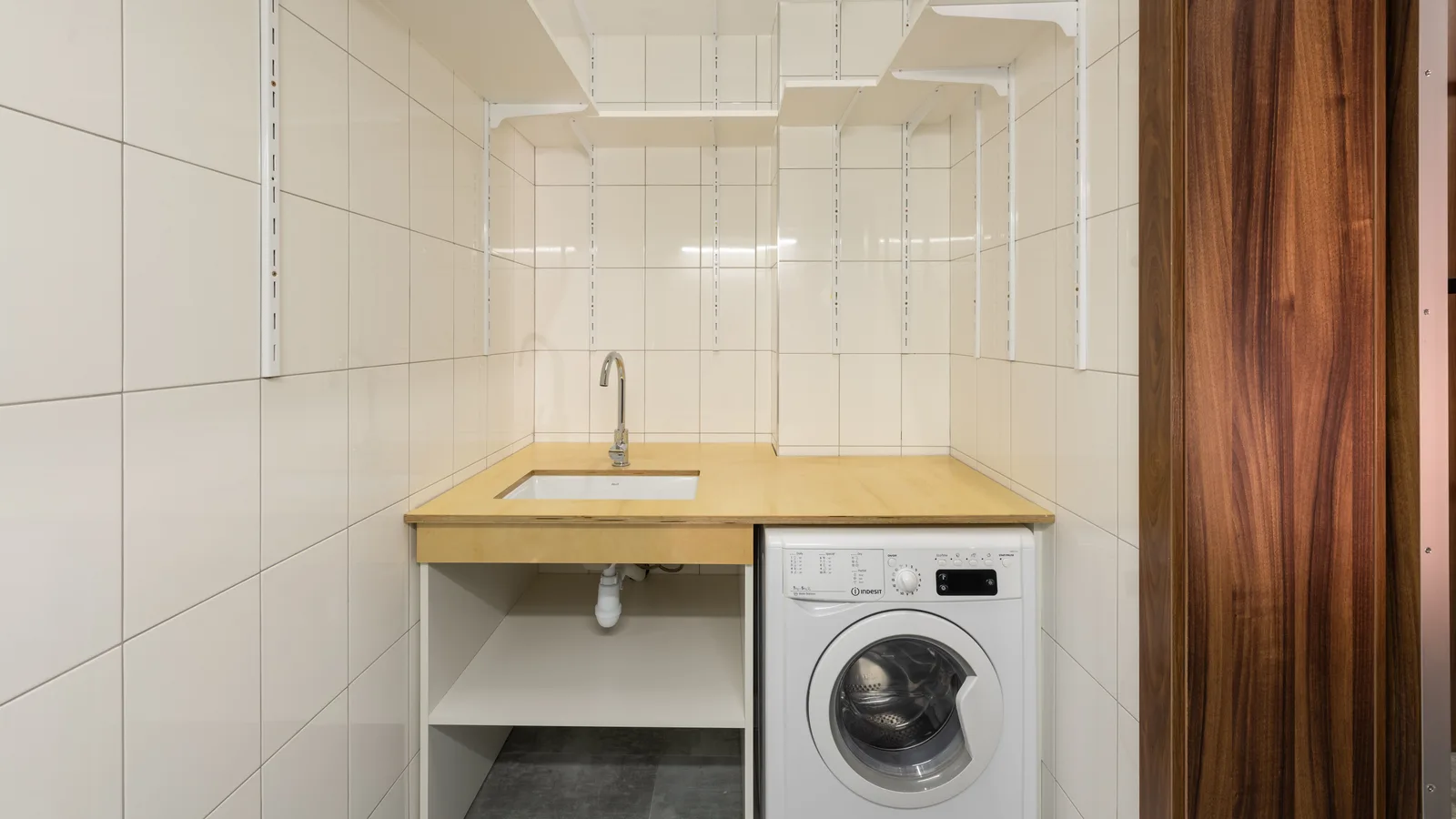
Protect the appliance and carrying paths, then give sorting, supplies, air-drying, and clean-clothes transfer one measured place each.
Organize a small laundry room by preserving the appliance and walking clearances first, then assigning compact zones for sorting, supplies, air-drying, and clean-clothes transfer. Measure around doors, hoses, valves, cords, vents, and controls before buying shelves or carts. The best layout is the one you can reset after every load without hiding a leak or blocking service access.
Define the four jobs of the room
Laundry-room organization is a repeatable path for dirty clothes, supplies, wet garments, and clean items. It is not the number of matching baskets on a shelf. In a tight room, every object should support one of four jobs: sort, wash, dry, or transfer.
Stand in the doorway with an empty basket and walk the whole cycle. Can you reach the washer, open each appliance fully, transfer a wet load, clean the lint filter, reach the valves, and leave with clean clothes? Test bifold doors, cabinet doors, appliance doors, pull-out pedestals, and a top-loader lid at full travel. A cart that fits between machines can still block a door or pinch a hose.
Record the room width, wall height, appliance depth, and every projection. Include trim, baseboards, hookups, dryer duct, vent grille, drain pan, shutoffs, receptacles, and door hardware. For a careful appliance-zone check, pair this plan with the washing-machine hose guide.
Clear and inspect before organizing
- Remove unrelated storage. Paint, automotive fluids, bulk paper, broken hangers, and donation bags should not consume the laundry route.
- Check the dry floor and walls. Look for drips, corrosion, lint, staining, soft material, musty odor, a crushed duct, or a cord under strain.
- Edit laundry products. Keep only products the household uses and can identify by the original label.
- Measure the cleared room. Mark no-storage zones around service points and appliance travel.
- Mock up before drilling. Use painter's tape and cardboard to test shelves, hooks, drying racks, and a folding surface.
Stop if you find an active leak, wet electrical equipment, heat damage, gas odor, a carbon-monoxide alarm, a repeatedly tripped breaker, or a damaged dryer duct. Keep people out of an unsafe area and call the appropriate utility, emergency service, appliance technician, plumber, electrician, or dryer-vent professional. Storage should never conceal a system problem.
Build zones around the laundry path
| Zone | What belongs there | Small-space move | Keep clear |
|---|---|---|---|
| Dirty sorting | One load-ready hamper or a few household categories | Slim rolling hamper or labeled bags outside the appliance door swing | Exit, floor drain, vents, and appliance fronts |
| Active supplies | Detergent, stain product, mesh bags, measuring tool | One removable tray or shallow shelf within safe reach | Controls, lid travel, outlets, and heat sources |
| Air-drying | Items that cannot use the dryer | Fold-down rack or rod with clear load rating | Lights, sprinkler heads, doors, and walking headroom |
| Folding or transfer | Clean load only | Adjacent counter, removable bridge, or fold-down surface | Required appliance clearance and ventilation |
| Backstock | One unopened replacement of products used regularly | Bounded bin in controlled storage | Children, pets, moisture, falling risk, and label conflicts |
| Maintenance | Lint bin, manual, flashlight, service record | Small wall pocket away from heat and moisture | Valves, plugs, duct, drain, and model labels |
Keep hazardous cleaning and laundry products in their original containers and follow every label. A high open shelf may be convenient for an adult but is not controlled storage if children can climb nearby appliances or shelving. The cleaning-supply storage guide covers the controlled stock area in more detail.
Use the walls without overloading them
Shallow shelving usually works better than deep cabinets in a narrow room because you can see supplies without leaning over an appliance. Set shelf depth from the actual container and walking clearance, not from a standard closet shelf. Put lighter items higher and liquids lower in a stable tray where a leak will be noticed.
Fasten shelves, cabinets, rods, and fold-down racks into supports appropriate for the wall and expected load. Do not guess at anchors or drill near concealed plumbing, gas, electrical, or vent routes. If the wall is crowded with utilities or the load is uncertain, hire a qualified installer. Keep all manufacturer service clearances and ventilation paths open.
A peg rail or a few hooks can hold empty hangers, mesh bags, a lint brush, and an ironing-board cord—but not so many items that the wall becomes another pile. Mount hooks outside the route where a basket or shoulder can catch them. Never hang clothing from pipes, sprinkler components, gas lines, valves, ducts, or electrical conduit.
Choose a folding and air-drying solution
Do not assume a fixed countertop can rest on appliances. Washers and dryers vibrate, need airflow and service access, and may have top controls or lids. Read both appliance manuals. A fixed counter should be independently supported and planned around required clearances; gas, electrical, plumbing, or vent changes belong to qualified trades.
For many small rooms, the better answer is reversible: a fold-down table on a clear wall, a board stored vertically and placed on a safe adjacent surface, or a rolling cart that leaves the room after use. Fold clean laundry promptly and return it to bedrooms or the linen closet. The laundry room should not become long-term clean-clothes storage.
A wall-mounted drying rack can free the floor, but verify its mounting method, projected depth, and rated load. Wet textiles are heavy. Keep them away from heaters, lights, outlets, controls, and traffic. ENERGY STAR recommends air-drying where practical as one way to save energy and help clothes last longer.
The 4Homes weekly email
Every Tuesday: what changed for homeowners this week, plus our newest guides.
No spam. Unsubscribe anytime.
Budget by problem, not by makeover
A useful reset can cost $0 when you remove unrelated items, reuse one sound basket, and relocate backstock. Angi's September 2026 cost guide lists basic bins at $5 to $20 each, premium bins at $20 to $60, and shelving at $30 to $200. It reports professional organizers at $50 to $150 per hour, with a single-room project commonly $200 to $500. Those figures are planning ranges, not local quotes.
Current retailer listings show how quickly upgrades can spread: a wall-mounted drying rack can run roughly $69 for one example, while small floating laundry cabinets appeared in The Home Depot listings checked in October 2026. Installation, delivery, wall repair, and hardware may be separate. Price the exact measured item and return policy before buying.
New plumbing, a sink, electrical work, cabinetry, countertops, dryer-vent changes, or appliance stacking is not an organization purchase. It is a home project that needs its own scope, permits where required, and qualified installation. Use the contractor quote comparison when storage becomes construction.
Save money and keep the system working
Run the new layout for two weeks using temporary labels and cardboard boxes. Buy only the organizer that fixes a repeated problem. Matching containers are optional; clear access, sound mounting, and easy returns are not. Keep one backstock limit per product so sale purchases do not take over the room.
Wash full loads when the fabric and appliance instructions allow, use cold water when suitable, and clean the dryer lint filter as directed. ENERGY STAR says an average American family washes about 300 loads each year, so a low-friction sorting system can support consistent full loads. Do not overload appliances to force fewer cycles.
Set a five-minute finish: wipe the folding surface, return the product tray, empty the lint container, remove clean clothes, and scan the floor and hookups for moisture. Add a monthly laundry check to the weekend home reset. If clean linens are the bottleneck, use the linen-closet return system rather than storing them on the dryer.
Small laundry room checklist
- Test appliance doors, controls, service points, and the basket route at full size.
- Fix leaks, vent problems, and electrical concerns before adding storage.
- Keep one bounded zone each for sorting, active supplies, air-drying, and transfer.
- Store products in original labeled containers under controlled conditions.
- Mount shelves and racks for the real wall and load.
- Keep valves, hoses, plugs, ducts, drains, labels, and clearances visible.
- Test the layout before buying permanent organizers.
- Reset the room after every load and inspect it monthly.
Frequently Asked Questions
How do I organize a very small laundry room?
Protect the appliance, door, and carrying paths first; then give the room four jobs: sorting, washing supplies, air-drying, and folding or transfer. Use measured wall storage for daily supplies, one bounded hamper system, and a temporary folding surface rather than filling every gap with bins.
What should be stored above a washer and dryer?
Store light, frequently used laundry supplies on shelving that is securely fastened and within safe reach. Keep products in original labeled containers, follow their storage directions, and avoid placing heavy liquids or loose objects where they can fall onto people, controls, hoses, cords, or appliances.
Can I install a countertop over my washer and dryer?
Only after checking the appliance manuals, required clearances, vibration, hookups, controls, door travel, and service access. A removable bridge or adjacent fold-down surface may be safer than a fixed top. Custom work near plumbing, gas, electrical, or venting should be planned by the appropriate qualified professional.
Where should laundry detergent be stored?
Keep detergent in its original labeled container, closed and stored exactly as the label directs, out of children's and pets' sight and reach. A high shelf is not a complete safety plan if it is unstable or climbable; use controlled storage and never transfer detergent into food or drink containers.