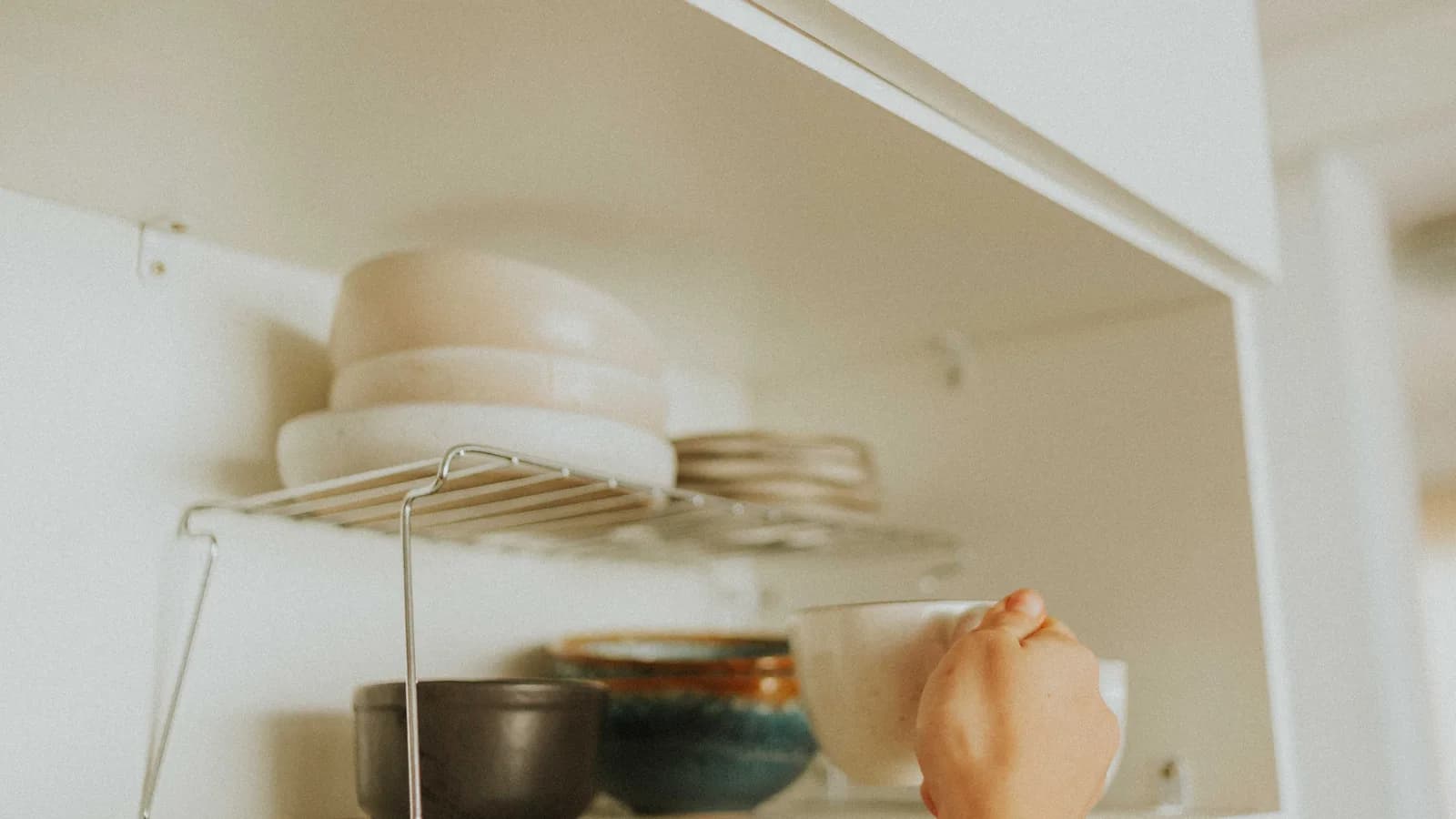
Organize the cabinets as a kitchen workflow: give everyday tasks the easiest reach, keep heavy items low, and add an organizer only when it removes a repeated motion.
Organizing kitchen cabinets without replacing them means assigning each existing shelf to a cooking task, then making the items for that task visible and easy to return. You are changing the workflow, not the cabinetry. Empty space is useful when it lets a hand reach the pan or plate behind it.
My judgment: a kitchen works better when one awkward cabinet is allowed to stay partly empty. Filling every gap creates impressive capacity on paper and daily frustration at dinner time.
Map the work before moving the objects
Walk through one ordinary meal. Where do you take out a cutting board? Which hand reaches for a plate? Where does the colander land after you wash vegetables? Mark five jobs: everyday dishes, food preparation, cooking, food storage, and occasional serving. A cabinet can serve more than one job, but avoid scattering one job across the whole room.
Start with one cabinet, not a kitchen-wide unload. Measure the clear width at the door, the usable depth, the height between shelves, and any hinge or center stile that narrows access. The cabinet box can be wider than the opening. That difference explains why a bin fits inside but cannot come back out when full.
If the counters are crowded because the workspace is poorly lit, use the kitchen lighting guide before adding cabinet hardware. Cabinet organization should support the counter workflow, not hide a heavy appliance where nobody will retrieve it.
Give the easiest reach to everyday work
Put daily plates, bowls, glasses, and mugs where they can be taken out and returned without moving another stack. Keep a complete everyday set together instead of spreading matching pieces across upper cabinets. Less-used serving pieces can move higher or farther from the dishwasher.
Store heavy cookware low. Nest only pieces that can be separated without lifting the whole stack onto the floor. A freestanding pan rack can turn a pile into individual slots, but it earns the space only if the pans slide out cleanly and the rack stays stable. Lids usually work better upright in a divided holder than balanced on top of pots.
Keep the item near its task when the cabinet permits it. Mixing bowls and measuring tools belong near the main prep surface. Oils and frequently used dry seasonings should be reachable from the cooking zone but not stored where the range or another heat source raises the cabinet temperature. Keep access to shutoffs, receptacles, plumbing, vents, and appliance connections clear.
Use organizers to remove one repeated motion
A shelf riser is useful when short dishes leave safe vertical space above them. A turntable helps bottles and jars at the back of a corner cabinet. A pull-forward bin can gather food-storage lids or baking supplies. Each product should remove a repeated move: lifting a stack, reaching behind a row, or searching through loose parts.
Test with what the organizer will actually hold. Load the shelf riser, close the door, and remove the bottom item. Spin the turntable with the tallest bottle in place. Pull the bin through the opening with both hands. Return anything that makes access tighter. The same measure-first rule applies in the deep-pantry guide, but a cabinet system has to account for dishes, cookware, hinges, and cooking sequence rather than grocery backstock alone.
Do not add adhesive hooks or hanging baskets until you check the product instructions, door clearance, surface, and loaded weight. A cabinet door that sags or will not close is not extra storage. It is a repair waiting to happen.
The 4Homes weekly email
Every Tuesday: what changed for homeowners this week, plus our newest guides.
No spam. Unsubscribe anytime.
Separate food from household chemicals
The U.S. Department of Agriculture says shelf-stable food belongs in a cool, dry place and warns against storing it above or beside the stove, under the sink, in a damp basement or garage, or in temperature extremes. That makes some convenient-looking cabinets poor food cabinets. Follow package directions when an item says it needs refrigeration after opening.
The U.S. Environmental Protection Agency advises keeping household hazardous products in their original containers with labels intact and following the label for storage and disposal. Do not decant cleaners into matching kitchen bottles. Keep them separate from food, dishes, and food-contact tools, with child and pet access considered. If the sink cabinet holds cleaners, it should not also be the overflow pantry.
Check canned and packaged food as it moves through the cabinet. The USDA says to discard bulging, leaking, badly rusted, or deeply dented cans. Do not let an organization project turn a damaged package into a decorative decanted ingredient with its identity and instructions removed.
Build the return path into the layout
Put things away after a normal dishwasher load and grocery trip. Those two events reveal whether the layout survives real life. If a stack has to be held in one hand while another item moves, the cabinet is too dense. If a family member cannot tell where a container belongs, the category is too clever.
Use plain labels inside cabinet doors only where they help a shared household: “lunch containers,” “baking,” or “serving.” A photo of the working shelf can be more useful than labels for dishes and cookware. Leave one flexible zone for an item entering or leaving the rotation instead of forcing it into the wrong cabinet.
Recheck one cabinet during the weekend home reset. Return strays, wipe a spill, and notice what keeps landing in front of something else. Repeated drift is evidence. Move the category closer to where it is used rather than demanding a better habit from everyone in the house.
The same active-zone-versus-reserve-zone approach also works on a bigger, messier space — see organizing a one-car garage for tools and seasonal bins.
Frequently Asked Questions
What should I organize first in kitchen cabinets?
Start with the cabinet closest to your busiest task, usually everyday dishes, food preparation, or cooking. Empty that one cabinet, remove what does not belong, and return items in the order you use them. A working cabinet gives you a better pattern for the rest of the kitchen than buying organizers for every door at once.
How can I add kitchen cabinet storage without drilling?
Use removable shelf risers, divided bins, turntables, and freestanding pan or lid racks only after measuring the clear opening and shelf. Test each piece with the cabinet door closed. Do not use a removable product where it can tip, overload a shelf, block a hinge, or make a heavy item harder to control.
Where should heavy kitchen items go?
Put heavy cookware and small appliances on a low shelf that lets you take them out with two hands without reaching overhead. The best location is near the place you use the item, provided the shelf and cabinet are sound and the item does not block plumbing, ventilation, or an appliance connection.