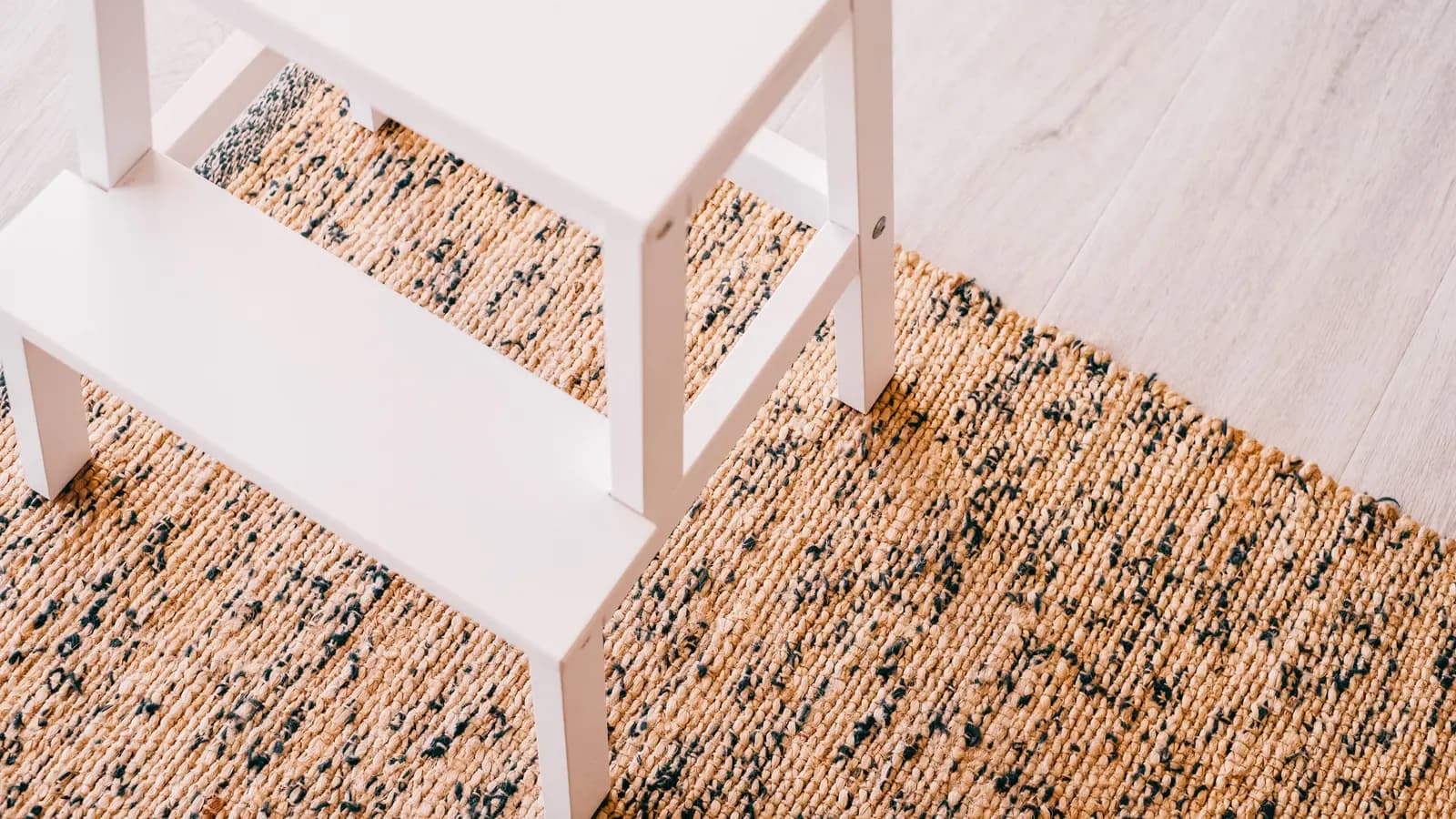
Store the stool where it stays dry, fits completely, and comes out without overreaching while doors, paths, vents, and emergency access stay clear.
The best place to store a kitchen step stool is a dry, clear spot close to the kitchen where the whole stool fits and you can retrieve it without reaching, twisting, or moving heavy objects. A measured pantry side wall, nearby utility closet, or dedicated cabinet slot is usually safer than a walkway, behind a door, or beside an appliance unless that appliance's required clearances remain open.
Use four tests before choosing the spot
A convenient gap is not automatically a storage place. Open the stool fully, close it, and measure its folded height, width, depth, and handle projection. Then measure the opening at its narrowest point, including hinges, trim, pipes, baseboards, shelves, and anything that narrows the route out.
Run four tests with the kitchen in normal use:
- Dry: the stool stays away from sink leaks, wet mops, pet bowls, damp floors, condensation, and cleaning chemicals that could affect its feet, finish, labels, or hardware.
- Clear: it does not reduce a walking path, door swing, cabinet access, appliance ventilation, utility access, fire extinguisher access, or the route out of the room.
- Nearby: the intended user can get it without crossing stairs, going outside, or deciding that a chair is quicker.
- Fully fitted: every foot, step, rail, and handle is inside the storage boundary. Nothing sticks into the aisle, and the stool cannot slide or tip out when another item is removed.
The retrieval test matters as much as the fit. Put the stool away, stand as you normally would, and take it out with one controlled motion. If you have to reach above shoulder height, bend behind an appliance, pull from under a heavy stack, or catch a falling stool, choose another location.
Compare the practical storage options
| Location | Why it can work | What can rule it out |
|---|---|---|
| Pantry side wall or floor slot | Close to high kitchen storage and easy to see | Food spills, blocked shelves, a stool protruding into the standing area, or a door that traps it |
| Nearby utility or broom closet | Dry, contained, and often tall enough for a handle | Chemicals spilling onto it, a vacuum or mop pinning it in place, or retrieval that requires lifting other equipment |
| Measured base-cabinet slot | Conceals a compact folded stool while keeping it near the work zone | Plumbing, heat, moisture, a narrow hinge opening, or lost storage that the kitchen needs more |
| Wall hook or bracket | Uses a narrow wall and keeps the floor clear | Unrated hardware, poor wall attachment, overhead lifting, child access, or the stool swinging into a path |
| Beside a refrigerator | A slim folding model may fit a nearby unused gap | Manufacturer clearance, blocked airflow, hot surfaces, cord or water-line contact, door interference, or awkward reach behind the appliance |
| Integrated cabinet step | Always in one place and avoids storing a separate folded frame | Cabinet modification, reduced interior space, installation cost, or a step not suited to the user's needed height and load |
My first choice is a visible floor-level slot in a pantry or closet, provided the stool cannot fall and nothing can be stacked in front of it. It is boring. That is good. The storage method should remove friction rather than turn a ten-second reach into a small unpacking job.
Be careful with refrigerator-adjacent storage
The narrow strip beside a refrigerator looks made for a folding stool, but the appliance decides whether that gap is available. Check the installation instructions for the exact model. Required side, rear, top, hinge, and ventilation clearances vary, and a generic gap recommendation cannot replace them.
Keep the stool away from the power cord, plug, water supply, shutoff, drain pan, hot surfaces, and wheels. It must not stop a refrigerator or freezer door from opening through its intended arc. You should be able to remove the stool from the front; reaching behind a large appliance or pulling on a wedged frame is a bad trade for saving a few inches.
If the manufacturer requires the space, leave it empty. Do not compress the clearance by counting the stool as “temporary.” It lives there every day.
Store the stool so it is ready to use safely
Close a folding stool according to its instructions and make sure fingers, aprons, and towels stay clear of hinges and locks. A latch, clip, or wall bracket should restrain the stored stool only in a way the stool maker permits. Do not drill into the frame, tie the legs together, or add a hook that can damage a step, label, spreader, or locking part.
The ANSI ASC A14.11-2018 stepstool standard covers safe construction, design, testing, care, use, and marking for qualifying stepstools in several materials and configurations, with duty ratings from 200 to 375 pounds. The public ANSI and American Ladder Institute explanations are useful shopping context, but the exact product label and instructions still control its use and storage. Check the duty rating against the user plus anything carried.
Inspect the stool as it comes out of storage. Look at the feet, steps, hinges, fasteners, rails, handle, locks, and spreaders. Dirt or grease on a tread needs cleaning by the maker's directions. If anything is cracked, bent, loose, missing, or reluctant to lock, set the stool aside so nobody grabs it out of habit.
Check recalls by brand and model
Do not assume a familiar product is safe because it has been in the kitchen for years. On July 31, 2025, the U.S. Consumer Product Safety Commission announced a recall of about 302,000 Cosco 2-Step Kitchen Steppers, plus about 11,000 sold in Canada. CPSC said the safety bar could detach or break. Cosco had received 34 reports of that failure, including two incidents involving head injuries.
The recall applied to specific model numbers, not every stool made by the brand. CPSC told owners to stop using the safety bar immediately, store the stepper away from children until repaired, and contact Dorel for a free repair kit. Read the current recall notice for the exact remedy. Record your own stool's manufacturer, model, and date or code in a phone note so a future check takes a minute.
Lower frequent-use items before adding storage hardware
Sometimes the best stool-storage fix is using the stool less. CDC's STEADI home fall-prevention checklist tells older adults to keep often-used kitchen items on lower shelves, around waist height. It also says that if a step stool is necessary, use a sturdy one with a bar to hold and never substitute a chair.
Move daily glasses, plates, cereal, spices, coffee supplies, and lightweight cookware into the easiest reach. Reserve high cabinets for light, infrequently used items. The kitchen-cabinet organization guide shows how to assign those reach zones without replacing the boxes. For deep food storage, the deep-pantry guide keeps active items at the front and backstock within a controlled boundary.
This change costs nothing and can eliminate several climbs a day. If an item is heavy, hot, fragile, or awkward enough to occupy both hands, lower it even if the stool itself feels stable.
What storage and stool options cost
Current Home Depot compact step-stool examples reviewed October 25, 2026 ranged from $17.98 for a two-step compact steel model to $39.97 for a three-step steel model. Prices, availability, capacity, folded size, and handle design can change, so measure first and confirm the current product label rather than treating price as a safety grade.
| Option | Planning cost | Cost check |
|---|---|---|
| Reuse a sound stool in a cleared floor slot | $0 | Confirm it fits fully, locks correctly, has no recall, and can be retrieved without obstruction |
| Compact folding stool | $17.98 to $39.97 in current Home Depot examples | Compare folded dimensions, height, duty rating, handhold, instructions, and return terms |
| Basic hook or restraint | Price the specified hardware locally | Include suitable fasteners and confirm the stool maker allows the storage method |
| Cabinet pullout or integrated step | Custom or local quote | Include cabinet modification, load support, clearances, finish repair, installation, and warranty |
The 4Homes weekly email
Every Tuesday: what changed for homeowners this week, plus our newest guides.
No spam. Unsubscribe anytime.
How to save money without creating a nuisance
Clear and test a location before buying an organizer. Painter's tape can mark the folded footprint on a pantry floor or cabinet side. Live with that boundary for a week. If groceries, doors, or feet cross it, the stool will be in the way too.
Reuse sound hardware only when its load, fastener, and mounting instructions fit the job. Avoid a custom cabinet step if lowering the few frequently used items solves the real problem. When buying a stool, bring the folded measurements and choose for the user's safe reach rather than the smallest frame. A cheap stool that stays buried behind the vacuum usually sends people back to a chair.
When to call a pro
Call a cabinet installer or qualified handyman when storage requires cutting cabinetry, building a narrow slot, adding a pullout, mounting into uncertain wall construction, or working around plumbing, wiring, tile, an appliance enclosure, or fire-rated surfaces. Ask for the usable opening, fastening method, supported load, appliance clearances, effect on doors and utilities, finish repair, and warranty in writing.
Use an occupational therapist for a home-access assessment when balance, strength, vision, joint motion, dizziness, a recent fall, or medication effects make climbing or retrieval uncertain. The better answer may be lowering storage, changing the kitchen layout, or avoiding a stool entirely. For choosing access equipment for other household tasks, read the homeowner ladder buying guide.
Kitchen step-stool storage checklist
- Measure the stool folded and open, including handles, feet, and projections.
- Measure the narrowest retrieval opening and the full route to the setup spot.
- Choose a dry location near the kitchen with the entire stool inside its boundary.
- Keep walking paths, doors, vents, appliance clearances, utilities, and emergency access open.
- Retrieve and return it without overhead lifting, sideways reaching, twisting, or moving another heavy item.
- Confirm the duty rating, instructions, locks, feet, and condition before use.
- Check the exact brand and model against CPSC recalls.
- Move frequently used and awkward items to lower shelves.
- Test a taped storage footprint for a week before buying hardware or altering a cabinet.
Related guides
- Choose the right ladder or step-access equipment for the task, load, footing, and reach.
- Organize a small pantry with deep shelves so everyday items stay visible and reachable.
- Organize kitchen cabinets by task and reach zone before adding more storage hardware.
- Plan narrow storage without blocking a household route.
Sources used
CDC STEADI, Check for Safety: A Home Fall Prevention Checklist for Older Adults; American National Standards Institute, New Standard for Stepstools, explaining ANSI ASC A14.11-2018; American Ladder Institute, ANSI/ALI A14.11 Stepstools scope and purpose; U.S. Consumer Product Safety Commission, July 31, 2025 recall of Cosco 2-Step Kitchen Steppers; current Home Depot compact step-stool product listings reviewed October 25, 2026; and the exact step-stool, appliance, cabinet hardware, and fastener manufacturer instructions for the products in the home.
Frequently Asked Questions
Where is the best place to store a kitchen step stool?
Store it in a dry, clear spot near the kitchen where the entire stool fits and can be pulled out without overreaching. A pantry side wall, nearby utility closet, or measured cabinet slot usually works better than a traffic path, behind an appliance, or in a gap that blocks ventilation, a door, or emergency access.
Can I store a step stool beside the refrigerator?
Only if the refrigerator manufacturer permits the side and rear clearances left by that exact setup. The stool must not restrict ventilation, pinch a cord or water line, interfere with the door, tip toward the appliance, or require reaching behind the refrigerator to retrieve it.
Is it safe to hang a folding step stool on the wall?
It can be, when the stool is designed or approved for that storage position and the hook or bracket is fastened into suitable structure for the full load. Mount it where it cannot fall into a walkway, strike a door, tempt a child to climb, or force an awkward overhead lift.
Should a kitchen step stool have a handle?
CDC STEADI guidance says that if a step stool must be used, choose a sturdy one with a bar to hold and never use a chair instead. A handle does not make every stool safe: the product still needs the right height and duty rating, sound feet and locks, a level setup, and enough room to climb without leaning sideways.
When should I replace a kitchen step stool?
Stop using it when a step, foot, hinge, lock, spreader, rail, or handle is cracked, loose, bent, missing, worn, or no longer works as the instructions describe. Also check the exact brand and model for recalls; a 2025 CPSC recall covered about 302,000 Cosco 2-Step Kitchen Steppers after safety-bar failures were reported.