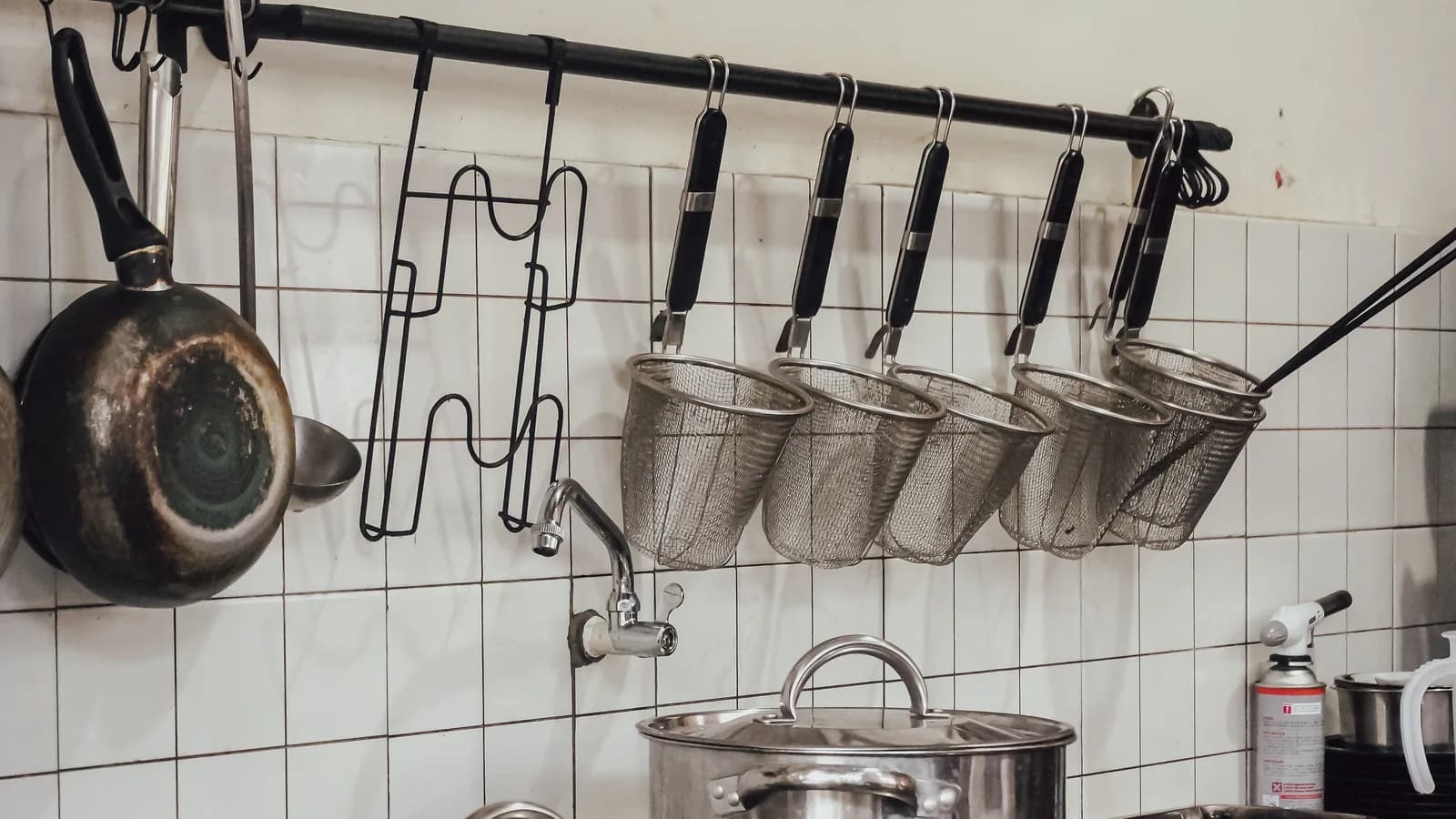
Keep daily cookware close, heavy pieces low, and lids upright, then test a measured layout before buying or mounting any organizer.
Organize pots and pans by frequency, weight, and the motion required to remove them: everyday cookware close to the range, heavy pieces low, and lids upright beside their matches. Empty the cabinet, keep only sound pieces that have a real job, then test a no-purchase layout before adding racks. The best system lets you take out one pan without unloading a stack.
Do not begin by buying an organizer. Measure the clear cabinet or drawer—not the face opening—and record hinges, pipes, shelf lips, handle projections, and the path each piece needs to travel.
Start with a cookware inventory
- Bring cookware and lids from cabinets, drawers, the oven, and overflow storage to one work surface.
- Match every lid. Set aside unmatched pieces while you check model numbers and replacement availability.
- Group by job: skillet, saucepan, stockpot, Dutch oven, baking pan, and specialty cookware.
- Move cracked, warped, badly corroded, loose-handled, or peeling pieces out of service according to the maker's guidance. Do not donate unsafe cookware.
- Put duplicates and once-a-year pieces in a trial box. If they are not used during the trial, donate usable pieces or recycle them through an accepted local program.
Keep the collection that matches actual cooking. A large stockpot used twice a year does not need prime space beside a daily skillet. The kitchen cabinet organization guide can help assign zones for cookware, food, dishes, and small appliances together.
Measure the cabinet and the cookware
Measure clear width, depth, and height at the narrowest point. Include hinges, face frames, shelf supports, plumbing, and door closure. Then measure the widest pot with handles, the tallest nested group, lid diameters, and the space needed to lift or tilt each item out.
| Storage location | Best use | Check before committing |
|---|---|---|
| Deep drawer | Heavy pots, pans filed on edge, lids in dividers | Drawer rating, handle clearance, and whether cookware shifts when closed |
| Lower cabinet | Everyday cookware on a freestanding rack or short stable stacks | Clear opening, shelf strength, reach to the back, and door swing |
| Corner cabinet | Large, lighter, less-used cookware | Turntable or pullout rating and clearance through the opening |
| Wall or ceiling rack | Selected cookware when structure and route are suitable | Structural fastening, load rating, head clearance, and safe reach |
| High shelf | Light seasonal pieces | No heavy cast iron or awkward lifting above shoulder height |
Build the layout in order of use
Put the daily skillet, saucepan, and pot where they can be reached with one motion. Keep the heaviest cast iron, Dutch oven, or stockpot on the cabinet floor or in a rated deep drawer, not on an upper shelf. Group pieces by the meals they serve rather than by color or set.
If nesting saves needed space, stack from large to small and use the protector specified by the cookware maker. Do not drag coated pans across one another. Limit the stack to what can be lifted comfortably. A rack that files pans vertically often improves access, but each divider must support the pan without pressing a handle against the door.
Store lids vertically by diameter, with knobs alternating where that saves room. Keep them next to the pots rather than in a distant drawer. A freestanding rack avoids holes; a door-mounted rack uses otherwise idle space but must clear shelves and cookware through the full swing.
Test before drilling or buying
Use cardboard boxes, bookends, or removable bins to mock up zones for one week. Cook a normal set of meals and notice every time you must lift, unstack, or reach behind something. Adjust the free layout first.
For a pullout, measure the actual framed opening and compare it with the product's minimum opening, overall dimensions, travel, fastener locations, and rated load. Confirm that screws will not pierce a thin panel or interfere with an appliance. For a door rack, load changes affect hinges; follow the cabinet and organizer instructions.
A hanging rack is a structural installation, not a styling shortcut. A qualified installer should locate suitable framing, choose listed fasteners for the actual assembly, and preserve required clearance. Keep hot, greasy, or heavy cookware out of a route where it could strike a person.
Typical organizer cost ranges
Start at $0 by decluttering and rearranging. Home Depot listings checked October 31, 2026 showed simple freestanding cookware dividers around $11.97 to $25.45. The Container Store showed adjustable lid and pan racks from $23.99 to $58. Those are current product examples, not an installed national range, and sale prices can change.
Pullouts and custom inserts cost more because hardware, cabinet fit, and installation vary. Price the exact product plus delivery, mounting hardware, cabinet repair, and installation. Get a written scope from a cabinet professional when a pullout needs cabinet modification, when shelves sag, or when a door or drawer cannot carry the proposed load.
The 4Homes weekly email
Every Tuesday: what changed for homeowners this week, plus our newest guides.
No spam. Unsubscribe anytime.
Protect cookware and cabinets
Clean and dry cookware before storage. Moisture trapped between pieces can stain finishes or encourage corrosion. Use washable, non-slip liner only if the cabinet and cookware instructions permit it; liner should not cover ventilation or hide a leak.
Do not store cookware in an oven unless every household member has a reliable removal routine before preheating; a forgotten pan or plastic handle can become a burn or fire hazard. Keep combustibles away from the range, and do not mount racks where handles project over burners.
Stop using a sagging shelf, loose rail, cracked drawer box, failing hinge, or organizer pulling away from its fasteners. A carpenter or cabinet installer should repair the support before it carries heavy cookware.
How to save money
Declutter before measuring so you do not buy storage for pieces you never use. Reuse a sturdy dish rack or file sorter only when it fits, stays stable, and can carry the load. Buy one rack after the cardboard trial rather than a matched set of organizers for every cabinet.
Keep modular cookware when replacing worn pieces so lids and footprints remain compatible. Look for replacement handles or lids from the manufacturer before replacing a sound pot. Compare return policies because organizers often fail on one hidden hinge or face-frame dimension.
If the room itself is tight, the kitchen clearance guide helps protect walking and work zones, while the small-kitchen layout guide prioritizes storage without crowding the cooking path.
Make the system easy to reset
Take a photo of the finished cabinet and give every household member one simple rule: a pan returns to its assigned slot only when it is clean and dry. If an item repeatedly lands on the counter, its home is too hard to reach or the category is too full. Change the layout instead of blaming the person putting dishes away.
Run a five-minute reset once a month. Match stray lids, remove pieces waiting for repair, wipe the shelf, and check mounted hardware and drawer travel. Keep a small donation box elsewhere so a usable duplicate can leave without starting another full cabinet project. This short routine protects the empty space that makes the system usable.
Pots and pans organization checklist
- Every pot has a purpose, matching lid, and safe handle and surface.
- Heavy cookware is stored low and within comfortable reach.
- Everyday pieces come out without unloading a large stack.
- Coated surfaces have maker-approved protection between them.
- Lids stand securely near their matching cookware.
- Clear opening, hinges, pipes, face frames, handles, and door swing were measured.
- Organizer and cabinet load ratings are known before installation.
- The layout passed a one-week no-purchase trial.
Frequently Asked Questions
What is the best way to organize pots and pans in a cabinet?
Keep the everyday pieces near the range, place heavy cookware low, and give each pan a direct path out. Nest only compatible finishes with protectors between them, and file lids vertically in a stable rack beside their matching cookware.
How do you organize pots and pans in a small kitchen?
Keep a smaller everyday set, move seasonal cookware to a secondary shelf, and use measured vertical space with a freestanding rack or deep-drawer dividers. Do not add a door rack, pullout, or overhead rail until its load and clearances are confirmed.
Is it okay to stack nonstick pans?
Follow the cookware maker's care instructions. If stacking is permitted, place a clean soft protector between pans and lift the top pan out instead of dragging it across the cooking surface. Replace cookware when its manufacturer says coating damage makes it unfit for use.
Where should pot lids be stored?
Store lids upright by diameter in a stable rack, divider, or deep drawer close to the matching pots. Before mounting anything to a cabinet door, check hinge capacity, handle projection, shelf clearance, and the organizer's installation instructions.
Can pots and pans be hung from the ceiling?
Only from a rack installed into suitable structure under its instructions, with verified load capacity and safe head and reach clearance. Do not hang heavy cookware from drywall, decorative trim, an unknown ceiling anchor, or above a cooking or walking route where a falling item could injure someone.