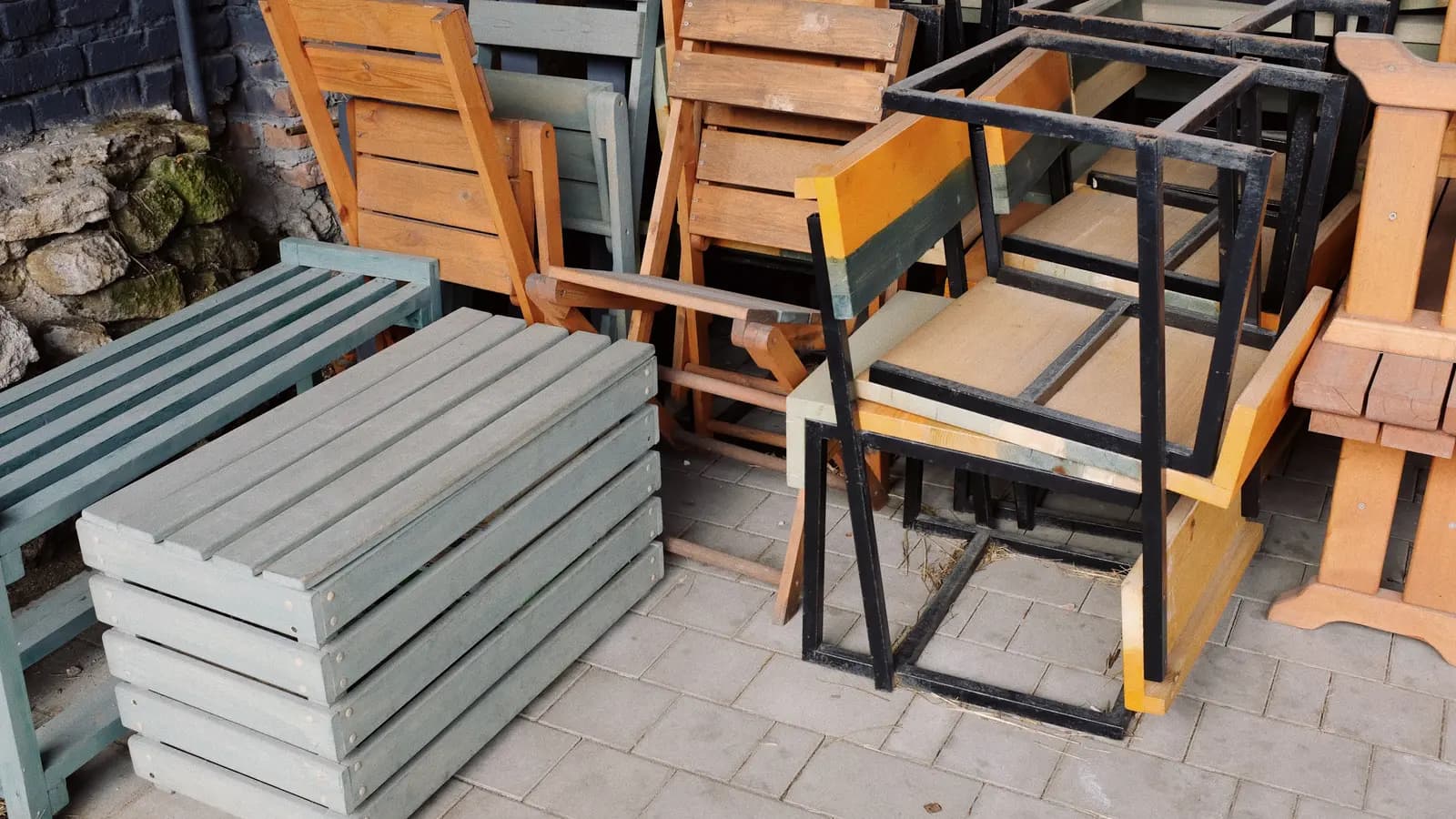
Match the frame, finish, hardware, fabric, and care plan to the patio's real sun, water, salt, wind, freeze, and storage exposure.
The best outdoor furniture material is the one whose documented limits and care routine fit your patio's harshest exposure. For wet, salty, sunny, or windy sites, compare the exact product's finish, drainage, fabric specification, warranty exclusions, and storage instructions rather than trusting a broad claim such as "all weather."
Do not choose by climate zone alone. A covered porch, an uncovered pool deck, and a shaded yard in the same city create different exposure. Map sun, rain, salt, wind, freeze-thaw cycles, irrigation spray, and storage before comparing materials.
Build a one-week exposure record
Stand where the furniture will go in the morning, midday, and evening. Note when direct sun reaches it, which way storm water moves, and whether sprinklers hit the area. After rain, look for puddles and slow-drying corners. NOAA climate normals can describe the region, but the chair will live in a small microclimate beside your wall, roof edge, pool, or hedge.
Record the following before shopping:
- Hours of direct summer sun and whether afternoon sun strikes dark surfaces
- Roof runoff, irrigation overspray, standing water, and how quickly the site dries
- Salt air, pool splash, deicing salt, fertilizer, or other corrosive exposure
- Prevailing wind, gust channels between buildings, and storm-storage options
- Freeze-thaw weather, snow load, and whether furniture must be moved for winter
- Tree sap, pollen, bird activity, mildew pressure, and the cleaning water available
If the patio itself holds water, solve that first with the patio comfort and drainage plan. Furniture feet and covers should not become the drainage system.
Material and climate decision table
| Material | Usually strongest fit | Main exposure to inspect | Maintenance reality |
|---|---|---|---|
| Powder-coated aluminum | The maker documents the coating, hardware, drainage, and intended exposure | Chips, hollow sections, fasteners, warranty exclusions, and product weight | Use the cleaner and touch-up method named for that model |
| Painted or coated steel | The finish and storage instructions fit the actual site | Scratches, joints, trapped water, hardware, and coastal exclusions | Inspect and repair the finish only by the maker's method |
| Stainless steel | The stated alloy, fasteners, and care guide address the exposure | Salt-contact instructions, crevices, and mixed-metal hardware | Use the rinse and cleaning schedule in the product documentation |
| Outdoor-rated wood | The species, joinery, finish, and care guide are intended for outdoor use | Feet, joints, end grain, finish wear, and drainage | Follow the maker's cleaning and refinishing schedule |
| Recycled-plastic or HDPE lumber | The model's temperature, support, and hardware limits fit the site | Surface-temperature warnings, expansion clearances, frame support, and hardware | Follow its cleaner and pressure-washing limits |
| Resin wicker over a frame | Both the weave and the hidden frame have documented outdoor-use limits | Loose strands, frame material, cleaning limits, weight, and storage directions | Use the brush, cleaner, and storage method the maker specifies |
My view: documented frame construction beats the material name on the tag. I would choose a chair with clear drainage details, identified hardware, and orderable parts over a set labeled only "weatherproof."
What heat and sun change
Read the product's surface-temperature and direct-sun warnings, then test a display piece when possible. Ask whether color variation, fading, chalking, or another surface change is covered by the warranty or treated as normal weathering.
Wood also changes outdoors. USDA Forest Products Laboratory publications describe sunlight and water as the main weathering forces on exposed wood. A finish can slow moisture movement and preserve appearance, but no outdoor finish makes wood maintenance-free. End grain and joints need a way to shed water, and feet should not sit in a puddle or damp soil.
For fabric, separate the cushion cover from the foam and fill. "Outdoor fabric" does not prove that the zipper, thread, backing, foam, and inner liner can stay wet. Ask how the cushion drains, whether covers are removable, which cleaner is allowed, and where the cushions go during a storm. Shade planning in the small-patio layout guide can reduce direct exposure without crowding the walking route.
Wet, humid, and coastal sites
For one concrete example, POLYWOOD's care instructions say to rinse its hardware with fresh water and towel-dry it after contact with salt water. That instruction applies to POLYWOOD's documented hardware, not every outdoor set. For another product, use that maker's salt-contact and cleaning directions.
Look underneath a display piece. Are fasteners identified? Do tube ends and seat pans have documented drainage? Is the coating continuous around welds and holes? Read the actual warranty for hardware, finish damage, commercial use, and coastal exposure rather than assuming the word "rust" covers every component.
Use the spacing, cleaning, and dry-before-storage directions for the exact set. Do not pressure-wash unless the maker gives a nozzle, distance, and pressure limit.
Wind, storms, snow, and freezing weather
Do not infer storm performance from weight or frame material. Read the maker's wind and severe-weather instructions and decide where every piece will go before buying it. If the documentation requires storage or anchoring, use only the location and method it approves.
Folding and stackable pieces save storage space only if you can lift them and the stack remains stable. Measure the shed or garage opening, shelf height, and carrying path. The one-car garage storage plan helps reserve a real seasonal zone rather than a theoretical one.
Check the stated winter-storage instructions before the first freeze or snowfall. If the manufacturer publishes no snow-load rating, do not treat the set as snow-rated. Ask how the exact product should be drained, covered, or stored, and follow that answer instead of improvising a de-icing method.
Compare the full purchase cost
Retail listings mix individual chairs, multi-piece sets, cushions, and very different construction, so a category-wide price range is not a reproducible comparison. Record the current price of the exact configuration you would buy, then compare equivalent seat count, frame construction, cushions, delivery, assembly, covers, and warranty.
| Cost line | What to price before purchase |
|---|---|
| Furniture | Exact pieces, dimensions, weight, frame material, hardware, and cushion construction |
| Delivery and assembly | Threshold or patio placement, packaging removal, and return pickup |
| Protection | Approved cover, glides, touch-up material, cleaner, or wood finish |
| Storage | Cushion box, rack, shed space, or paid seasonal moving |
| Repair | Replacement sling, cushion, foot, hardware kit, tabletop, or woven panel |
Ask for parts prices now. A replaceable sling or cushion can extend the useful life of a sound frame. A proprietary part that disappears after one season can turn a small failure into a complete-set replacement.
The 4Homes weekly email
Every Tuesday: what changed for homeowners this week, plus our newest guides.
No spam. Unsubscribe anytime.
Use the warranty as a specification sheet
Read the warranty before checkout. Search for exclusions involving salt, pools, freeze damage, wind, fading, fabric, commercial use, surface rust, improper covers, and unauthorized cleaners. Save the care guide and receipt with photos of labels and hardware.
Check the product's weight capacity and any anti-tip or anchoring instructions. If a frame, leg, woven panel, or glass support is damaged, stop and ask the manufacturer whether the part is replaceable and who is qualified to repair it. Do not turn a furniture repair into an improvised climbing or structural job.
How to spend less over the life of the set
Buy fewer pieces that fit the measured layout. Painter's tape can mark table and chair pull-out space before delivery. Keep the path clear, and use the backyard lighting guide so cords and fixtures do not compete with furniture feet.
Clean salt or other deposits at the interval and by the method in the care guide. Store cushions as directed. Tighten only the fasteners the manual identifies, using its sequence and torque guidance. These are maintenance tasks, not promises of a fixed lifespan or savings amount.
Skip a bargain that needs a maintenance routine you already know you will ignore. Low purchase price does not help if the set is too light for the site, too hot to sit on, or too large to protect during winter.
Outdoor furniture buying checklist
- The real sun, water, salt, wind, freeze, and storage exposure is written down.
- Frame, finish, hardware, fabric, fill, feet, and replacement parts are identified.
- Water can drain from seats, rails, joints, and covers.
- Every piece fits the patio and the route to seasonal storage.
- Care instructions match the time, water, tools, and indoor space available.
- Warranty exclusions have been read, not inferred from the sales label.
- The full cost includes delivery, assembly, covers, care supplies, and likely replacement parts.
Outdoor furniture material FAQs
What outdoor furniture material lasts longest in the rain?
There is no defensible winner based on the material label alone. Compare the exact product's intended exposure, drainage details, fastener specification, warranty exclusions, replacement parts, and rain-care instructions. The better choice is the documented assembly you can maintain and store as directed.
Is aluminum or steel better for outdoor furniture?
Neither material name settles the choice. Compare the exact product's weight, finish, hardware, drainage, care guide, coastal-use exclusions, and storm-storage instructions. A chair that is easy to move may suit planned storage; a heavier set still needs a manufacturer-approved wind plan.
Is wood outdoor furniture suitable for a humid climate?
It can be, if the species, joinery, finish, and care plan are meant for outdoor use. USDA Forest Products Laboratory guidance explains that sunlight and moisture weather wood surfaces. Leave drainage and drying space, follow the maker's cleaning and refinishing schedule, and expect appearance to change when wood is left unfinished.
Does resin wicker survive winter outdoors?
The word wicker describes the woven form, not a single material specification. Check the maker's temperature, cover, cleaning, and winter-storage directions for the exact weave and frame. If the documentation gives no snow or wind rating, do not invent one; ask the manufacturer where the product should be stored during severe weather.
Should outdoor furniture be covered all year?
Follow the furniture and cover makers' directions. Confirm that the cover fits the exact piece, when the furniture must be dry, how water is kept from pooling, and what the storm-storage instructions require. Do not assume a generic cover changes the product's wind or winter rating.
Frequently Asked Questions
What outdoor furniture material lasts longest in the rain?
There is no defensible winner based on the material label alone. Compare the exact product's intended exposure, drainage details, fastener specification, warranty exclusions, replacement parts, and rain-care instructions. The better choice is the documented assembly you can maintain and store as directed.
Is aluminum or steel better for outdoor furniture?
Neither material name settles the choice. Compare the exact product's weight, finish, hardware, drainage, care guide, coastal-use exclusions, and storm-storage instructions. A chair that is easy to move may suit planned storage; a heavier set still needs a manufacturer-approved wind plan.
Is wood outdoor furniture suitable for a humid climate?
It can be, if the species, joinery, finish, and care plan are meant for outdoor use. USDA Forest Products Laboratory guidance explains that sunlight and moisture weather wood surfaces. Leave drainage and drying space, follow the maker's cleaning and refinishing schedule, and expect appearance to change when wood is left unfinished.
Does resin wicker survive winter outdoors?
The word wicker describes the woven form, not a single material specification. Check the maker's temperature, cover, cleaning, and winter-storage directions for the exact weave and frame. If the documentation gives no snow or wind rating, do not invent one; ask the manufacturer where the product should be stored during severe weather.
Should outdoor furniture be covered all year?
Follow the furniture and cover makers' directions. Confirm that the cover fits the exact piece, when the furniture must be dry, how water is kept from pooling, and what the storm-storage instructions require. Do not assume a generic cover changes the product's wind or winter rating.