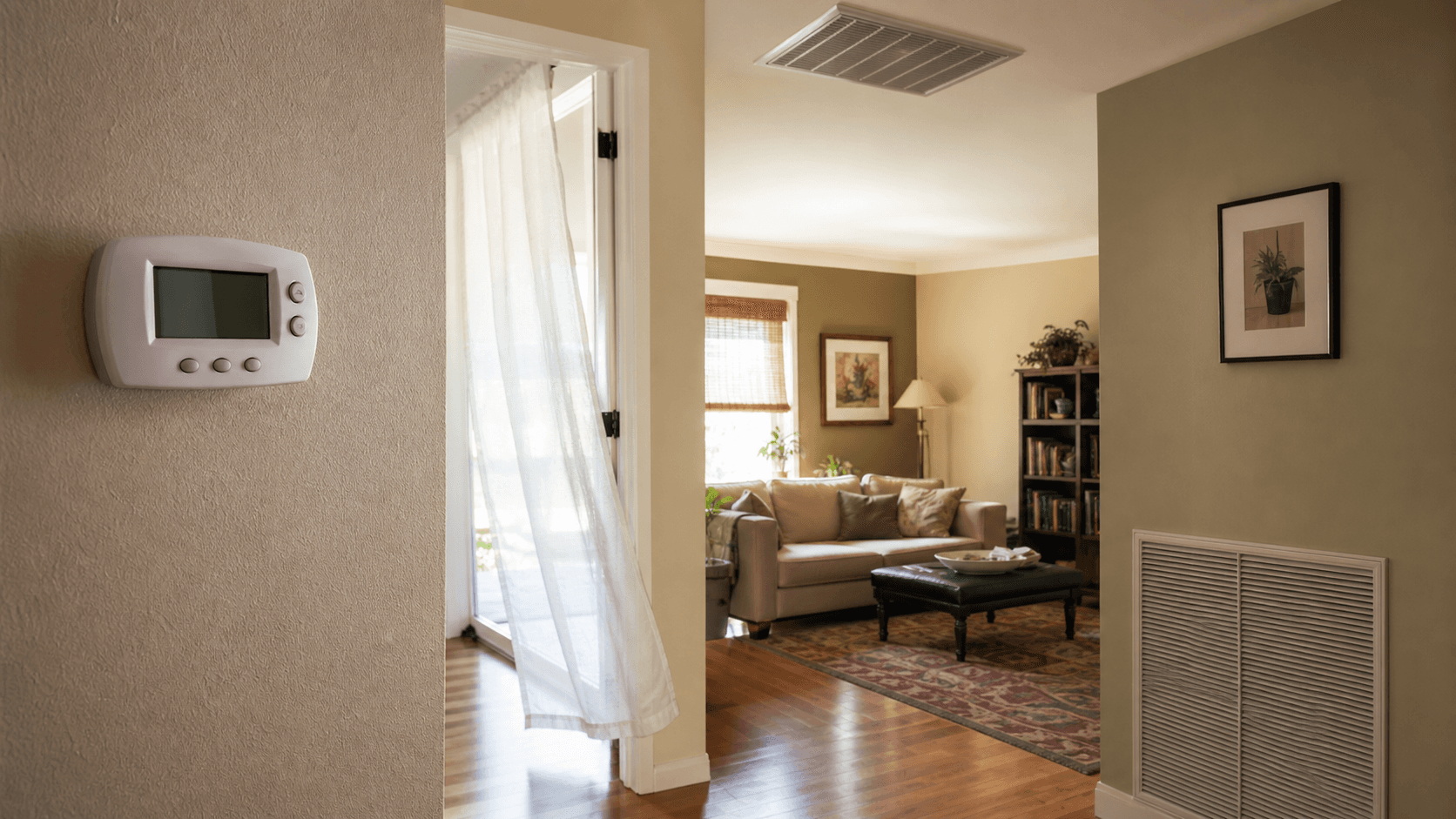
Start with what the thermostat requested, where air is moving, and which part of the system failed to answer.
If the AC is running but the house is not cooling, check the thermostat, filter, airflow, and visible outdoor equipment before calling for service. Stop sooner if there is ice, leaking water, a burning odor, smoke, sparking, or a breaker that trips. Do not open equipment panels, handle refrigerant lines, or keep restarting a system that is showing a safety warning.
The useful question is not “Is the AC dead?” It is “Which part of the cooling process appears to be missing?” A few observations can make the service call much better without turning the homeowner into the technician.
Give the thermostat one careful look
Confirm that the thermostat is set to cooling and that the requested temperature is below the room temperature shown on the display. If it uses replaceable batteries and the screen is weak or blank, follow the thermostat maker's instructions. Check whether a schedule, away setting, or utility control has changed the requested temperature.
Then leave it alone for a bit. Repeatedly lowering the setting does not make the equipment produce colder air. It can also muddy the symptom record. Note what the display says, whether the indoor blower starts, and whether the outdoor equipment starts at roughly the same time.
A thermostat screen does not prove the entire system has power. If the indoor fan runs but the outdoor unit is silent, or if the thermostat is calling for cooling and nothing starts, record that difference. Do not open the outdoor disconnect, remove an equipment cover, or reach into a service panel.
Airflow comes before temperature
Hold a hand near an accessible supply register without removing it. Is air moving with its usual force, barely moving, or absent? Check more than one room. Make sure supply registers and return grilles are not blocked by rugs, furniture, boxes, or closed louvers.
Check the filter only through the normal homeowner access described by the equipment maker. Confirm its size and airflow direction. If it is visibly loaded, replace or clean it according to those instructions. Do not run the system without a filter and do not force a thicker filter into a slot that was not designed for it.
ENERGY STAR puts filter care on the homeowner side of routine maintenance and assigns electrical measurements, refrigerant work, coil service, blower adjustment, and control testing to contractors in its heating and cooling maintenance checklist. That is a sensible dividing line here too.
Weak airflow after a filter check is enough reason to stop guessing. The cause could involve the blower, coil, ductwork, controls, or something else a hand at the register cannot identify.
Look at the outdoor unit without working on it
From outside the equipment, note whether the fan is turning, whether the sound is normal, and whether leaves, grass, fabric, or stored items are crowding the cabinet. Clear ordinary loose debris from the surrounding ground only when that does not require touching the cabinet, reaching through a guard, or using tools near electrical parts.
Do not spray cleaner into the unit, bend fins, remove a guard, or put a hand near the fan. A stopped fan, repeated clicking, harsh buzzing, or a unit that starts and stops quickly belongs in the service-call notes.
The U.S. Department of Energy's home cooling guide lists dirty filters, thermostat trouble, drainage problems, duct restrictions, control failures, and refrigerant problems among common reasons cooling performance falls off. Several produce similar symptoms. That is why the observation matters more than a homeowner diagnosis.
Ice changes the plan
Ice on an exposed refrigerant line, the indoor cabinet, or nearby tubing is not proof that the system needs more refrigerant. Restricted airflow, coil trouble, controls, or a refrigerant problem can all be involved. Turn off cooling through the normal thermostat control and arrange service. Do not chip the ice, pour hot water on it, or open the cabinet to speed thawing.
Tell the technician where the ice was visible and whether airflow had become weak before it appeared. If the system cools again after the ice melts, that does not mean the cause is gone.
The 4Homes weekly email
Every Tuesday: what changed for homeowners this week, plus our newest guides.
No spam. Unsubscribe anytime.
Water needs its own decision
Cooling equipment removes moisture from indoor air, and that water has to drain. Look for water around the indoor equipment, a full auxiliary pan, staining below the unit, or a wet ceiling near its location. ENERGY STAR notes that a blocked condensate drain can damage the house and affect indoor humidity.
Stop cooling if water is escaping its intended drain or approaching wiring, a ceiling, or stored belongings. Move possessions when it is safe. Do not open the cabinet or probe a drain beside electrical parts. Active ceiling damage, sagging material, or water near electrical equipment calls for a wider safety response, not another thermostat adjustment.
Odor, smoke, and power problems are stop signs
Treat a new burning or hot-plastic odor as a stop sign. Turn the system off with the normal control if that can be done safely. Smoke, sparking, or signs of fire mean leave the area and contact emergency services.
If a breaker has tripped, do not keep resetting it to make the cooling return. Use the breaker-tripping guide to decide what can be recorded safely and when the circuit needs to stay off.
Make the service call worth the visit
Before calling, write down the thermostat setting and room reading, when cooling dropped off, which rooms are affected, how strong the airflow feels, and whether the indoor and outdoor equipment start. Add the filter size and condition, visible ice, water, unusual sounds or odor, and any breaker event. Photograph only what can be seen without opening equipment.
Ask the technician to identify the failed part or failed function, the tests used, and the likely cause. Our position is simple: a replacement recommendation made before a written diagnosis is a sales pitch, not an answer.
If the diagnosis leads to a larger decision, continue with the HVAC repair-or-replace guide. First find out why the house is not cooling. Equipment age and a monthly payment can wait.