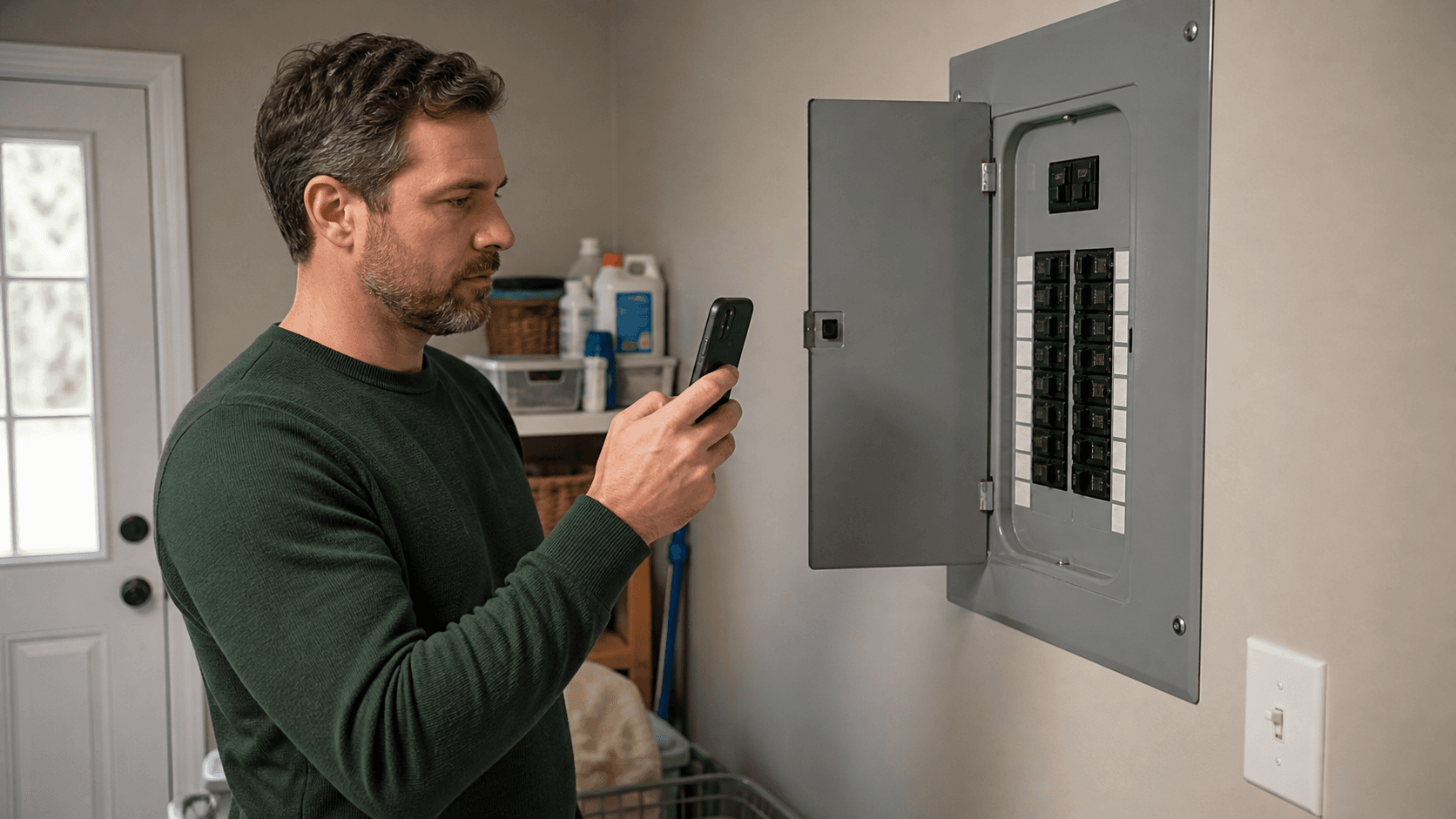
The breaker is doing protective work. Remove the likely load, record the pattern, and do not keep asking it the same question.
When a breaker keeps tripping, unplug or switch off the devices on the affected circuit and write down what was running. Consider one reset only when the likely overload has been removed, the panel and surrounding area are dry and undamaged, and there is no odor, buzzing, heat damage, smoke, or sparking. If the breaker trips again, leave it off and call a qualified electrician.
A breaker that trips twice has already answered the homeowner's question. Stop resetting it.
The trip is protection, not the failure itself
A circuit breaker opens a circuit when current exceeds the level the circuit is meant to carry or when certain fault conditions are detected. The U.S. Consumer Product Safety Commission explains this protective role in its guide to home wiring hazards. Restoring power without removing the cause can put the same condition right back on the wiring.
An overload is one possibility. A damaged appliance, short circuit, ground fault, arc fault, loose connection, or wiring problem can also be involved. The breaker handle cannot tell a homeowner which one occurred. The pattern around the trip can help an electrician find out.
Know when not to touch the breaker
Stay away from the panel when there is smoke, sparking, crackling, a burning or rubbery odor, visible heat damage, active water, rust with fresh moisture, or damage to the enclosure. Do not operate a breaker that feels loose or will not move normally. Do not touch the panel to check whether it is hot.
Keep people away and contact emergency services when there is fire or smoke. Water near the panel may require the electric utility and an electrician before the area is safe. If the warning is at an outlet, switch, cord, power strip, or appliance, do not handle that item merely to unplug it.
ESFI identifies frequent trips, flickering lights, buzzing, sparks, hot-insulation odor, discoloration, and shocks or tingles as signs that warrant electrical inspection in its home wiring safety guidance.
Unload the circuit from the room
If there are no stop signs, begin away from the panel. Turn off switches and unplug portable devices that lost power when the breaker tripped. Include space heaters, portable air conditioners, hair tools, countertop cooking appliances, vacuums, power tools, extension cords, and power strips. Do not move a large or hardwired appliance just to reach its connection.
Look at the items, plugs, and cords without touching anything damaged. A crushed cord, melted plug, discolored receptacle, or device that smelled hot changes the next step. Leave the circuit off and have the equipment and circuit evaluated.
Be honest about what was running. Two ordinary devices can be too much when they share a circuit with equipment in another room. A directory label such as “bedroom” may not describe every outlet actually connected to that breaker.
Record the pattern before resetting anything
Write down the breaker label and which lights or outlets lost power. List the devices that were on, which one had just started, and where extension cords or power strips were in use. Note whether the trip happened immediately, after equipment warmed up, or when several loads ran together. Add any dimming, sound, odor, or visible damage.
Photograph the directory and the breaker handle from outside the closed enclosure. Do not remove screws, trim, or the inner metal cover. Do not reach around a missing filler or opening. If the circuit label is vague or wrong, add that to the electrician's work list rather than experimenting inside the panel.
One reset has strict conditions
A single reset may be reasonable when all of these statements are true:
- The panel is dry, intact, normally accessible, and free of warning signs.
- The suspected plug-in overload has been removed.
- No cord, receptacle, switch, or appliance shows damage.
- The breaker handle can be reached through the normal hinged door without removing a cover or screw.
- The panel and breaker instructions allow the homeowner to reset it.
Follow the manufacturer's instructions. Many tripped breakers sit between on and off and must be moved fully off before returning to on. ESFI's home electrical system guide describes that common handle behavior and says the apparent problem should be removed first.
Use only the normal breaker handle and only as the equipment instructions direct. Never use a tool or remove a screw or cover to reach it. If there is uncertainty about the panel, the circuit, or the condition that caused the trip, skip the reset and call an electrician.
The 4Homes weekly email
Every Tuesday: what changed for homeowners this week, plus our newest guides.
No spam. Unsubscribe anytime.
If it holds, add loads slowly
A breaker that remains set with everything unplugged has not proved the circuit healthy. Turn on built-in lights first, then reconnect one portable device at a time. Wait long enough to see whether a specific device or combination brings the problem back. Stop immediately if lights flicker, an odor appears, a plug becomes discolored, or the breaker trips.
Do not use an extension cord into another room as the permanent solution. Do not replace the breaker with a larger one, tape it in position, or hold it on. The breaker rating protects the circuit wiring. Changing that protection is electrical work, not troubleshooting.
Trips without an obvious plug-in load need a professional
A breaker that trips when a refrigerator, dishwasher, disposal, pump, furnace, air conditioner, or other fixed equipment starts may point to the equipment, the circuit, or both. Leave the circuit off after a repeat trip. Give the electrician the device information and the trip pattern.
A breaker that trips with little or nothing operating deserves the same response. So does a trip that appears after rain, plumbing work, drilling, hanging hardware, pest damage, or a remodel. Those details can narrow the investigation, but they do not make the wiring safe to inspect from inside the panel.
Give the electrician a clean record
Share the circuit label, affected rooms, device list, trip sequence, photographs, and any recent work in the area. Ask what was tested, what condition caused the trip, and whether the fix involves the connected equipment, branch circuit, breaker, panel, or more than one of them.
Never remove the dead front or service-panel cover. Internal inspection, voltage testing, tightening, breaker replacement, conductor work, and circuit changes belong with a qualified electrician. For a broader outside-only review, use the electrical-panel safety guide.