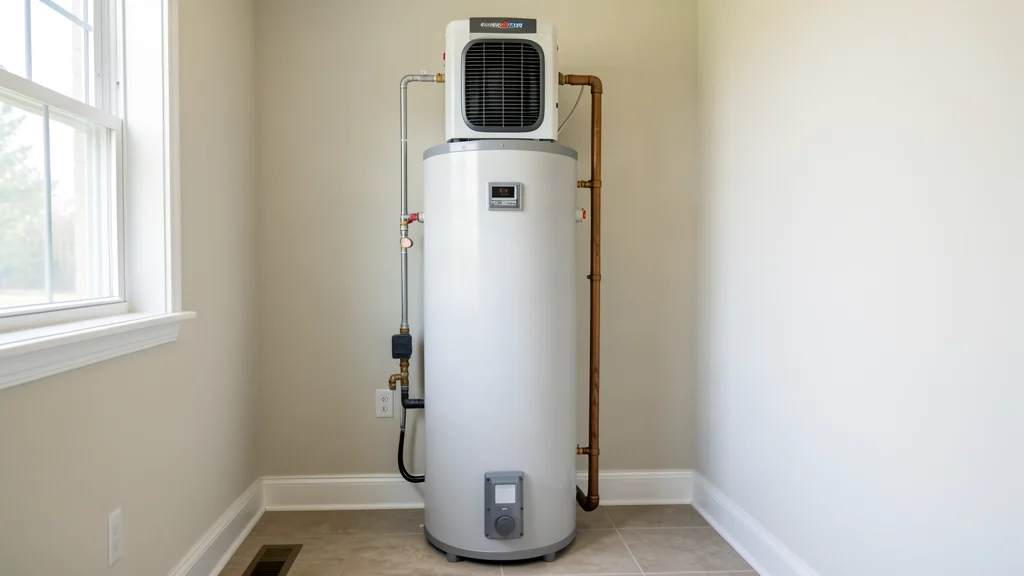
Compare household hot-water demand with the real installation space, electrical and drainage scope, operating tradeoffs, incentives, and complete installed cost.
A heat pump water heater can cut your electric water-heating bill significantly—ENERGY STAR notes certified models can use around 70% less energy than a standard electric water heater, with modeled savings of roughly $550 per year for a typical four-person household. Whether it fits your home depends on room size, airflow, condensate drainage, and your existing electrical and plumbing setup. If your space and budget align, it is a strong long-term upgrade; if not, a standard electric or gas unit may serve you better.
Quick Fit Table
Use this table as a first-pass screen before you call anyone. It does not replace a site visit, but it will tell you whether a heat pump water heater is likely to work in your space.
| Factor | Good Fit | Needs Planning or May Not Fit |
|---|---|---|
| Room volume | Open garage, basement, or utility room that meets the selected model’s documented room-volume or ducting requirement | Small closet, tight crawlspace, or enclosed cabinet with less than the model's required volume |
| Airflow | Unobstructed air around the unit; the heat pump pulls heat from surrounding air | Unit boxed in, blocked by stored items, or in a sealed enclosure |
| Condensate drainage | Floor drain, condensate pump, or easy pipe run to a drain nearby | No drain within reach; would require a new condensate pump and tubing |
| Temperature | Room stays above the model's minimum operating temperature (varies by unit) | Uninsulated garage that drops below the model's rated minimum in winter |
| Service clearance | At least the manufacturer-specified clearance on all sides for filter access and maintenance | Tight corner with no room to pull the unit forward for service |
| Electrical | Electrical supply matches the selected model | Existing supply does not match the selected model; circuit or panel work may be needed |
| Plumbing | Existing water connections can be adapted as the model and code require | Lines would need rerouting through finished walls or floors |
If two or more rows land in the "Needs Planning" column, budget extra time and money for a contractor to solve those details. If the room simply cannot meet the model-specific volume or airflow numbers in the manufacturer installation instructions, a heat pump water heater is not a safe fit no matter how attractive the savings look.
Quote Checklist
Before you accept any written estimate, make sure the quote covers every line below. You can also walk through the full list in our water-heater-replacement-quote-checklist for a printable version.
- Exact make and model of the proposed heat pump water heater, verified in the official ENERGY STAR certified-product directory
- Confirmed room volume and airflow check against that model's installation guide
- Condensate drainage plan (floor drain, pump, or new piping) with materials listed
- Electrical requirements for the exact model: voltage, circuit, breaker, wiring, disconnect, and panel capacity; some models are 120 V and others are 240 V
- Plumbing modifications: shut-off valves, expansion tank, T&P valve discharge, supply-line length changes
- Permit fees and who pulls the permit
- Disposal and haul-away of the old unit
- Warranty terms for both the unit and the labor
- A clear start date and estimated completion window
- Line-item pricing so you can compare scope across bids (see our contractor-quote-comparison guide for how to line up multiple bids side by side)
If a quote is a single lump sum with no model number or scope breakdown, ask for the breakdown before you sign.
Installed-Cost Ranges (Planning Ranges, Not Quotes)
ENERGY STAR notes that the purchase and installation cost of a heat pump water heater is often higher than a conventional electric water heater, so plan for a larger upfront outlay in exchange for lower operating costs over time.
Current national planning ranges from major home-services platforms:
- Angi: roughly $3,200 – $4,700 for professional installation
- HomeAdvisor's water-heater replacement cost guide: roughly $1,200 – $3,500 for hybrid heat-pump models within its broader replacement-cost table
These are planning ranges only, not quotes. Your actual number will shift based on:
- The specific model and capacity (tank capacity, first-hour rating, and operating modes)
- Electrical work (new circuit, panel upgrade)
- Drainage work (condensate pump, new floor drain)
- Permit fees in your municipality
- Location of the unit (basement vs. second-floor closet vs. garage)
- Whether the old unit must be removed from a tight space
Treat both figures as national reference ranges, not a floor, ceiling, or local quote. Actual costs may fall below or above them. Get multiple written, line-item quotes from licensed local contractors before committing.
When to Call a Licensed Professional
Skip the DIY route and call a licensed plumber or HVAC contractor if any of the following apply:
- The selected model needs a new circuit, disconnect, or panel modification
- The condensate drain requires a new pump, a new floor drain, or piping through a finished wall
- The unit must be mounted on a wall or in a location that requires structural support
- Your local code requires a permit for water-heater replacement (many jurisdictions do)
- The old unit is corroded, leaking, or shows the warning signs described in our water-heater-warning-signs guide
- You are not confident you can verify the model-specific room volume, airflow, temperature, and service-clearance requirements from the manufacturer installation instructions
A licensed professional will also confirm that the T&P relief valve discharge is routed correctly and that an expansion tank is installed where required, both of which protect your home and the new unit.
The 4Homes weekly email
Every Tuesday: what changed for homeowners this week, plus our newest guides.
No spam. Unsubscribe anytime.
Ways to Save Money
- Verify incentives before you buy. The U.S. Department of Energy notes that federal, state, and utility incentives for heat pump water heaters change frequently and must be verified for your address and the exact model you choose. Check your utility's website and the DOE energy-savings page for current programs. Do not assume a rebate you saw online still applies.
- Time the replacement with other work. If you are already opening a wall for plumbing or electrical, bundle the heat pump water heater install into that project to save on labor mobilization. Our renovation-priority-plan template can help you sequence projects so you are not paying twice for the same trade.
- Right-size the unit. Capacity affects purchase cost, standby losses, recovery, and how often a hybrid model uses resistance backup. Match the first-hour rating to your household's busiest hot-water hour instead of choosing by tank gallons alone.
- Run a monthly cost audit. Before you upgrade, track your current water-heating spend for two or three months so you can confirm the savings are real after installation. Our monthly-home-cost-audit worksheet walks you through the math.
- Ask about off-peak or time-of-use electricity rates. Some utilities charge less at night. A heat pump water heater that preheats during off-peak hours can stretch the savings further.
- Maintain the air filter. Follow the exact model's instructions for inspecting, cleaning, or replacing its air filter. Keep the required air path clear so the unit can operate as designed.
Heat-pump water heater FAQs
How long does a heat pump water heater last?
Service life varies by model, water quality, installation, operating conditions, and maintenance. Compare the written tank, parts, compressor, and labor coverage for the exact model instead of relying on a generic lifespan.
Can I install a heat pump water heater in a small closet?
Sometimes, but only when the selected model’s instructions allow the room volume, transfer-air grilles, louvers, or ducting design. A contractor should document how the installation meets those requirements.
Will a heat pump water heater cool the room?
Usually. It moves heat from surrounding air into the tank, so the discharge air is cooler and drier. The effect depends on room size, ducting, operating mode, climate, and run time.
Do I need a special drain for a heat pump water heater?
The unit needs a manufacturer-approved condensate route, such as an appropriate drain or condensate pump. The installer should include that route, overflow protection, and any required discharge piping in the written scope.
Frequently Asked Questions
How long does a heat pump water heater last?
Service life varies by model, water quality, installation, operating conditions, and maintenance. Compare the written tank, parts, compressor, and labor coverage for the exact model instead of relying on a generic lifespan.
Can I install a heat pump water heater in a small closet?
Sometimes, but only when the selected model’s instructions allow the room volume, transfer-air grilles, louvers, or ducting design. A contractor should document how the installation meets those requirements.
Will a heat pump water heater cool the room?
Usually. It moves heat from surrounding air into the tank, so the discharge air is cooler and drier. The effect depends on room size, ducting, operating mode, climate, and run time.
Do I need a special drain for a heat pump water heater?
The unit needs a manufacturer-approved condensate route, such as an appropriate drain or condensate pump. The installer should include that route, overflow protection, and any required discharge piping in the written scope.