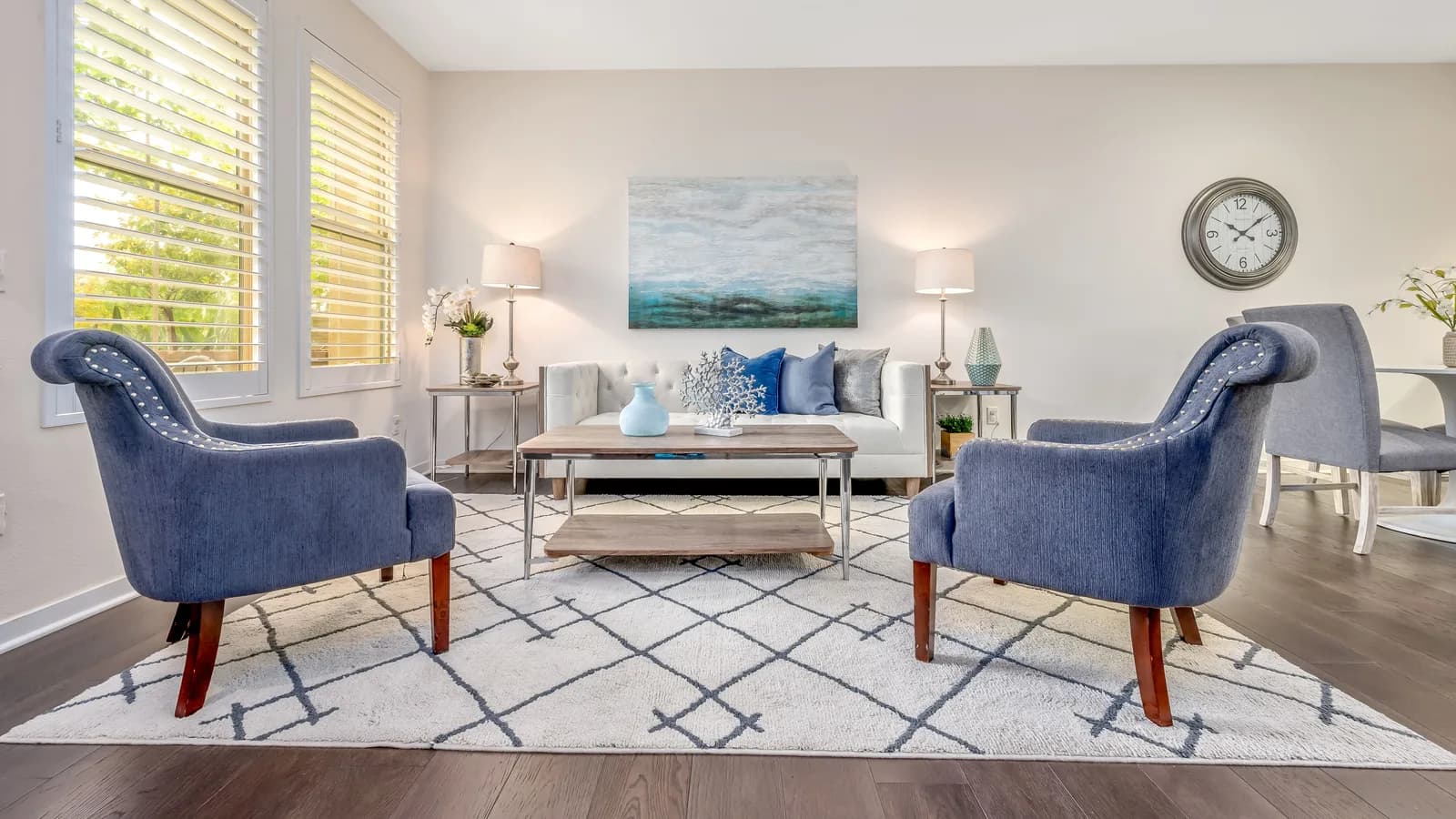
Tape the rug at full size around the real seating footprint, then test furniture legs, doors, walking routes, edges, care, and total cost.
Choose a living room rug around the complete furniture group, not a generic room-size chart. Put the proposed dimensions on the floor with tape. If the sofa and chairs look stranded, a door drags, or the main path becomes awkward, the rug is wrong before color or pattern enters the discussion.
Start with the furniture footprint
Draw the room with walls, doors, windows, hearths, vents, floor outlets, and openings to adjacent spaces. Then measure the sofa, sectional or chairs in their real positions. The useful footprint is the outside rectangle of the seating group, not the empty floor between the coffee table and sofa.
If the furniture layout is still unsettled, solve that first with the small living room layout guide. A rug cannot repair a blocked path or make an oversized sofa fit. When a new sofa is part of the plan, use the room and delivery-path measurement guide before choosing the rug.
A useful sketch needs a handful of real dimensions:
- Outside width and depth of the full seating group
- Sofa and sectional arm-to-arm width, depth, and leg positions
- Chair width, angle, and front-leg positions
- Main walking routes and the narrowest usable point
- Open door sweep and clearance beneath the door
- Distance to hearths, floor vents, thresholds, and dining furniture
Tape out the rug at full size
Mark the outside edge with low-tack painter's tape. Start with your likely size, then move the tape instead of trying to picture another six inches. If the flooring finish allows, leave the outline down for a day or two. Walk through normally. Open the doors, shift the chairs, and look at the shape from every entrance.
- Place the furniture where it functions best.
- Mark the front legs and outside corners of the seating group.
- Tape a rectangle that supports the chosen leg placement.
- Check whether every furniture foot sits fully on the future rug rather than on a bound edge.
- Add the expected rug pad thickness when checking door and transition clearance.
- Measure the final taped rectangle twice and compare it with the seller's actual dimensions.
Nominal names such as 8-by-10 are shortcuts. The listed product may differ by several inches, so use the exact dimensions in the product specification.
Choose one leg-placement strategy
| Layout | Usually fits | Pass condition |
|---|---|---|
| All legs on | Large rooms and open plans where the rug defines a complete conversation zone | Every sofa, chair, and table foot is fully supported with a visible border beyond the group |
| Front legs on | Standard living rooms and many apartments | Front legs of sofa and chairs land securely on the rug and the group reads as one zone |
| One-piece exception | A tight room where one chair must remain off the rug | The exception looks deliberate and does not create an unstable mixed-height seat |
| Coffee table only | Very compact zones where a larger rug would block doors or paths | The rug is large enough for the table and safe clearance, but this option may visually fragment a full seating group |
IKEA's rug guidance illustrates a medium rug around 170 by 240 centimeters with the front edges of seating on it, and a large rug around 200 by 300 centimeters anchoring the whole group. They are visual references, not laws.
For most living rooms, front legs on is the best place to begin. It ties the seating together without making an oversized rug the price of admission. The tape test may prove otherwise, especially in a large open plan, but it is the most useful first layout to try.
Sectional, apartment, and open-plan examples
Sectional with a chaise
Treat the chaise as part of the sofa footprint. A rug that reaches only under the main sofa section can make the chaise look detached. Tape an option that catches the front legs of both the sofa and chaise, then include any chair that faces them. If all legs on is too expensive or crowds the room, a consistent front-legs-on layout is usually clearer.
Small apartment living room
The route from the entry to the kitchen, balcony, or bedroom comes first. Do not push a rug into a doorway merely to reach a standard size. A slightly smaller rug that catches the front legs and leaves the path flat beats a larger one with a raised transition. If a desk also shares the room, work through the shared-room home office plan before ordering.
Open living and dining plan
Use the living-room rug to define the seating group without touching the dining-chair pullout zone. Leave a readable strip of floor between zones when possible. Aligning the rug with the main sofa or room axis usually looks more intentional than aligning it to the entire open floor.
Check doors, edges, and accessibility
Measure from the floor to the lowest point of every door that crosses the proposed rug. Add rug and pad thickness. A door that barely clears the bare floor may drag, fold a corner, or trap the rug. Do not cut a door, remove a required threshold, or cover a floor vent just to fit a preferred size.
Edges deserve the same attention as the center. Choose a pad approved for both the rug and the flooring. It should sit inside the rug perimeter and keep the surface flat without creating a visible ridge. Follow the floor maker's material restrictions because some backings or adhesives can discolor a finish.
For a household member using a wheelchair, walker, cane, or limited-foot-lift gait, test a rug sample and pad at the real transition. Keep fringe, curled corners, and thick edges out of primary routes. A rug that shifts or will not lie flat is not improved by its visual proportions.
The 4Homes weekly email
Every Tuesday: what changed for homeowners this week, plus our newest guides.
No spam. Unsubscribe anytime.
Read material and safety information
Choose pile and fiber around traffic, pets, spills, cleaning equipment, and furniture movement. A dense low pile or flatweave can be easier for doors, casters, and mobility equipment than a deep pile, but the exact construction and backing matter. Check cleaning instructions before buying; some rugs allow spot cleaning only, while others require professional cleaning.
The U.S. Consumer Product Safety Commission explains that carpets and rugs sold in the United States fall under federal surface-flammability standards in 16 CFR parts 1630 and 1631. Small rugs that do not meet the acceptance criterion can be sold only with a specified permanent flammability warning; larger rugs do not have the same labeling allowance. Check product labels and keep rugs away from ignition sources, fireplaces, heaters, and hot equipment according to their instructions.
Build a realistic 2026 rug budget
An IKEA U.S. category snapshot reviewed in October 2026 showed medium and large living-room rugs from roughly $70 for some synthetic examples to about $700 for a large hand-tufted wool example, with many examples between about $100 and $350. This is a planning range from one major retailer, not a quality ranking or nationwide price promise.
| Cost line | What changes it |
|---|---|
| Rug | Exact dimensions, fiber, weave, construction, pattern, and handwork |
| Pad | Rug size, floor compatibility, thickness, grip, and trimming |
| Delivery and return | Oversize shipping, pickup access, packaging, restocking, and return freight |
| Care | Vacuum suitability, spot treatment, rotation, and professional cleaning instructions |
| Furniture handling | Safe lifting or paid moving for heavy sofas and sectionals |
Do not spend the full room budget on the rug before accounting for the pad and return risk. The staged furniture budget guide can keep a rug purchase from displacing more urgent seating, lighting, or storage needs.
How to save money on the right size
Do the tape test before the purchase. Standard sizes often cost less and are easier to return than custom dimensions, but that advantage vanishes when the standard rectangle fights the measured layout. Compare exact size, construction, pad need, cleaning method, and return cost rather than price alone.
Then try the free layout change: rotate the outline, move a chair, tighten the conversation zone, or switch from all legs on to front legs on. A used rug can still be a bargain, but only when both sides can be checked for odor, stains, pests, edge damage, backing failure, and labels. Price the cleaning too.
Rotate the rug only as the care instructions permit, use the approved pad, respond to spills by the maker's method, and keep direct sun in mind. Good care can delay replacement, but no honest source supports one lifespan for every fiber, room, pet, or household.
Living room rug checklist
- The room, furniture group, openings, routes, vents, hearth, and thresholds are measured.
- The exact seller dimensions are taped on the floor at full size.
- All legs on, front legs on, or another deliberate rule is applied consistently.
- Sofa, chaise, and chair feet sit fully on the rug rather than on a bound edge.
- Doors clear the rug plus pad, and primary routes remain flat and accessible.
- Rug and pad are compatible with the flooring and cleaning routine.
- Flammability labels, care instructions, return terms, and total delivered cost are checked.
Frequently Asked Questions
What size area rug works with a standard sofa?
There is no reliable size based on the sofa label alone. Measure the entire seating footprint and tape out the proposed rug. A common starting point is a rug long enough to extend beyond both sofa arms and deep enough to hold at least the front legs of the sofa and chairs without placing furniture feet on a bound edge.
Should all living room furniture legs be on the rug?
Not always. All legs on can define a large open-plan seating zone, while front legs on often works in a standard room. The key is consistency: keep comparable seating pieces anchored the same way, support every furniture foot fully, and leave a clear, stable walking route.
What rug size works under a sectional sofa?
Measure the sectional's actual outside footprint, including the chaise, then add the chairs or tables that belong to the conversation zone. Tape the rug so it reaches under the front legs of both the main sofa and chaise, or under the full group if space and budget allow. Avoid a small rug that touches only the coffee table.
How much of the floor should show around a living room rug?
Use the room and furniture group rather than a fixed border rule. Aim for a visually consistent exposed-floor band where possible, but protect doors, vents, hearths, transitions, and the main path first. In an open plan, the rug should define the seating zone without intruding into dining or circulation space.
How do I stop an area rug from becoming a trip hazard?
Choose a rug and pad compatible with the floor, keep edges flat, support furniture feet fully, and avoid curled corners or loose fringe in the walking route. Check door clearance and transitions. If someone uses a walker, cane, or wheelchair, test the taped outline and a sample edge before buying, and replace or secure any rug that will not stay flat.