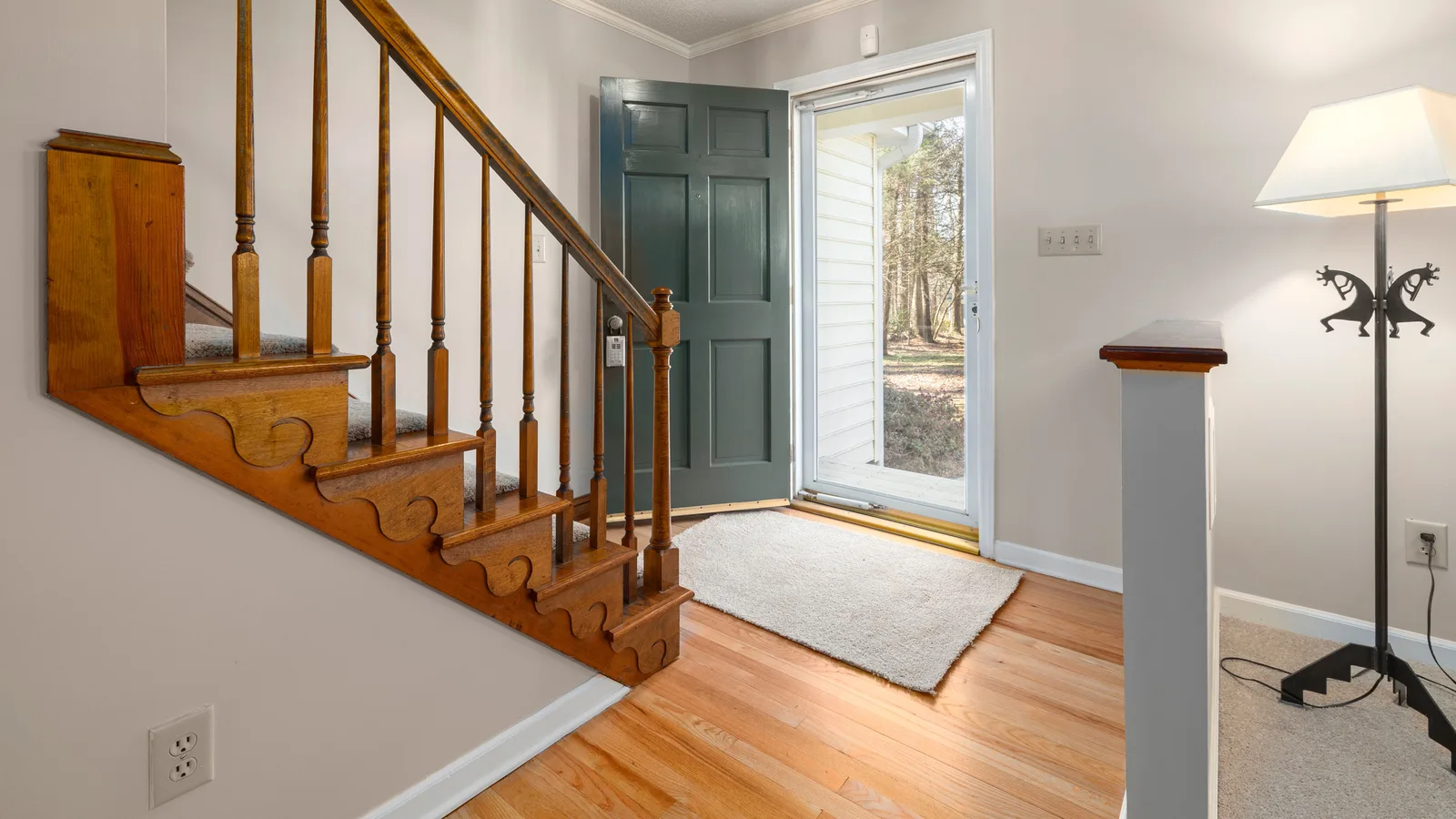
Choose an entryway rug by measuring door clearance and the actual walking route first, then match a low-profile, cleanable material and stable backing to the traffic.
Choose an entryway rug by testing the door swing and the walking path before choosing the pattern. Measure the actual clearance under every moving door, tape the exact rug size on the floor, and select a low-profile construction that can handle the dirt and moisture your household brings inside. A rug that drags under the door, slides on the floor, or makes a raised edge in the route is the wrong rug, even if it fits the décor.
An entry rug is not a smaller living-room rug. It is a landing surface between outside grit, wet shoes, bags, pets, and the rest of the house. Start with what has to move through it.
Measure the moving parts first
Open the exterior door all the way. Then open the storm door, closet door, powder-room door, or interior door that crosses the same area. Record the width and depth of the clear landing, the narrowest ordinary walking point, the threshold, floor vent, and the lowest point of each door above the bare floor. If the home uses a wheelchair, walker, cane, stroller, or rolling cart, include its actual line through the entry rather than an imagined straight path.
Place painter's tape at the proposed rug perimeter and walk it for a day. Carry groceries. Step in wearing wet shoes. Open the door from both sides. The tape test costs nothing and catches the two expensive mistakes: buying a rug that interferes with the door and buying one so small that people walk around it anyway.
| Entry shape | Useful starting layout | Pass condition |
|---|---|---|
| Small landing inside an in-swing door | Compact low-profile mat outside the swing, or no interior rug | Door opens, latches, and closes normally with no edge under it |
| Long, narrow hall | Runner centered in the actual travel line | Floor remains visible at the edges and nearby doors still clear |
| Open foyer | Small area rug that defines the landing, not every inch of floor | Routes to stairs, closets, and rooms remain obvious and flat |
| Wet-weather or pet entry | Washable, low-pile rug plus a separate shoe or boot plan | Wet footwear does not leave the rug saturated against the floor |
Do not treat a common nominal size as the finished dimension. Compare the tape outline with the seller's stated width and length, then add the thickness of a pad or attached backing to the door-clearance check. The living-room version of this method is in our area-rug measurement guide; this entryway version puts the swinging door and traffic route ahead of furniture placement.
Calculate clearance with the whole stack
Measure from the floor to the lowest point of a closed and opening door at its tightest point. Then compare that number with the listed pile height, backing, and pad thickness together. A thick rug can look fine when the door is parked open yet bunch or catch during ordinary closing. Storm doors and doors with weatherstripping can have a different low point from the main door, so test each one.
- Put a ruler or stack of thin cardboard at the taped rug edge.
- Close and open the door slowly without forcing it.
- Add a sample of the proposed rug and pad if available.
- Reject the setup if the door rubs, pushes the sample, folds an edge, or needs extra force to latch.
- Retest after rain or normal cleaning if the rug can swell, curl, or shift when damp.
Do not plane a door, remove a threshold, or defeat a weather seal to rescue a rug purchase. A door that changes operation may be protecting the entry from drafts and water. If the door is already dragging on bare flooring or has uneven gaps, use the drafty exterior-door diagnosis guide before adding anything underneath it.
Choose material and pile for the mess you actually have
Rugs Direct's entryway guidance separates runners for long entries, mats for compact landings, and small area rugs for wider foyers. That is a useful shape starting point, but fiber and construction decide whether the purchase survives. Look for a specific care label and construction description, not a vague claim that a rug is “durable.”
| Situation | Practical construction to investigate | Tradeoff to check |
|---|---|---|
| Frequent wet shoes, pets, or children | Machine-washable or washable low-pile synthetic | Confirm washing capacity, drying method, and whether the backing tolerates repeated care |
| Dry, covered entry with heavy foot traffic | Dense low pile, flatweave, or tightly woven wool | Check the maker's spot-cleaning and professional-cleaning instructions |
| Tight door clearance | Flat or low-profile weave with a slim compatible pad, if any | Backing and pad count toward the final height |
| Gritty outdoor approach | Separate outdoor scraper mat plus indoor rug | Clean under both regularly; a rug cannot remove grit after it is embedded |
Low pile is not only about door clearance. It makes grit easier to remove before it grinds against the fibers and the floor. Skip loose fringe in the travel line and do not assume a natural-fiber look belongs where snowmelt, mud, or dog paws arrive daily. If a product says “washable,” read the maximum washer size, drying restrictions, and backing instructions before you order.
Backing, pads, and the slip boundary
Non-slip backing is a feature to test, not a promise of safety. Rug and floor makers may limit which rubber, PVC, adhesive, or pad materials can sit on a finished wood, vinyl, laminate, tile, stone, or radiant-heated floor. Read both sets of instructions. A pad should stay inside the rug perimeter so it does not become a separate edge, and it should not add enough height to change the door test.
Keep the rug dry and free of grit underneath. Lift it during routine cleaning to inspect the floor and backing for moisture, discoloration, shedding, or residue. Replace it rather than taping down a curled corner or trying to disguise a shifting surface. For a household member with limited foot lift or a mobility device, test a sample edge under real use; appearance never outranks a stable route.
Plan the rug with the rest of the entry, not as an isolated purchase. Our entryway storage guide helps keep wet boots, keys, coats, and bags from landing on the same path. A boot tray can contain drips, but it should not trap water against the rug or flooring.
Cleaning routine that protects the floor and the rug
Vacuum or shake out loose grit at the frequency the use demands, following the rug label for brush-roll and suction settings. Blot spills; do not scrub them deeper. Use only the maker's approved spot treatment, rinse method, and drying direction. Before returning a washable rug, make sure it is fully dry and the floor below is dry too.
A simple prevention sequence saves more than a specialty cleaner: scrape or wipe shoes outside, use the right-size indoor rug, remove grit before it is walked through the house, and clean up wetness promptly. The lowest-cost entryway upgrade may be using a mat you already own in the correct place rather than buying a deeper pile that demands a new door adjustment.
The 4Homes weekly email
Every Tuesday: what changed for homeowners this week, plus our newest guides.
No spam. Unsubscribe anytime.
Costs and a buying list
Price the complete setup: rug, compatible pad if needed, delivery, tax, return shipping, and the cleaning method it requires. Recent listed examples show why an entryway budget needs a range: Tribesigns listed washable entry rugs from about $27 to $40, while Rugs Direct showed low-profile entry rugs beginning around $31 and other constructions far higher. Those are retailer snapshots, not a quality ranking or a promise that a size will be in stock at the same price.
Save by measuring before buying, choosing a standard size that passed the tape test, and ordering one returnable rug before matching the rest of the house. A used rug can be worthwhile only after checking both sides for odor, pests, stains, backing breakdown, curled edges, and a care label. The cheapest rug becomes expensive if it damages a floor finish, blocks a door, or has to be replaced after one wet season.
When not to use a rug
Skip the interior rug if the only workable position lies in a door swing, blocks a required route, stays wet, creates an unstable transition, covers a floor vent, or conflicts with a household member's mobility. Use an outside scraper mat where suitable, solve the water or door problem, or keep the landing bare and easy to clean. A floor covering is optional; safe movement through the entry is not.
Sources used
Rugs Direct, What Size Should an Entryway Rug Be? and current entryway product listings; Tribesigns washable entry-rug product and collection listings; U.S. Access Board floor and ground surface guidance; CDC fall-prevention guidance on throw rugs; the exact rug, pad, floor, and door manufacturers' instructions; and local accessibility guidance where an entry is part of an adapted route.
Frequently Asked Questions
What size rug is best for an entryway?
Use the measured landing or walking path, not a room-size chart. Tape the exact rug dimensions in place, open every nearby door, and leave the primary route and thresholds clear. A compact landing may need a small mat; a long, narrow hall may need a runner.
How much clearance does a door need over a rug?
Measure the lowest point of the moving door above the bare floor, then compare it with the rug plus any pad or built-in backing. Do not buy on an assumed clearance. If the door barely clears, choose a thinner construction or keep the rug outside its swing path.
What rug material is best for a high-traffic entryway?
Choose around the water and grit the entry really receives. A low, dense synthetic or washable construction is often practical for wet shoes and frequent cleaning; tight wool can work in a drier entry if its care label fits the household. Avoid a material that cannot be cleaned on the schedule the space requires.
Do entryway rugs need a non-slip pad?
A compatible non-slip pad or integrated backing can help, but it is not a universal cure. Check both the rug and flooring manufacturer instructions, keep the pad inside the rug edge, and remove any rug that still curls, shifts, or creates a raised transition.
Can an entryway rug create a trip hazard?
Yes. A curled edge, thick pad, loose fringe, shifting backing, wet surface, or rug placed in a door swing can create a trip or slip risk. Test the real route with footwear, mobility aids, strollers, and the door before keeping it.