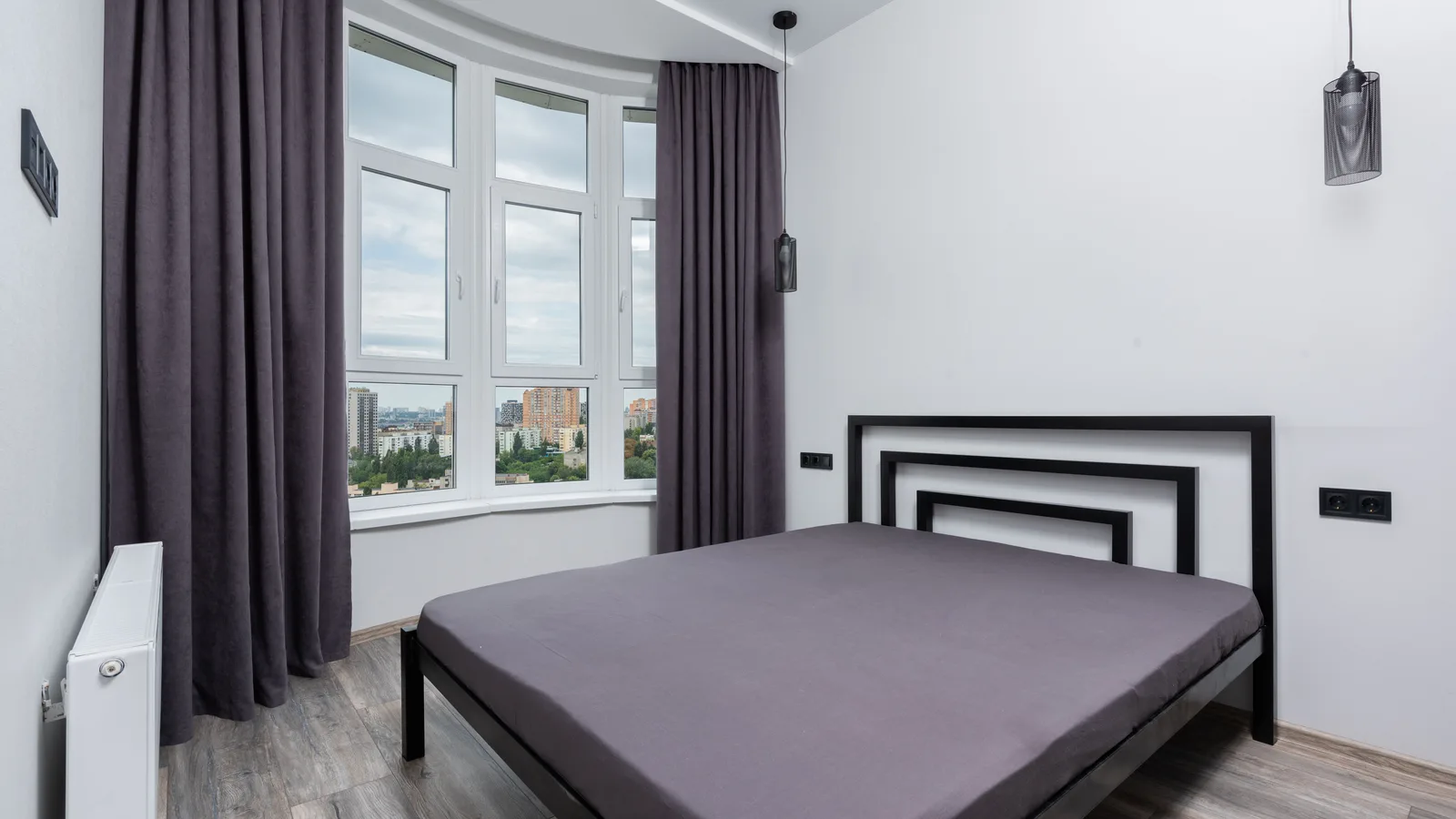
A fabric rating cannot stop light that slips around the installation. Measure the blackout zone, plan the overlap, and mount the full load safely.
Choose blackout curtains by measuring the area that must be covered, not just the window glass, and by treating edge gaps as seriously as the fabric. Pick a lined or tightly constructed panel whose light-blocking claim you can verify, give the pair enough width to overlap at the center, and mount the rod or track close enough to the wall that light cannot wash around the sides. The best-looking fabric will disappoint if the installation leaves a bright frame around it.
Decide how dark the room actually needs to be
“Blackout” and “room darkening” are not interchangeable shopping goals. Room darkening may be enough for an ordinary bedroom where a soft dawn glow is acceptable. A daytime sleeper, nursery, street-facing room, or bedroom opposite a bright security light may need much tighter control. Write down the troublesome light source and the hours it matters before choosing anything.
Test the room at that hour. Close any treatment already there and photograph the window with the room lights off. Mark whether light comes through the material or around the top, sides, bottom, and center. This separates two different purchases: better fabric and better coverage. In my view, coverage is the more commonly missed half of the job.
Measure the blackout zone before choosing panel size
Measure the outside edges of the trim, the clear wall on both sides, the space above the trim, and the distance to the floor or sill. Note radiators, baseboard heaters, vents, handles, deep sills, furniture, nearby walls, and the window's emergency-escape role. Then measure the rod or track you intend to use. Curtain size should answer that finished installation, not a generic window width.
| Measurement | Why it matters for darkness | What to record |
|---|---|---|
| Side coverage | Panels ending at the trim leave a bright vertical line | Trim edge, available wall, bracket position, finial, and desired return |
| Top coverage | A low rod can expose a bright band above the header | Trim-to-ceiling space, bracket height, header drop, and track depth |
| Bottom coverage | A short panel leaks light across the sill or floor | Finished hanging point to sill or floor, minus safe clearance |
| Center closure | Two panels that only touch can separate during normal use | Usable rod width, panel return, heading, fullness, and planned overlap |
| Projection | A rod far from the wall lets light turn around the side | Trim depth, existing blind, bracket return, and wall-to-fabric gap |
IKEA's measuring guidance suggests extending a curtain rod at least 15 centimeters, about 6 inches, beyond each side of a window and bases pleated curtain width on the rod length. Treat that as a starting point, not a universal blackout rule. Thick panels need room to stack when open, and a bright window may need wider side coverage or a return-style rod that brings the curtain back toward the wall.
Seller dimensions can be slippery. A package may state the flat width of one panel, the combined width of a pair, or the finished width after pleating. TWOPAGES tells buyers to determine rod or track placement first and then account for the maker's default fullness. Confirm whether the number in the cart is fabric width or finished coverage, and write the pair's combined finished width on your worksheet.
Control the four common light gaps
- Sides: extend coverage beyond the opening and use a rod with returns, a wraparound rod, or a track positioned close to the wall. Check that the outer edge can reach the wall without fighting a finial or bracket.
- Center: use enough finished width for the panels to close with relaxed folds. Overlap the leading edges or use a track with a master carrier when a hairline split would wake the sleeper.
- Top: place the rod or track high enough that the header blocks the view to the glass. A ceiling track or simple pelmet can address a persistent top glow, but only when mounted as its maker directs.
- Bottom: choose a finished length that reaches the sill or floor while staying clear of heat sources, wet areas, door travel, and tripping or cleaning problems.
A flashlight held behind a fabric sample can reveal pinholes or obvious transmission, but it cannot prove how the whole window will perform. The better test is one returnable panel hung in the real room during the brightest hour. Use painter's tape or dark towels temporarily at the edges to see whether added overlap fixes the problem before buying new fabric.
Choose the fabric and lining as a system
Blackout performance can come from a dense woven construction, a bonded or coated backing, or a separate opaque lining behind a face fabric. None is automatically best for every bedroom. A woven blackout panel may be washable and simple. A coated backing may provide strong opacity but can have cleaning and creasing limits. A separate lining lets you choose a decorative face fabric and can be replaced or altered, though the finished treatment becomes heavier.
| Construction | Check before buying | Likely tradeoff |
|---|---|---|
| Blackout yarn or dense weave | Hold a sample to a strong light; read care and opacity claims | Color and weave can affect remaining glow |
| Bonded or coated backing | Inspect sample flexibility, odor, crease behavior, and cleaning instructions | Backing can require gentler handling than the face fabric |
| Separate blackout lining | Confirm attachment, combined weight, stack depth, and whether lining reaches every edge | More weight and bulk for the rod, brackets, and daily movement |
| Layered curtain plus shade | Operate both together and keep all controls safe and accessible | Higher cost and more depth, but the layers can cover one another's gaps |
Dark color is not a substitute for an actual construction claim. A pale face fabric with an opaque lining can outperform an unlined dark panel. Order swatches, read the care label, and check whether panels are sold singly or in pairs. Ordinary curtains do not soundproof a room.
Match the heading and hardware to daily use
Grommets and rod pockets are straightforward, but they can create top scallops or friction that keeps the center from closing neatly. Back tabs hide the rod but may not slide easily. Rings or a traverse track can close more consistently, especially across a wide span. The right choice is the one the household can fully close every night without tugging on the brackets.
Use the rod maker's span, bracket-count, center-support, and load instructions. Weigh the full pair with lining, rings, and any overlap hardware when the specification asks for load. Stud attachment is useful where bracket locations permit it. Otherwise use fasteners approved for the actual wall material and expected load; the tiny generic anchors in a hardware bag are not proof that a heavy lined curtain is safe on every wall. Our guide to hanging curtain rods at the right height and width covers the bracket layout and load check in detail.
Keep the installation safe
Do not drill blindly beside or above a window. Wiring, plumbing, metal corner bead, masonry, lintels, and framing can change the mounting plan. Stop if the wall crumbles, a fastener spins, the bit meets unexplained resistance, or the bracket moves after loading. Keep fabric away from radiators, baseboard heaters, vents, candles, lamps, and other heat sources according to the appliance and curtain instructions.
The U.S. Consumer Product Safety Commission says cordless window coverings are the safest option where young children are present. If the curtain layers over a shade or blind, do not hide an accessible cord behind it. Secure any permitted continuous-loop operating cord with the required tension device and correct fasteners, and move cribs, beds, toys, and climbable furniture away from cords. The window must also remain reachable and operable if it serves as an emergency escape opening.
What blackout curtains cost
HomeGuide's national cost guide lists blackout curtains at about $10 to $250 per panel and curtain rods at about $3 to $40 or more. It places professional curtain installation around $45 to $250 per window, with higher totals for custom fabric, unusual sizes, specialty hardware, difficult access, or motorization. Current Home Depot examples reviewed for this guide ranged from roughly $17 for a basic liner pair to about $70 for some ready-made blackout panel pairs. These are planning ranges, not quotes; size, stock, shipping, lining, panel count, returns, hemming, and hardware can change the total.
| Budget line | Planning range or pricing step | Do not leave out |
|---|---|---|
| Ready-made panels | About $10 to $250 per panel, per HomeGuide | Number of panels, finished width, lining, shipping, and returns |
| Rod and basic hardware | About $3 to $40 or more for the rod, per HomeGuide | Returns, rings, center support, rated fasteners, and tools |
| Professional installation | About $45 to $250 per window, per HomeGuide | Measurement, wall type, height, patching, cleanup, and minimum visit fee |
| Custom treatment | Request a written local quote after final measurements | Face fabric, lining, fullness, track, fabrication, delivery, and fit remedy |
The 4Homes weekly email
Every Tuesday: what changed for homeowners this week, plus our newest guides.
No spam. Unsubscribe anytime.
How to save without accepting a bright edge
Improve the installation before upgrading the fabric. Reuse a sound rod if it has the required width, return, span, and load rating. Buy one returnable pair for the problem window, test it at the troublesome hour, then repeat the order. Stock lengths can work when the planned rod height matches them; hemming ready-made panels may cost less than custom fabrication.
Layering existing cordless blinds with curtains can improve darkness because one treatment covers the other's gaps. Measure first with the window-measurement guide for blinds. If solar heat or winter drafts are the real complaint, use the room-by-room energy reset before assuming curtains will repair the window. The U.S. Department of Energy advises using curtains and shades to manage direct summer sun and winter heat loss, but operation and fit matter.
When to call a pro
Call a qualified window-treatment installer or handyman for tall stairwell windows, very wide spans, heavy lined drapery, ceiling tracks, masonry or tile, damaged plaster, uncertain framing, or repeated anchor failure. Use a licensed electrician for hardwired motorized tracks or new electrical work. Ask for a written scope covering measurements, finished coverage, bracket and fastener method, load assumptions, center supports, cord safety, patching, cleanup, and the remedy if the treatment does not fit. Compare bids with the contractor quote comparison guide.
Bedroom blackout-curtain checklist
- Test the room during the brightest troublesome hour and mark every light path.
- Measure trim, side wall, ceiling, sill or floor, obstacles, and the proposed rod or track.
- Confirm whether product width is per panel, per pair, flat fabric, or finished coverage.
- Choose a verified opaque weave, backing, or lining and read its care instructions.
- Plan side returns, relaxed center overlap, top coverage, and safe bottom clearance.
- Match the rod, brackets, supports, and fasteners to the complete fabric load and wall.
- Keep cords inaccessible, heat sources clear, and emergency window operation available.
- Install and test one complete window before repeating the order.
Related guides
- Set curtain-rod height, width, and brackets from the actual panels and wall.
- Measure windows for blinds or layered shades without inventing a factory deduction.
- Plan a small bedroom so curtains do not crowd the bed or walking path.
- Build a one-room refresh budget before custom fabric consumes the project.
- Trace comfort and energy problems room by room instead of asking curtains to fix the window.
Sources used
U.S. Department of Energy guidance on energy-efficient window coverings and seasonal curtain operation; U.S. Consumer Product Safety Commission window-covering cord guidance; IKEA measuring guidance for curtain rods, brackets, and pleated width; TWOPAGES drapery measuring instructions; HomeGuide's national curtain cost guide; current Home Depot blackout-curtain listings reviewed October 24, 2026; and the exact curtain, rod, track, bracket, fastener, and wall-anchor manufacturer instructions for the products being installed.
Frequently Asked Questions
How do I choose good blackout curtains for a bedroom?
Start with the darkness the sleeper needs, then compare a physical fabric sample or documented blackout lining, finished panel width, hanging style, returns at the wall, center overlap, and floor or sill coverage. A strong fabric rating will not stop light that enters above, beside, below, or between the panels.
What is the difference between blackout and room-darkening curtains?
Room-darkening curtains reduce light but may leave the room visibly lit. Blackout curtains use an opaque weave, backing, or separate lining intended to block far more light through the fabric. Neither term guarantees a dark room unless the installed treatment also controls edge and center gaps.
How wide should blackout curtains be?
Measure the finished rod or track coverage, not only the glass. The combined finished curtain width must close without stretching flat and must suit the selected heading's fullness. IKEA's curtain guidance uses about 1.5 to 2 times rod length for a single-pleat effect and 2 to 2.5 times for a double pleat, but the exact curtain maker's measuring rules control.
Why do my blackout curtains still let light in?
Most remaining light enters around the installation: above the rod, at the side returns, below a short hem, or through a center split that barely meets. Close the curtains during the brightest troublesome hour, identify each bright line, and change coverage or hardware rather than assuming a darker fabric will fix an edge gap.
Do blackout curtains help with heat and cold?
Closed curtains can reduce solar heat entering during hot sunny periods and help reduce heat loss in cold weather, but performance depends on fit, layers, operation, and the window itself. U.S. Department of Energy guidance treats window coverings as one part of heat-gain and heat-loss control, not as a repair for a leaking or failed window.