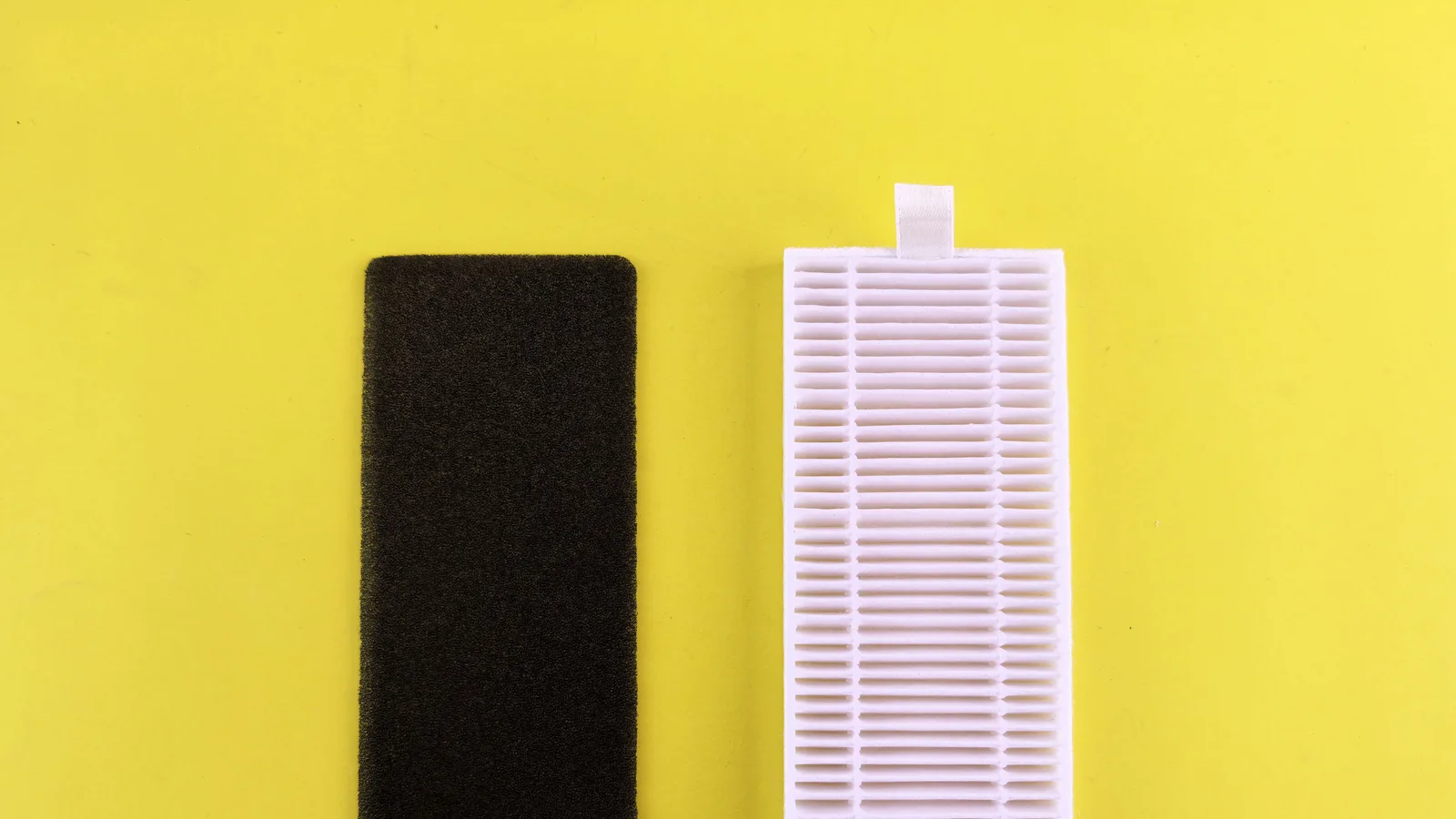
Identify every filter layer before cleaning: maintain only the model-approved pre-filter and replace rather than wash most HEPA and carbon media.
Clean an air purifier filter only after identifying each layer in the exact model manual. Unplug the unit, clean a washable or vacuumable pre-filter only by its instructions, and replace rather than wash most HEPA, main, and activated-carbon filters. A filter that looks cleaner after an improvised rinse is not necessarily still performing as designed.
“Air purifier filter” can mean a coarse screen, fabric sleeve, foam pre-filter, pleated particle filter, HEPA filter, carbon sheet, pellet bed, or a bonded cartridge containing several of them. Those parts can sit inches apart and require opposite care. The model number and filter part number settle the question; color and texture do not.
Identify the filter before touching it
| Component | Common job | Safe default until the manual is found |
|---|---|---|
| Mesh, fabric, or foam pre-filter | Catches hair and larger dust before the main media | Do not wash; confirm whether the model allows vacuuming or rinsing |
| Pleated main or HEPA filter | Captures airborne particles | Keep dry and replace when due unless explicitly labeled washable |
| Activated-carbon layer | Targets some gases and odors | Do not wash or add fragrance; replace by the model schedule |
| Combination cartridge | Packages two or more media in one part | Treat the complete cartridge as replace-only unless its manual says otherwise |
Photograph the installed stack before removal. Record the purifier model, filter part number, airflow arrow, tabs, gasket position, filter-light status, and installation date. If the manual is missing, use the manufacturer's support library keyed to the full model number. A generic video for a similar-looking cylinder is not a match.
EPA describes portable air cleaners as a supplement to source control and clean-air ventilation, not a device that removes every pollutant. It also says overloaded filters do not work well. Cleaning the right pre-filter and replacing spent media preserve the product's tested airflow path; neither step fixes a moisture source, combustion problem, active smoke source, or ongoing chemical release.
Use a model-first cleaning sequence
- Turn the purifier off and unplug it. Move it only by its handle or cabinet instructions. Stop for a hot plug, damaged cord, liquid exposure, smoke, sparking, or a burning odor.
- Open only the owner-access filter cover. Do not remove screws, fan guards, ionizer assemblies, sensors, or electrical panels. Photograph the filter order before lifting anything out.
- Carry the removable filter carefully. Avoid shaking captured dust through the room. Households with respiratory sensitivity should follow their health professional's advice about exposure and have another person handle a loaded filter when appropriate.
- Clean only the approved pre-filter. Some manuals specify a soft-brush vacuum; others allow a rinse; some say the part cannot be washed. Use no soap, disinfectant, bleach, essential oil, compressed air, or brush unless the manual names it.
- Dry a washable part completely. Use the manual's drying position and time. Keep it away from a dryer, hair dryer, oven, direct flame, or other shortcut that can warp the media.
- Replace due or damaged media. Match the complete part number and model compatibility. Remove shipping plastic from the new filter, but do not remove a bonded layer that is part of the cartridge.
- Reassemble in the recorded direction. Seat gaskets, tabs, and covers without forcing them. Restore power only when every washable part and the cabinet are dry.
- Reset and verify. Use the model's reset sequence, run the normal mode, and check for ordinary airflow, sound, odor, and a securely closed cover.
Do not turn a filter reminder into a cleaning contest
A reminder may be based on elapsed time or estimated use; another model may consider fan speed or measured resistance. It does not prove the filter can be restored with a vacuum. Levoit's current maintenance guidance says pre-filters can typically be vacuumed and some model-specific pre-filters rinsed, while main and carbon filters are replaced. Samsung gives a similar distinction for covered models: its pre-filter is washable, while the deodorization and dust-collecting filters are not. Those are manufacturer examples, not permission for a different purifier.
Check earlier than the calendar after wildfire smoke, indoor construction, heavy pet shedding, or another unusual particle event. Replace a filter with a torn frame, damaged seal, collapsed pleats, moisture exposure contrary to the manual, or a persistent odor the instructions identify as a replacement sign. Do not spray fragrance or cleaner onto media to mask an odor.
If airflow stays weak with the correct new filter, or the fan rattles, overheats, smells hot, will not run, or repeatedly reports a fault, stop. Internal fan, sensor, control, or electrical diagnosis belongs with manufacturer support or qualified appliance service. The indoor-air-quality reset helps separate equipment care from pollutant-source work.
Check the fit before blaming the new filter
A replacement can be the correct shape and still be the wrong part. Compare the complete part number, dimensions, tabs, gasket, and airflow arrow with the old filter and the model's parts list before discarding the packaging. Confirm that all shipping wrap is removed, every layer is in the recorded order, and the cover closes without pressure. A crushed gasket, reversed cartridge, leftover wrapper, or cover that is not latched can restrict airflow or let air bypass the media.
After reassembly, run the purifier at its normal setting for several minutes and compare sound and airflow with the pre-service condition. Record the installation date and the indicator reset in a phone note, calendar, or label that will not block an intake. Keep the receipt and filter part number together. If the new filter immediately produces unusual odor, noise, heat, repeated warnings, or weak airflow, unplug the unit and recheck only the owner-access steps. Do not trim, tape, compress, or force an incompatible filter to make it fit.
Plan the recurring cost before buying another filter
Home Depot listings checked November 9, 2026 showed model-specific portable-air-cleaner filter examples at $35.98 and $59.97, while the broader category ranged from about $10 to $400. Levoit listed one large-model replacement at $99.99. These are dated national online examples, not recommendations or local quotes. The exact purifier may need one cartridge, a main filter plus carbon sheets, shipping, or a proprietary part that changes annual cost.
| Cost line | What to verify | Saving move that preserves performance |
|---|---|---|
| Replacement media | Exact model, part number, included layers, and quantity | Compare annual filter cost before replacing the purifier |
| Pre-filter care | Approved vacuum or wash method and interval | Maintain the reusable layer without touching replace-only media |
| Electricity | Power by speed and realistic daily run time | Use a correctly sized unit at a tolerable setting instead of an undersized unit at full speed |
| Duplicate equipment | Room need, CADR, placement, and source-control work | Move or right-size an existing purifier before buying another |
The best savings is not stretching a saturated filter past its instructions. Keep the intake clear, clean the approved pre-filter, and reduce the pollutant source so the main filter is not carrying avoidable dust. The air-purifier buying guide explains CADR and replacement-cost comparisons; the furnace-filter guide covers the separate central-HVAC job.
The 4Homes weekly email
Every Tuesday: what changed for homeowners this week, plus our newest guides.
No spam. Unsubscribe anytime.
Filter-care checklist
- The full purifier model and replacement-filter part number are recorded.
- Each pre-filter, HEPA, carbon, and combination layer is identified.
- The unit is unplugged and only owner-access covers are opened.
- Only the manual-approved component receives water or vacuuming.
- Washable parts are completely dry before reassembly.
- New media is correctly oriented, unwrapped, seated, and sealed.
- The indicator is reset only after the required maintenance is complete.
- Persistent odor, weak airflow, heat, noise, or electrical damage has a service path.
Air purifier filter FAQs
Can you wash an air purifier HEPA filter?
Usually no. Wash a HEPA filter only when the exact model manual explicitly calls that filter washable and gives a rinse-and-dry procedure. Most portable-air-cleaner HEPA and main filters are replacement media; washing, brushing, or improvising a cleaner can damage them even when they still look intact.
How often should an air purifier filter be changed?
Use the interval and filter indicator for the exact model, then check sooner when smoke, pets, construction dust, or long run times load the filter quickly. EPA says every filter needs regular replacement; manufacturer examples commonly span several months to about a year, but they are not a universal schedule.
Can I vacuum an air purifier filter?
Vacuum only the component and surface the model manual permits, usually a pre-filter. Use the stated tool and suction method without pressing into pleats. Vacuuming a replace-only HEPA or carbon layer is not a substitute for replacement and may damage media that was not designed for owner cleaning.
Why is the air purifier filter light still on after replacement?
Many indicators are timers or usage counters and need a model-specific reset after a new filter is installed. First confirm the replacement part, orientation, packaging removal, and cover closure, then follow the manual's reset sequence. Do not reset the light merely to postpone a due replacement.
Should I replace the carbon filter at the same time as the HEPA filter?
Follow the model's filter design. A bonded combination filter is replaced as one assembly, while a separate carbon sheet may have its own interval. Lingering odor can signal exhausted carbon, but it can also mean the pollution source needs removal rather than more filtration.
Sources used
U.S. Environmental Protection Agency, Guide to Air Cleaners in the Home, for filtration limits, CADR context, source control, and regular replacement; Levoit, How to Clean Your Air Purifier, and Samsung air-purifier filter guidance for model-specific examples; Home Depot and Levoit listings checked November 9, 2026 for dated filter-cost examples; and the installed purifier's owner manual for the controlling cleaning, drying, replacement, and reset instructions.
Frequently Asked Questions
Can you wash an air purifier HEPA filter?
Usually no. Wash a HEPA filter only when the exact model manual explicitly calls that filter washable and gives a rinse-and-dry procedure. Most portable-air-cleaner HEPA and main filters are replacement media; washing, brushing, or improvising a cleaner can damage them even when they still look intact.
How often should an air purifier filter be changed?
Use the interval and filter indicator for the exact model, then check sooner when smoke, pets, construction dust, or long run times load the filter quickly. EPA says every filter needs regular replacement; manufacturer examples commonly span several months to about a year, but they are not a universal schedule.
Can I vacuum an air purifier filter?
Vacuum only the component and surface the model manual permits, usually a pre-filter. Use the stated tool and suction method without pressing into pleats. Vacuuming a replace-only HEPA or carbon layer is not a substitute for replacement and may damage media that was not designed for owner cleaning.
Why is the air purifier filter light still on after replacement?
Many indicators are timers or usage counters and need a model-specific reset after a new filter is installed. First confirm the replacement part, orientation, packaging removal, and cover closure, then follow the manual's reset sequence. Do not reset the light merely to postpone a due replacement.
Should I replace the carbon filter at the same time as the HEPA filter?
Follow the model's filter design. A bonded combination filter is replaced as one assembly, while a separate carbon sheet may have its own interval. Lingering odor can signal exhausted carbon, but it can also mean the pollution source needs removal rather than more filtration.