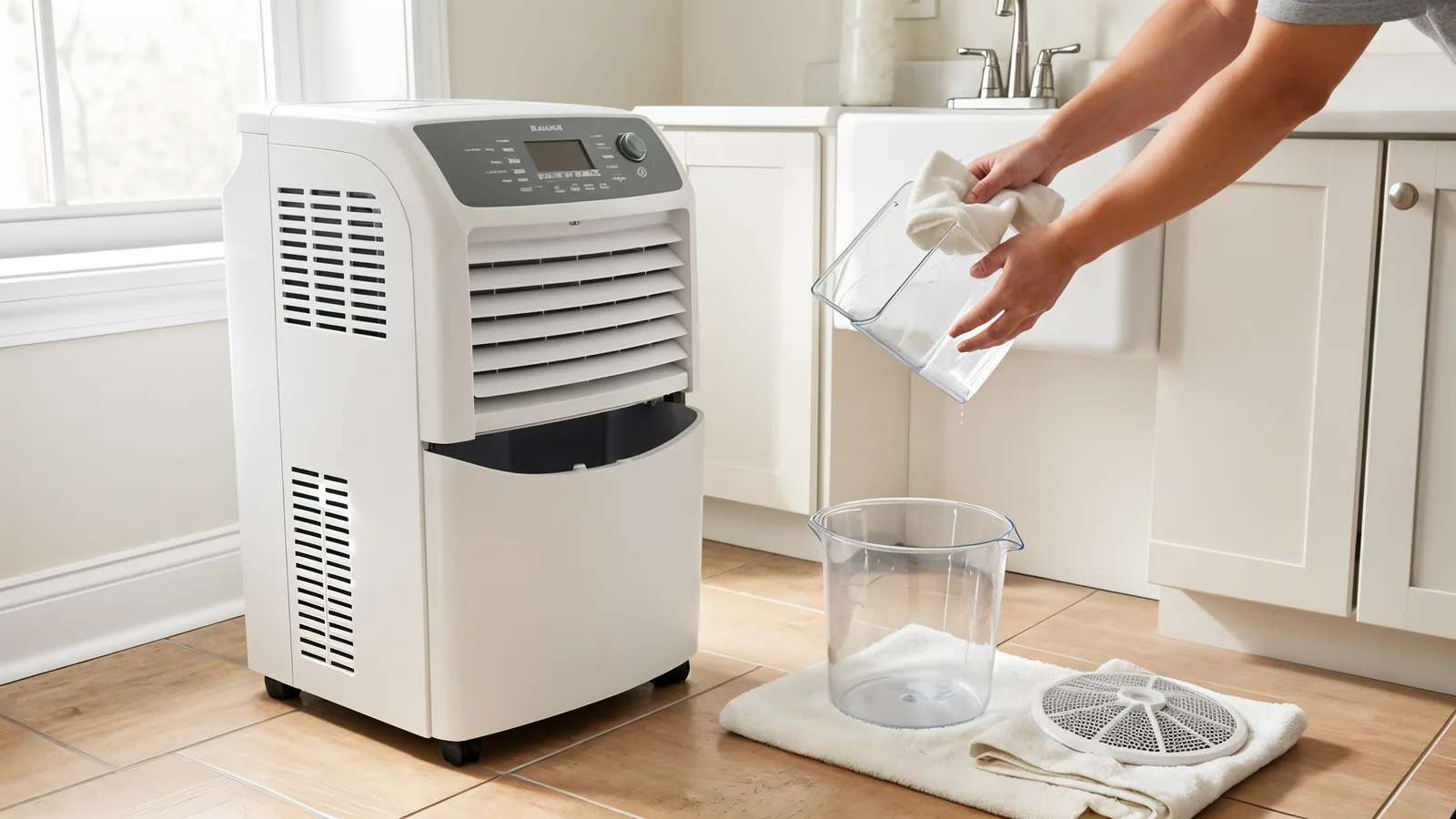
Clean the removable filter and bucket by the model manual, then use humidity readings to decide whether the appliance or the home needs the next step.
To clean a portable dehumidifier, turn it off and unplug it, empty the removable bucket, wash the bucket with clean water and a little mild detergent, rinse it, then clean the removable air filter by the exact model manual. GE’s current guidance permits warm, soapy water for its covered washable filters; rinse and let the filter dry completely before reinstalling it. Never run the appliance without its filter or with water near the cord, outlet, controls, or internal cabinet.
This is a dehumidifier task: the appliance removes moisture from indoor air and collects the condensate in a bucket or sends it through a drain. It is not a humidifier, which adds moisture. Cleaning the bucket and filter helps the machine handle the moisture problem it was chosen for, but it does not repair a plumbing leak, wet foundation, or damaged building material.
Start with the model number and the right manual
Before releasing a grille or pulling a bucket, find the model number and read its owner’s manual. Filter access varies. GE says that newer covered models place the filter behind the rear grille, while older models may use a different location and removal sequence. The exact manual decides whether the filter is washable, which panel comes off, and how a reminder is reset.
That lookup is also the line between routine care and improvisation. Do not remove the outer cabinet, reach through a grille toward coils or a fan, pour cleaner into the appliance, or substitute instructions written for a humidifier, air conditioner, or another dehumidifier model. A removable bucket and accessible air filter are homeowner maintenance; sealed refrigeration and electrical parts are not.
What to gather and what to keep dry
- The model-specific owner’s manual.
- A dry towel for the work surface and the outside of the bucket.
- Clean water and a little mild detergent for the removable bucket.
- A vacuum with a soft attachment if the manual allows vacuuming the filter.
- A sink or basin for a filter the manual says is washable.
Choose a dry, stable surface. Keep the plug, cord, controls, rear grille, and cabinet openings away from water. GE’s owner guidance says to turn the dehumidifier off and remove the plug from the wall outlet before cleaning. If the appliance is standing in water, do not step into that water to unplug it; GE’s safety guidance says to disconnect the power supply before stepping into standing water. Keep people and pets away and get qualified help when electrical safety is uncertain.
Cleaning checklist: filter, bucket, and reassembly
| Part | GE-supported routine | Do not do |
|---|---|---|
| Air filter | Remove it by the model’s stated method. Vacuum it, or for a washable GE filter use warm, soapy water, rinse, and dry completely. | Operate without it, use an automatic dishwasher, reinstall it damp, or force the grille. |
| Water bucket | Empty it, partly fill with clean water and a little mild detergent, swish, empty, rinse, and return it to its track. | Use an automatic dishwasher, leave standing water in it, or force a bucket that will not seat. |
| Filter reminder | On applicable GE models, replace the clean, dry filter and hold the Filter button for three seconds to reset the reminder. | Assume every model has the same button or reset sequence. |
| Cabinet and grille | Leave internal parts to the manual or service provider; keep dust and dirt sources away from the appliance. | Spray into openings, bend coils, or open the electrical/refrigeration cabinet. |
Clean the removable air filter without damaging it
- Turn the appliance off. Unplug it from a dry, properly grounded outlet with dry hands.
- Use the manual’s removal path. For covered newer GE models, remove the rear grille with the filter attached; older layouts can differ.
- Inspect the filter under good light. Loose dust may be removable with a vacuum where the manual permits it.
- If the manual identifies it as washable, use warm, soapy water. GE says to rinse it and let it dry before replacement.
- Set it aside until completely dry. Refit the filter and grille in their original position without forcing either part.
GE says a clogged air filter can reduce dehumidifier performance and warns not to operate without the filter because dirt and lint can clog the appliance. That is the savings case for regular care: a clean, correctly seated filter supports normal airflow without buying mystery cleaners, prying into the cabinet, or treating a filter reminder as a repair diagnosis.
My practical view: skip the “deep-clean” theatrics. If the bucket and filter come out and the manual says the filter is washable, this should be a calm reset—not a reason to spray chemicals into the grille or dismantle a working appliance. Clean the parts you can identify, let them dry, put them back properly, and check whether the room’s humidity actually changes.
For covered current GE units, 250 operating hours is the scheduled check point, not a promise that every home has identical dust conditions. ENERGY STAR likewise advises locating a dehumidifier away from dust and dirt sources such as woodworking equipment, which can clog coils and grilles. If the filter is visibly loaded earlier, use the manual’s approved routine sooner.
Wash and reseat the bucket
Slide the bucket out level enough to avoid spilling. Empty it into a suitable drain, then follow the GE routine: partly fill it with clean water, add a little mild detergent, swish it around, empty it, and rinse. Dry the outside before carrying it back to the appliance so the floor and electrical area stay dry. GE says to clean the bucket every few weeks to help prevent mold, mildew, and bacteria growth.
Guide the bucket back onto its tracks; do not slam it or defeat a float, switch, or interlock. GE states that the bucket must be in place and securely seated for the dehumidifier to operate. ENERGY STAR explains that portable units typically use a removable bucket and often include automatic shutoff when full. A unit that stops with a full bucket may be responding normally; an empty, correctly seated bucket that still prevents operation needs the exact manual’s troubleshooting sequence or service.
The 4Homes weekly email
Every Tuesday: what changed for homeowners this week, plus our newest guides.
No spam. Unsubscribe anytime.
Set a moisture target, not an endless runtime
Cleaning is only one part of moisture control. EPA advises keeping indoor relative humidity between 30 and 50 percent and using a moisture or humidity gauge to check it. EPA also says high humidity increases the likelihood of mold. An ENERGY STAR unit includes a humidistat that cycles the appliance to maintain a selected relative humidity, and a separate hygrometer can help when a model does not show relative humidity.
Do not use a clean dehumidifier as proof that the moisture source is solved. ENERGY STAR lists drainage around the foundation, open gutters and downspouts, grading that directs water away from the foundation, and avoiding over-watering as ways to reduce moisture entering the home. For a musty area, water stain, or recurring dampness, start with the musty-basement moisture source map. If water is entering the house or nearing outlets or appliances, use the home water-leak plan instead of relying on the machine alone.
Safety stops and when to call a professional
Stop routine cleaning and leave the unit off for water near electrical equipment, a damaged cord or plug, a wet outlet, a hot or burning smell, sparking, or an appliance that must be opened beyond the filter and bucket access described in its manual. Do not route a drain hose near electrical circuits or devices. ENERGY STAR says the appliance should be connected to a properly grounded outlet and that drain hoses should stay away from electrical cords and connections.
Call a qualified appliance professional for a cabinet, electrical, refrigeration, drainage, or control issue that the manual does not identify as owner care. Call the trade that can diagnose the source when indoor humidity stays high despite normal operation, or when there is standing water, an active leak, persistent odor, or visible water damage. The indoor air-quality reset helps separate moisture, ventilation, filtration, and source-control questions; the crawl-space inspection guide explains what a moisture inspection should document before a larger proposal.
Cost planning and practical savings
Routine care is a low-material task: GE names clean water, a little mild detergent, and a vacuum or warm, soapy water for the covered filter procedures. For a replacement benchmark, Home Depot’s “Compare Similar Dehumidifiers” table on file listed four portable models from $178.98 to $279.00: Danby 30-pint, $178.98; GE ADEL35LZ 35-pint, $199.00; Frigidaire FFAD3533W1 35-pint, $208.00; and a GE 50-pint pump model, $279.00. That is a retailer snapshot, not a national repair-price estimate or a promise that a local store will match it.
GE, EPA, and ENERGY STAR do not publish a national price for dehumidifier cleaning or repair, so do not treat a generic online service quote as a reliable budget. If service is needed, request a written, model-specific diagnosis that separates a cleaning visit, a drain or bucket problem, an electrical or refrigeration repair, and any replacement recommendation.
The useful savings are measurable rather than speculative. Keep the filter clear so lint and dirt do not reduce performance, use the humidistat or a hygrometer to avoid running below the EPA’s 30-to-50-percent humidity guidance, close doors and windows to the dehumidified space while the unit runs, and correct outside water and leak sources that add moisture in the first place. ENERGY STAR says its certified dehumidifiers use 20 percent less energy than similarly sized conventional models, so an eventual replacement comparison should use the product label and the capacity appropriate to the space—not a promise that cleaning alone changes the machine’s rating.
Research note: This guide targets “how to clean a dehumidifier filter and bucket.” Its FAQ questions match documented Google Autocomplete suggestions; the full provenance record is retained in 4Homes’ guide-source metadata. Model-specific and safety answers rely on GE, EPA, and ENERGY STAR guidance.
Frequently Asked Questions
How often should I clean a dehumidifier filter? Use the interval in the exact owner’s manual. GE’s current portable-dehumidifier guidance says to check and clean the air filter at least every 250 operating hours, or more often when needed; the filter reminder on applicable models illuminates after 250 hours. Dusty conditions can justify an earlier check.
Can I wash a dehumidifier filter? Only if the manual for the exact model identifies the filter as washable. GE’s covered portable-dehumidifier instructions allow warm, soapy water, followed by rinsing and complete drying before reinstallation. GE also says not to use an automatic dishwasher. A filter that is not identified as washable should be handled exactly as its manual directs.
How to clean a dehumidifier water bucket? Turn the appliance off and unplug it first. GE’s owner guidance says to empty the removable bucket, add clean water and a little mild detergent, swish it, empty it, rinse it, and slide it back into the unit. Do not use a dishwasher, and make sure the bucket is seated securely before operating the unit.
Do dehumidifiers shut off automatically when full? Many portable dehumidifiers use a removable bucket and a warning light, and ENERGY STAR notes that there is typically an automatic shutoff when the bucket is full. On a GE model, the bucket also has to be in place and securely seated for the appliance to run. Check the exact model manual before assuming a fault.
Frequently Asked Questions
How often should I clean a dehumidifier filter?
Use the interval in the exact owner’s manual. GE’s current portable-dehumidifier guidance says to check and clean the air filter at least every 250 operating hours, or more often when needed; the filter reminder on applicable models illuminates after 250 hours. Dusty conditions can justify an earlier check.
Can I wash a dehumidifier filter?
Only if the manual for the exact model identifies the filter as washable. GE’s covered portable-dehumidifier instructions allow warm, soapy water, followed by rinsing and complete drying before reinstallation. GE also says not to use an automatic dishwasher. A filter that is not identified as washable should be handled exactly as its manual directs.
How to clean a dehumidifier water bucket?
Turn the appliance off and unplug it first. GE’s owner guidance says to empty the removable bucket, add clean water and a little mild detergent, swish it, empty it, rinse it, and slide it back into the unit. Do not use a dishwasher, and make sure the bucket is seated securely before operating the unit.
Do dehumidifiers shut off automatically when full?
Many portable dehumidifiers use a removable bucket and a warning light, and ENERGY STAR notes that there is typically an automatic shutoff when the bucket is full. On a GE model, the bucket also has to be in place and securely seated for the appliance to run. Check the exact model manual before assuming a fault.