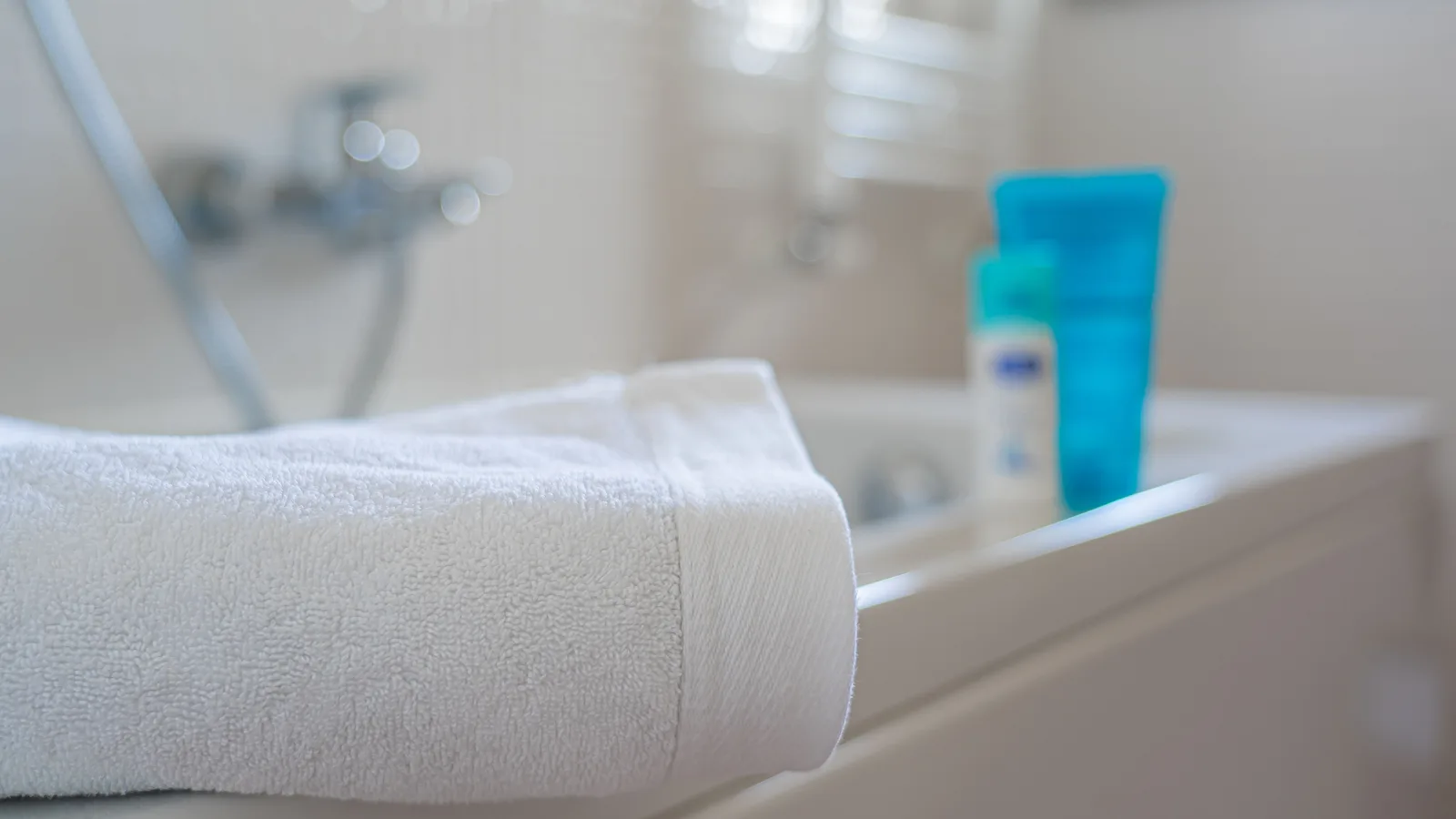
Choose bath towels by the fiber label, terry construction, weight, size, and drying time in your home, not by store softness alone. A midweight cotton terry towel with secure hems is a practical everyday starting point.
Choose bath towels by the fiber label, terry construction, weight, size, and how quickly they can dry in your home, not by the softest display sample. For an everyday set that lasts, a midweight cotton terry towel with secure hems and a realistic care routine is usually a steadier choice than a very plush towel bought only for its first touch.
What a bath towel is, and what the label can tell you
A bath towel is an absorbent woven textile, usually made with terry: loops of yarn that create the pile you feel and use to take up water. The loops, the yarn beneath them, the edge finish, and the fiber content all matter. A label that says only “luxury,” “hotel,” or “bamboo” does not answer the practical questions: what is the towel made of, how dense is it, and can it handle the household’s wash-and-dry routine?
Start with the required fiber-content label. CottonWorks notes that cotton towels can be evaluated by fiber, yarn, construction, and finish. Its Cotton Home Buyer’s Guide describes GSM, or grams per square meter, as a measure of towel weight and density. It also distinguishes plied yarns, which signal strength, from zero- or low-twist yarns, which can feel very soft but may trade off durability. Those are useful clues, not guarantees: a well-made towel still has to suit the person, rack, washer, dryer, and wash habits that will use it.
Be especially literal about “bamboo.” In an April 8, 2022 consumer alert, the Federal Trade Commission explained that soft sheets, towels, and other housewares advertised as bamboo are often rayon made from chemically processed bamboo. The FTC says textile labels and ads must state the fibers actually used. Treat “bamboo-derived rayon” as a fiber description to compare, not as proof that a towel is automatically natural, greener, longer-lasting, or more absorbent.
Use this five-minute shelf test
- Read the fiber content first. Decide whether you want 100% cotton, a cotton-rich blend, or a rayon-containing towel. Do not make that decision from a front-label claim alone.
- Check the weight and drying fit. CottonWorks groups 400 to 600 GSM towels as lighter and faster drying, and 600 to 800 GSM towels as plusher. A dense towel can feel wonderful but is a poor fit if it stays damp on your rack.
- Inspect loops and edges. Look for even terry loops, consistent pile, and hems that lie flat without loose threads. Pulling a loop in the store is not useful; instead, look for obvious snags, thin spots, or uneven stitching before checkout.
- Measure the real storage and hanging spot. Check the towel’s listed dimensions against the rack, hook, shelf, washer capacity, and dryer space. A bath sheet is not automatically an upgrade if it cannot spread out to dry.
- Read care and return terms before washing. Save the receipt and leave one washcloth or towel unwashed until the first washed pieces prove acceptable. Consumer Reports has noted that store softness can come from a finish that changes after washing.
Compare the towel types before buying a whole set
| Option | Best fit | What to watch |
|---|---|---|
| Midweight cotton terry, about 400–600 GSM | Daily use, shared baths, smaller laundry loads, and homes where faster drying matters | It may feel less dramatic on the shelf than a very heavy towel; inspect construction and hems instead of assuming lighter means flimsy. |
| Plush cotton terry, about 600–800 GSM | People who want a dense feel and have room to hang it fully open or dry it promptly | More bulk can mean a slower rack dry and a heavier laundry load. Do not buy a complete set before testing one towel at home. |
| Low- or zero-twist cotton | Softness is the first priority and the towel will get normal, careful laundering | CottonWorks cautions that low-twist yarns may not be as durable. Check the return policy and buy one first if longevity is the goal. |
| Cotton-rich blend | Households that value a particular dry time, texture, or price point | Compare the stated percentage and care label. A blend is not inherently better or worse, but it is a different performance tradeoff. |
| Rayon, including rayon derived from bamboo | Shoppers who prefer a smooth, soft hand and understand the actual fiber content | Do not rely on “bamboo” marketing. The FTC says labels should identify the fiber; compare it honestly with the cotton option beside it. |
Build a towel purchase around the bathroom, not the display table
First choose the job. Everyday family towels need to dry between uses, survive repeated laundry, and be easy to identify and put away. Guest towels can prioritize appearance because they are washed and used less often. Face cloths used with acne treatments deserve their own small, inexpensive group: Consumer Reports notes that benzoyl peroxide can bleach towels. Keeping those cloths separate can protect the towels you want to keep looking consistent.
Then choose a small test purchase. Buy one bath towel and, if relevant, one washcloth in the preferred fiber, weight, and color. Wash and dry them once according to the label. Notice shrinkage, lint, edge twisting, loop pulls, odor after rack drying, and whether the towel still feels and works the way you expected. A test is more honest than committing to twelve matching pieces because the display version felt unusually soft.
Color deserves a practical call, too. White makes it easier to replace a single towel later and to see staining, but it may not suit every household’s laundry choices. Dark colors can hide some marks but can fade or show lint. Buy a modest number of the same line while it is available; decorative trim, mixed textures, and a one-time colorway can make a later single-towel replacement needlessly difficult.
Budget the set without pretending price predicts durability
Two current Costco Same-Day six-piece listing examples run from $11.32 for a WelHome Textured Towels set to $28.36 for a Grandeur Hospitality 100% cotton bath towel six-pack. That $11.32–$28.36 range is a pair of regional same-day planning examples, not a national price range; location, availability, and promotions can change the price. Compare current listings with the same piece count, dimensions, and fiber content rather than treating price as a quality or durability ranking.
The savings move is to avoid a “whole bathroom” purchase before a trial. Test one or two towels, then buy the working line during a sale if the washed result earns it. Keep the receipt and one unused matching piece until the return period passes. A fixed, smaller towel inventory also reduces overbuying: rotate the same towels, track which ones fail first, and replace that single job category rather than chasing an entirely new coordinated set.
The 4Homes weekly email
Every Tuesday: what changed for homeowners this week, plus our newest guides.
No spam. Unsubscribe anytime.
Care choices that protect the purchase
Follow the care label over generic advice. Avoid cramming a washer or dryer so full that towels cannot rinse or dry thoroughly, and get them dry before folding or storing them. If a towel smells damp repeatedly, the right response is to improve drying time, laundering, or bathroom ventilation rather than cover the odor with fragrance. Keep daily towels spread on a bar or hook arrangement that exposes enough surface area; a thick towel bunched over a narrow hook may be a mismatch for the bathroom even if the towel itself is sound.
Consumer Reports also warns that liquid fabric softeners can leave a film that reduces absorbency. Read the product and towel labels before adding any laundry aid, and change one variable at a time if absorbency falls. For storage, keep clean towels fully dry and leave the linen closet focused on return and inventory. Our linen closet organization guide covers that separate storage problem; it should not decide what you buy in the first place.
When a towel problem is really a home problem
No towel upgrade fixes a bathroom that cannot dry. If towels, walls, or the cabinet repeatedly stay damp; paint peels; a musty odor returns; or you see active leaking, investigate the moisture source and ventilation rather than buying more textiles. Start with our bathroom refresh priorities to separate cosmetic changes from leak and ventilation clues. Persistent moisture, suspected hidden water damage, or an exhaust fan that does not move air outdoors can justify a qualified plumber, electrician, or ventilation professional, depending on the diagnosis.
Related 4Homes guides
- Keep a linen closet organized after you choose the towels
- Set bathroom refresh priorities before spending on decor
- Organize a small laundry room around the real towel routine
Source notes
Material and construction guidance: CottonWorks, Cotton Home Buyer’s Guide. Fiber-label guidance: Federal Trade Commission, “FTC says Kohl’s and Walmart bamboozled customers.” Store-softness, absorbency, and care context: Consumer Reports, “How to Choose Bath Towels That Last.” Cost planning examples: Costco Same-Day listings for the WelHome Textured Towels six-piece set and Grandeur Hospitality 100% cotton bath towel six-pack.
Frequently Asked Questions
What makes a bath towel last longer?
Start with the actual fiber label and a sound terry construction, then judge the hem, loops, and care instructions rather than store softness alone. A towel that suits the household's drying time and laundering routine is more likely to stay in rotation than an extra-heavy one that never dries fully.
Is a higher GSM towel always better?
No. GSM is fabric weight per square meter, not a complete quality grade. CottonWorks places many lighter, quicker-drying towels around 400 to 600 GSM and plusher towels around 600 to 800 GSM. Choose the weight that can dry between uses in your bathroom and laundry routine.
Are bamboo towels really made from bamboo?
Read the fiber-content label. The FTC says soft textile products advertised as bamboo are commonly rayon made from bamboo that has been chemically processed, and labels must state the actual fiber. That does not make the towel unusable, but it means 'bamboo' alone is not enough information to compare it with cotton or another fiber.
Should I buy bath sheets or standard bath towels?
Buy the size that fits the people using it, the rack, and the washer and dryer load. A bath sheet offers more coverage, but its extra fabric can take longer to dry and may crowd a small washer, dryer, or towel bar. Measure the storage and hanging space before buying a matched set.
How many bath towels should a household buy?
Begin with the number needed to keep one towel in use, one clean, and one available while laundry is delayed for each regular user. Add only enough guest or backup towels for realistic use. A smaller repeatable set makes it easier to notice wear and replace one failed towel without discarding a whole collection.