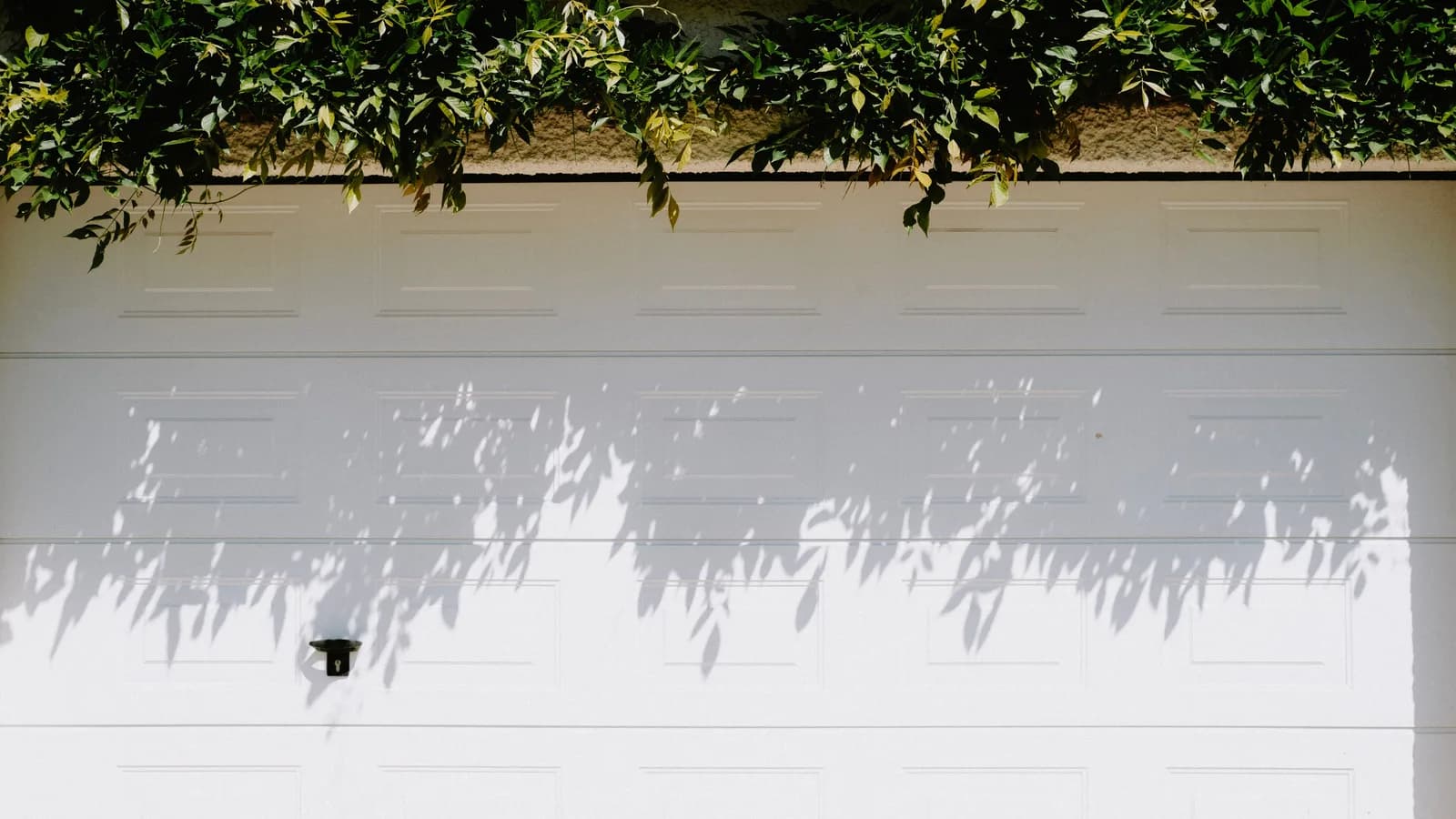
A rigid bottom section can sometimes be replaced without buying a complete door, but the match, loaded bottom fixtures, balance, and safety tests make this professional work.
Yes, you can sometimes replace just the bottom section of a garage door. It works when an exact compatible section is available and the rest of the door, track, spring system, opener, and opening are still sound. Because the lift cables attach to bottom brackets on that section, this is a trained garage-door technician's job, not a panel swap to attempt at home.
Make sure the rigid section is actually the problem
The bottom section is the lowest rigid horizontal panel of a sectional garage door. The bottom seal is the flexible strip beneath it. They are separate parts with very different repair boundaries, even though homeowners and sellers often call both of them the “bottom panel.”
| What you see | Likely problem | Safe next step |
|---|---|---|
| Torn, flat, brittle, or missing flexible strip | Bottom weather seal | Use the bottom-seal matching guide |
| Dent, crack, rust-through, split skin, or crushed edge in the rigid panel | Bottom section | Request a professional section and system inspection |
| One corner sits higher, a cable hangs loose, or the door is crooked | Spring, cable, drum, track, roller, or bracket problem | Stop operation and keep clear |
| Daylight under a level door over a low spot in concrete | Floor or drainage geometry | Measure the slab before changing door parts |
| Door touches the floor and reverses | Obstruction, seal fit, travel, force, or safety fault | Do not increase force; arrange diagnosis |
A shallow cosmetic dent does not automatically require a new section. Torn steel around an attachment, a panel that bows during travel, separated layers, or collision damage deserves quicker attention. Do not cycle the door to “see if it gets worse.”
The safety boundary starts at the bottom brackets
Look from a safe distance. Do not loosen, remove, tighten, cut, or reposition a bottom bracket, lift cable, spring, cable drum, roller carrier, or related fastener. Do not pull the emergency release on a door that is crooked, partly open, off track, unusually heavy, or suspected of having spring or cable damage. Unplugging the opener does not remove stored spring energy.
DASMA says the cables attached to the bottom brackets should be replaced only by a trained technician and that the brackets themselves are under extreme tension. Clopay likewise lists door sections, springs, track, and operator work as professional repairs, while treating a compatible bottom seal as a different type of part. That distinction settles the DIY question for this guide.
If you heard a bang, see a spring gap, have a loose cable, or the door will not stay controlled, follow the broken garage-door spring first-response steps. Keep people, pets, and vehicles out of the travel area. Use another entrance until the door is made safe.
When one-section replacement makes sense
Amarr says damage confined to one or two sections can be a candidate for section replacement when the door otherwise functions properly. Clopay tells owners ordering a section to identify the model, section size, color, and whether the needed part is the top, bottom, or middle. For a bottom-section repair, the technician also needs to confirm the section's construction and every attachment that transfers load into it.
One-section replacement is strongest when all of these are true:
- The manufacturer or an authorized source can identify and supply the exact compatible bottom section.
- Damage is confined to that section and has not distorted the opening, track, jambs, or adjacent panel.
- The remaining sections are structurally sound, with no widespread corrosion, delamination, cracking, or failed joints.
- The new section's weight, thickness, edge profile, reinforcement, and hardware pattern work with the complete door system.
- The technician will rebalance, cycle, and safety-test the door after installation.
My view: appearance should be the last yes-or-no test, not the first. A perfect color match on the wrong construction is worthless. Get the operating match right, then decide whether a modest color difference is acceptable.
Identify the door before anyone quotes a panel
Start with photos, not disassembly. Photograph the complete door from inside and outside, the damaged area, all section joints, both tracks, and any labels you can read without reaching around moving hardware. Record the finished door width and height, the number and approximate height of sections, insulation construction, panel pattern, windows, exterior color, and whether the door was painted after installation.
Look for a manufacturer label, serial number, model, order number, or warranty paperwork. Clopay says the serial number on doors made in the last ten years is commonly found on the interior bottom section. Do not reach behind hardware to find it.
Ask each bidder to put the proposed manufacturer, collection, model, exact section size, construction, insulation, finish, reinforcement, and compatible hardware in writing. “White steel panel” is not enough. Section-edge shapes, thickness, embossing, stile locations, and weights can differ even when two doors look similar from the driveway.
Get a quote for the whole repair, not a loose section
A useful quote separates the section from the labor and names what will be inspected, transferred, replaced, adjusted, and tested. Use this scope table when comparing proposals:
| Quote line | What should be written down |
|---|---|
| Diagnosis | Damage to the section, adjoining panels, tracks, rollers, hinges, brackets, cables, springs, opener attachment, and framing |
| Replacement section | Maker, model, dimensions, layer construction, insulation, pattern, finish, availability, freight, and return limits |
| Hardware | Which hinges, rollers, stiles, struts, bottom fixtures, seal, and fasteners are new or reused |
| Counterbalance | How the changed section weight will be checked against spring and cable setup, with any correction priced separately |
| Finish match | Expected color difference and manufacturer-approved paint or refinishing path, if any |
| Closeout | Balance, full-cycle, track, opener travel, photo-eye, contact-reversal, weather-seal, cleanup, warranty, and disposal checks |
Do not accept an opener-force increase as the fix for binding after the repair. The new section changes a moving system. It must travel smoothly and remain correctly counterbalanced before the opener is asked to move it.
What bottom-section replacement costs
Two secondary planning references were checked October 25, 2026. HomeGuide lists sectional garage-door panel replacement at about $300 to $900 per panel installed, including a broad mix of materials and jobs. Doorvana lists about $600 to $900 or more for a damaged bottom section. Doorvana is a regional service company's published range, while HomeGuide is a national cost guide. Neither is a local bid or a guarantee.
Width, height, material, insulation, section availability, custom color, decorative hardware, wind-rated construction, freight, technician time, and counterbalance work can move the result. An older or discontinued door may have no orderable match. Get at least two written local quotes that price the same section and closeout tests, then compare them with the garage-door replacement quote checklist.
Ask for a full-door alternate when the section is unavailable, several panels are weak, or warranty and remaining service life may justify the difference. Do not compare a section-only parts price with a complete installed-door price.
How to save money without gambling on the fit
Do the useful desk work yourself: find the invoice and warranty, take clear photos, copy label information, and send every bidder the same door dimensions and damage record. That can prevent a wasted diagnostic trip or an incorrect special order. Ask whether the manufacturer still supplies the original section and whether an authorized dealer order preserves any remaining warranty rights.
Schedule ordinary-hours service if the door can remain safely closed. Separate required work from cosmetic work. Reusing sound, compatible hardware may save money when the technician documents the choice. A used section bought by width and color alone is a bad shortcut.
The 4Homes weekly email
Every Tuesday: what changed for homeowners this week, plus our newest guides.
No spam. Unsubscribe anytime.
What a safe handoff looks like
After installation, the technician should demonstrate smooth travel and verify balance under the manufacturer's procedure. CPSC says a severely unbalanced door can crash and should be serviced professionally. The technician should also test opener controls, travel limits, photoelectric protection, and contact reversal. CPSC's published test uses a 2-by-4 laid flat in the door path; an opener that fails should be disengaged until corrected.
Watch from outside the travel area. Save the section label, invoice, warranty, finish information, test results, and before-and-after photos. Note any visible color difference while the ordering terms and workmanship warranty are still fresh.
Bottom-section replacement checklist
- Confirm the rigid bottom section, not only the flexible seal or uneven floor, is damaged.
- Stop operation for a crooked, off-track, unusually heavy, or partly supported door.
- Keep all tools and hands off springs, cables, drums, bottom brackets, and their fasteners.
- Record the manufacturer, model or serial number, size, construction, pattern, finish, and damage with safe photos.
- Require an exact section specification and written availability before authorizing removal.
- Compare section replacement and complete-door alternatives on the same installed scope.
- Price hardware, freight, labor, counterbalance work, finish limits, disposal, tests, and warranty.
- Have the trained technician demonstrate balance, full travel, photo-eye function, and contact reversal.
- Keep labels, warranty, invoice, test record, and final photos in the house file.
Related guides
- Replace a garage-door bottom seal when the flexible weatherstrip is the actual failed part.
- Compare a complete garage-door replacement quote when one-section repair is not the sound choice.
- Respond to a broken garage-door spring without operating or releasing the door.
- Compare contractor quotes line by line after every bidder receives the same repair scope.
Frequently asked questions
Can you replace just the bottom section of a garage door?
Yes, when the manufacturer can supply a compatible section and the remaining sections, tracks, counterbalance system, opener, and opening are sound. A trained door-systems technician should confirm the model, dimensions, construction, hardware attachment, weight, and finish before ordering or removing anything.
Is the garage door bottom section the same as the bottom seal?
No. The bottom section is the rigid lowest panel of a sectional door. The bottom seal is the flexible weatherstrip attached along its lower edge. A torn seal may be a small parts job; replacing the rigid section involves spring-connected lift cables and bottom brackets and belongs with a trained technician.
How much does garage door bottom section replacement cost?
As planning references checked October 25, 2026, HomeGuide lists $300 to $900 installed per sectional panel, while Doorvana lists $600 to $900 or more for a bottom section. These are secondary national or regional estimates, not bids. Door width, model availability, material, insulation, finish, freight, hardware, labor, and local rates can move the price, so compare written local quotes.
Will a new garage door section match the old door?
It may match the original factory specification without looking identical beside weathered sections. Sun, dirt, oxidation, prior paint, discontinued embossing, and changed production runs can create visible differences. Ask for the exact model and finish, a color-match warning in writing, and the approved painting or refinishing options before ordering.
When should I replace the whole garage door instead of one section?
Compare full replacement when the exact section is unavailable, several sections are damaged, the remaining door is badly corroded or separating, tracks or framing are compromised, required hardware cannot be matched, or the section repair approaches the cost of a complete compatible system. The decision should follow a written inspection and two itemized scopes, not age alone.
Sources used
Clopay service and replacement guidance and its support material on damaged door sections; Door and Access Systems Manufacturers Association garage-door safety guidance; Amarr guidance on when a replacement section may make sense and why finish matching can be imperfect; U.S. Consumer Product Safety Commission Publication 523 on garage-door balance and opener reversal; HomeGuide garage-door panel replacement cost guide; Doorvana damaged bottom-section service pricing; and the exact door and opener manufacturer instructions. Cost pages were checked October 25, 2026.
Frequently Asked Questions
Can you replace just the bottom section of a garage door?
Yes, when the manufacturer can supply a compatible section and the remaining sections, tracks, counterbalance system, opener, and opening are sound. A trained door-systems technician should confirm the model, dimensions, construction, hardware attachment, weight, and finish before ordering or removing anything.
Is the garage door bottom section the same as the bottom seal?
No. The bottom section is the rigid lowest panel of a sectional door. The bottom seal is the flexible weatherstrip attached along its lower edge. A torn seal may be a small parts job; replacing the rigid section involves spring-connected lift cables and bottom brackets and belongs with a trained technician.
How much does garage door bottom section replacement cost?
As planning references checked October 25, 2026, HomeGuide lists $300 to $900 installed per sectional panel, while Doorvana lists $600 to $900 or more for a bottom section. These are secondary national or regional estimates, not bids. Door width, model availability, material, insulation, finish, freight, hardware, labor, and local rates can move the price, so compare written local quotes.
Will a new garage door section match the old door?
It may match the original factory specification without looking identical beside weathered sections. Sun, dirt, oxidation, prior paint, discontinued embossing, and changed production runs can create visible differences. Ask for the exact model and finish, a color-match warning in writing, and the approved painting or refinishing options before ordering.
When should I replace the whole garage door instead of one section?
Compare full replacement when the exact section is unavailable, several sections are damaged, the remaining door is badly corroded or separating, tracks or framing are compromised, required hardware cannot be matched, or the section repair approaches the cost of a complete compatible system. The decision should follow a written inspection and two itemized scopes, not age alone.